_edi.png)
Most companies have a CRM. Far fewer use it in a way that drives predictable revenue. Many teams still struggle with unclear pipeline stages, inconsistent data, and forecasts they can’t fully trust. The issue isn’t the software, it’s the structure behind it.
According to HubSpot’s 2026 State of Marketing report, 65% of marketers are meeting or exceeding their goals, and 77% report high-quality leads. Results like these come from clear processes and aligned teams, not tools alone.
A CRM platform on its own does not create alignment, forecasting accuracy, or pipeline discipline. A well-designed CRM strategy does. In 2026, organizations competing in complex buying environments cannot afford fragmented lifecycle stages, inconsistent data entry, or weak forecasting standards. Your CRM must operate as the control center of your revenue engine.
Core takeaways
- Forecast accuracy depends on clear stage definitions and pipeline ownership. Without defined exit criteria and accountability, reporting quickly loses credibility.
- Stage-to-stage conversion rates, sales cycle length, and deal velocity reveal where revenue stalls. These metrics expose friction in qualification, handoffs, and opportunity progression.
- Win rate, retention rate, and expansion revenue determine revenue quality, not pipeline volume alone. A structured lifecycle improves long-term predictability.
- Data governance drives reporting reliability. Mandatory fields, defined ownership, and periodic audits protect data integrity and leadership confidence.
- CRM performance is measured by adoption, pipeline health, and KPI alignment. Execution discipline, not configuration, determines whether the system drives measurable growth.
What is a CRM System?
A Customer Relationship Management (CRM) system is software that helps you manage interactions with prospects and customers across the entire lifecycle, from first touch to renewal.
At its core, a CRM centralizes:
- Contact and account data
- Sales activities and communication history
- Pipeline stages and deal progression
- Forecasting and revenue reporting
But modern CRMs do more than store information. They automate workflows, trigger follow-ups, integrate marketing data, and surface pipeline insights in real time. In 2026, a CRM is not just a sales database. It is your revenue control center.
Some Popular CRM Tools Examples
Several platforms dominate the U.S. startup ecosystem. Each supports CRM execution, but none replaces strategy.
- HubSpot: Popular among early-stage SaaS teams. Known for ease of use, strong marketing integration, and fast setup.
- Salesforce: Highly customizable and powerful. Often used by growth-stage and enterprise companies with complex workflows.
- Pipedrive: Sales-focused and straightforward. Good for teams prioritizing pipeline visibility without heavy configuration.
- Zoho: Cost-effective and feature-rich. Common among small businesses and budget-conscious startups.
The right tool depends on your growth stage and operational complexity.
What is a CRM Strategy?
A CRM strategy is the plan behind how your company manages prospects and customers to drive revenue. The software supports it, but the strategy defines how data is structured, how leads move through the pipeline, and how teams engage and retain customers.
Without a clear CRM strategy, a CRM becomes a storage system. With one, it becomes a growth engine. When sales, marketing, and customer teams operate from the same data and defined processes, decisions improve, pipelines become more predictable, and revenue scales with less friction.
Aligning Your CRM Strategy to B2B and B2C Buying Models
A CRM platform may look the same across industries. Your CRM strategy should not. B2B and B2C revenue models operate differently. Sales cycles, data structure, communication style, and performance metrics are not interchangeable. If your CRM strategy does not align with how your customers actually buy, it will create friction across sales, marketing, and reporting.
Here is the practical distinction:
The principle is straightforward. Your CRM strategy should mirror how revenue is generated in your business. When it reflects actual buying behavior, reporting becomes cleaner, adoption improves, and revenue visibility strengthens.
Key Considerations Before Building a High-Impact CRM Strategy
A strong CRM strategy doesn't start inside the software. It starts with clarity. Before you configure fields, automate workflows, or migrate data, pressure-test the fundamentals.
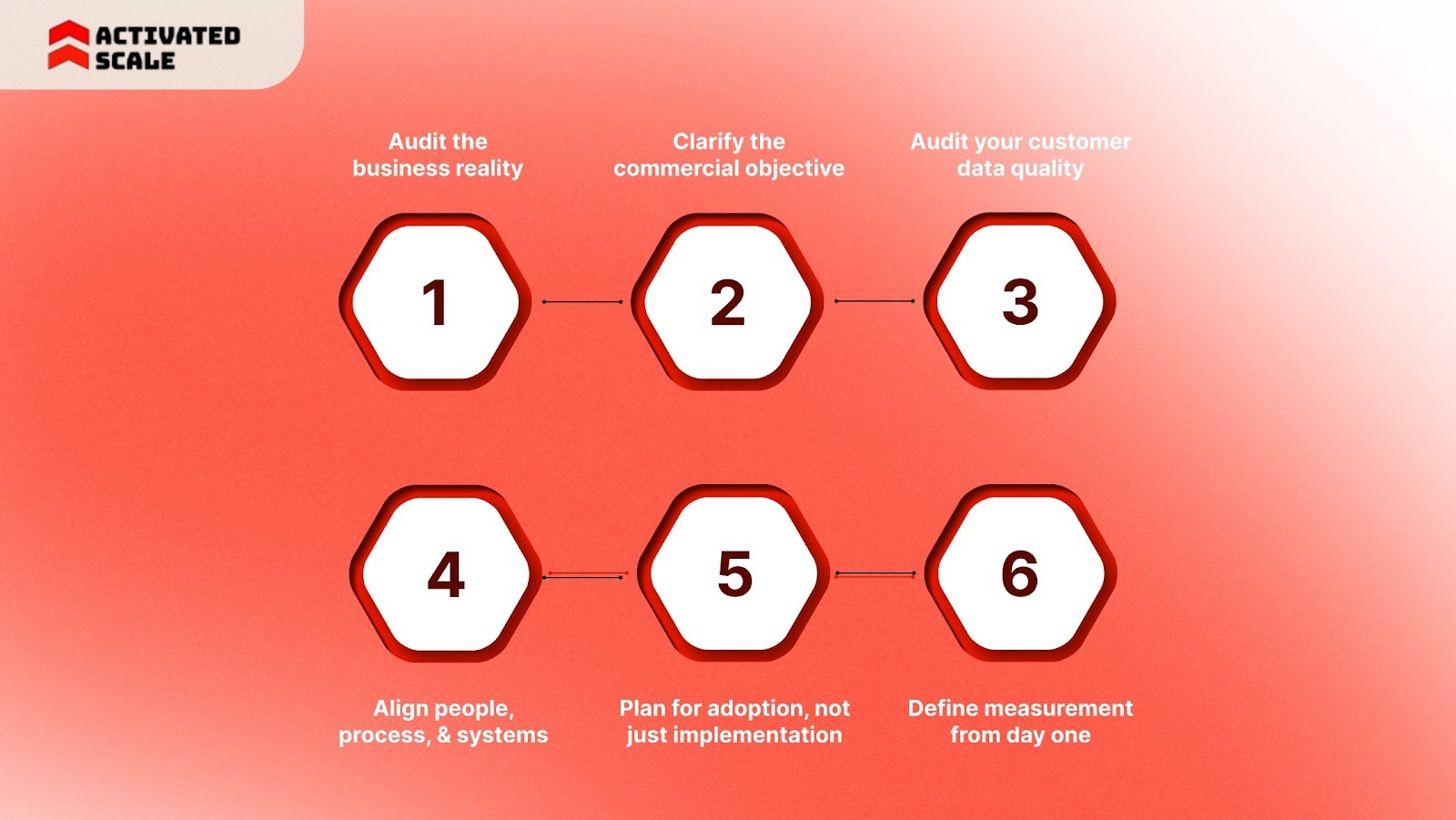
- Audit the business reality: Run a practical SWOT analysis. Identify where revenue stalls, where customer experience breaks down, and where internal handoffs fail. A CRM should solve real friction, not mask it.
- Clarify the commercial objective: Be specific. Is the goal to shorten the sales cycle? Improve retention? Increase expansion revenue? A CRM strategy tied to measurable revenue outcomes stays focused. One built around vague "better visibility" goals drifts.
- Audit your customer data quality: Look beyond volume. Assess accuracy, duplication, completeness, and ownership. Map the actual customer journey, from first touch to renewal, and identify where data gaps distort decision-making. Bad data will undermine even the best-designed system.
- Align people, process, and systems: Sales, marketing, and customer success must operate from the same definitions, lifecycle stages, and reporting logic. If teams interpret pipeline stages differently, no dashboard will fix that. Alignment is structural, not technical.
- Plan for adoption, not just implementation: Define how teams will use the CRM on a daily basis. Set expectations around required fields, activity tracking, and forecasting hygiene. Leadership accountability and structured training drive adoption; configuration alone does not.
- Define measurement from day one: Select a small set of revenue-focused KPIs: conversion rate, win rate, average sales cycle, retention, and expansion revenue. Build reporting around these outcomes and commit to quarterly refinement. A CRM strategy should evolve with performance data, not assumptions.
Get these foundations right, and the technology becomes an accelerator, not another system your team has to work around.
Learn more about: Creative 15 Sales Incentive Ideas to Motivate Your Team
10 Practical Steps to Build a Revenue-Driven CRM Strategy in 2026
An effective CRM strategy is not about installing software or replicating a template. It is about designing a structured revenue system that aligns marketing, sales, and customer success around measurable outcomes. When built correctly, your CRM becomes the operating layer of your go-to-market engine, not just a reporting tool.
Here is how to approach it with clarity and intent.
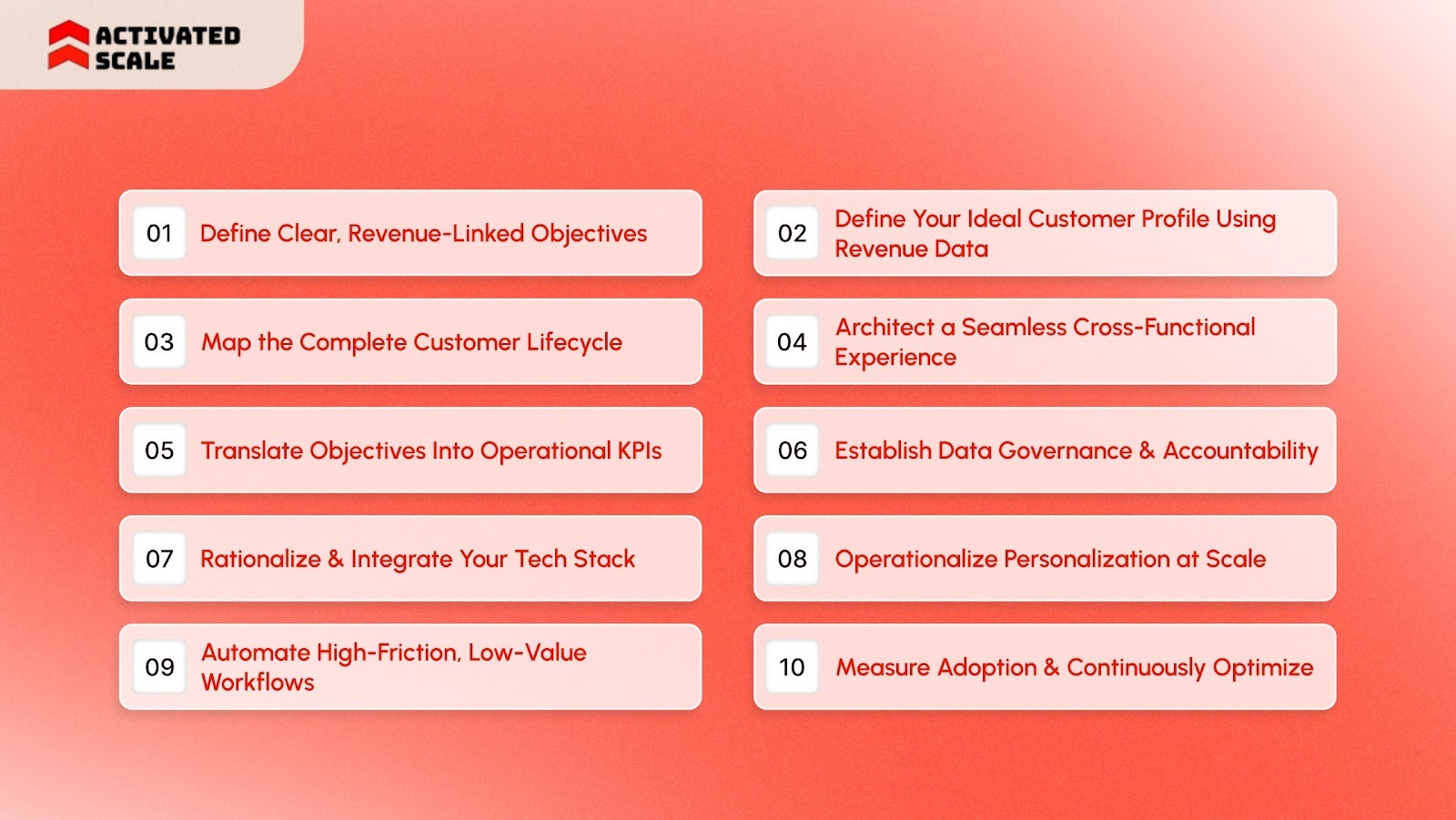
1. Define Clear, Revenue-Linked Objectives
Start with outcomes that materially affect growth.
Your CRM strategy should answer one core question: What business problem are we solving? That could mean reducing sales cycle length, improving win rates, increasing expansion revenue, strengthening retention, or improving forecast accuracy.
Avoid vague goals like “improve visibility” or “organize data better.” Instead, define measurable targets tied directly to revenue performance. For example, reducing sales cycle time by 15% within two quarters or increasing retention by 5% year-over-year.
Before finalizing objectives, evaluate operational readiness. Do you have clearly defined sales stages? Is pipeline ownership structured? Are teams aligned on definitions? If the foundation is weak, the CRM will only amplify confusion.
2. Define Your Ideal Customer Profile Using Revenue Data
A CRM strategy must be built around profitable customers, not broad assumptions. Analyze closed-won deals to identify patterns in:
- Industry
- Company size
- Average deal value
- Sales cycle duration
- Renewal likelihood
Then compare this against churned accounts. Where did misalignment occur? Were they outside your core segment? Did they require excessive support resources?
Your ideal customer profile should reflect accounts that close efficiently and expand predictably. This ensures your CRM segmentation, scoring, and routing logic are grounded in financial reality.
3. Map the Complete Customer Lifecycle
Document how prospects move from first interaction through renewal or expansion. Break down each lifecycle stage and clarify:
- Entry criteria
- Exit criteria
- Responsible team
- Required data fields
Where do handoffs happen? Are they structured or informal? Many CRM failures stem from unclear ownership between marketing-qualified leads and sales-qualified opportunities.
Mapping the lifecycle allows you to design workflows that eliminate friction, reduce delays, and prevent lost opportunities. Astrategy without lifecycle clarity results in stalled pipelines and inconsistent customer experiences.
4. Architect a Seamless Cross-Functional Experience
Customers do not differentiate between departments; they experience one company. Review how marketing captures intent data, how sales advances conversations, and how customer success manages onboarding and renewals. If these systems operate independently, customer data becomes fragmented.
Define standardized processes for:
- Lead qualification
- Opportunity progression
- Handoff documentation
- Renewal forecasting
When structured correctly, your CRM strategy ensures continuity from first touch to long-term expansion. This reduces internal friction and strengthens customer trust.
But here’s the operational reality: even the best CRM architecture fails if the people using it don’t understand your industry, buyer psychology, and qualification standards.
Execution often breaks down at the SDR level. If top-of-funnel reps don’t qualify consistently or log clean data, your CRM quickly becomes unreliable.
Activated Scale helps startups plug in vetted, U.S.-based fractional SDRs with proven SaaS and industry-specific experience. These reps are pre-screened, trained in structured qualification frameworks, and ready to operate inside your CRM from day one, without the risk of a long-term hire.
Strong process plus experienced execution keeps your revenue engine clean and predictable.
5. Translate Objectives Into Operational KPIs
Strategic goals must convert into measurable performance metrics. Beyond basic reporting, focus on indicators that influence revenue predictability:
- Conversion rates between stages
- Average deal velocity
- Revenue per account
- Expansion rate
- Churn rate
- Forecast accuracy
Each KPI should align with the objectives defined earlier. If a metric does not inform a decision or drive improvement, remove it. Excess reporting creates noise, not clarity.
6. Establish Data Governance and Accountability
Data quality determines CRM effectiveness. Define mandatory fields, naming conventions, and ownership rules. Clarify who is responsible for data hygiene at each stage of the pipeline. Implement periodic audits to prevent duplicate records, outdated opportunities, or incomplete fields.
Without governance, reporting becomes unreliable, and leadership loses confidence in the system. A disciplined data framework transforms your CRM strategy from a tracking tool into a forecasting asset.
7. Rationalize and Integrate Your Tech Stack
Many companies accumulate tools without integration planning. Conduct a structured audit of your marketing automation, sales engagement, customer support, and analytics platforms. Identify redundancies and integration gaps. Your CRM should act as the operational backbone, synchronizing data across systems.
Eliminate manual data transfers and disconnected reporting. Integration reduces administrative workload, improves data accuracy, and enhances visibility across teams. A well-integrated CRM strategy accelerates operations while maintaining control.
8. Operationalize Personalization at Scale
Personalization must be driven by structured data, not intuition. Segment accounts by lifecycle stage, industry, product adoption, and engagement behavior. Use this data to trigger targeted outreach, renewal reminders, or upsell campaigns.
For example:
- Automatically notify account managers when product usage declines
- Trigger expansion sequences for highly engaged customers
- Prioritize outreach for high-value accounts nearing renewal
A strategic CRM strategy turns customer data into proactive engagement rather than reactive follow-ups.
9. Automate High-Friction, Low-Value Workflows
Automation should reduce inefficiency without sacrificing visibility. Identify repetitive tasks such as:
- Lead routing and assignment
- Data enrichment
- Follow-up reminders
- Renewal notifications
- Status updates
Design workflows that remove manual entry while preserving accountability. The goal is to give revenue teams more time to focus on closing and expanding deals rather than updating records.
Be selective. Over-automation can create hidden complexity. Prioritize workflows that directly impact revenue velocity and customer retention.
10. Measure the Effectiveness of CRM Strategy and Continuously Optimize
CRM implementation is not a one-time project. It requires a structured review.
Track:
- User adoption rates
- Pipeline accuracy
- Stage conversion health
- Reporting reliability
- KPI performance
Collect feedback from frontline teams to identify friction points. If reps are bypassing workflows, investigate why. If dashboards are underused, assess whether they answer meaningful questions.
Execution gaps often stem from leadership bandwidth or inconsistent sales discipline. Many companies address this by bringing in experienced fractional sales leaders, through platforms like Activated Scale, to reinforce pipeline standards, coach reps on process adherence, and maintain forecasting accountability as they scale.
As your go-to-market strategy evolves, your CRM strategy must adapt. Regular audits ensure that your system remains aligned with business growth rather than becoming outdated infrastructure.
The Benefits of Building a CRM Strategy in 2026
A strong CRM strategy is not about storing contacts. It is about building a structured revenue system that aligns teams, clarifies execution, and drives measurable outcomes.
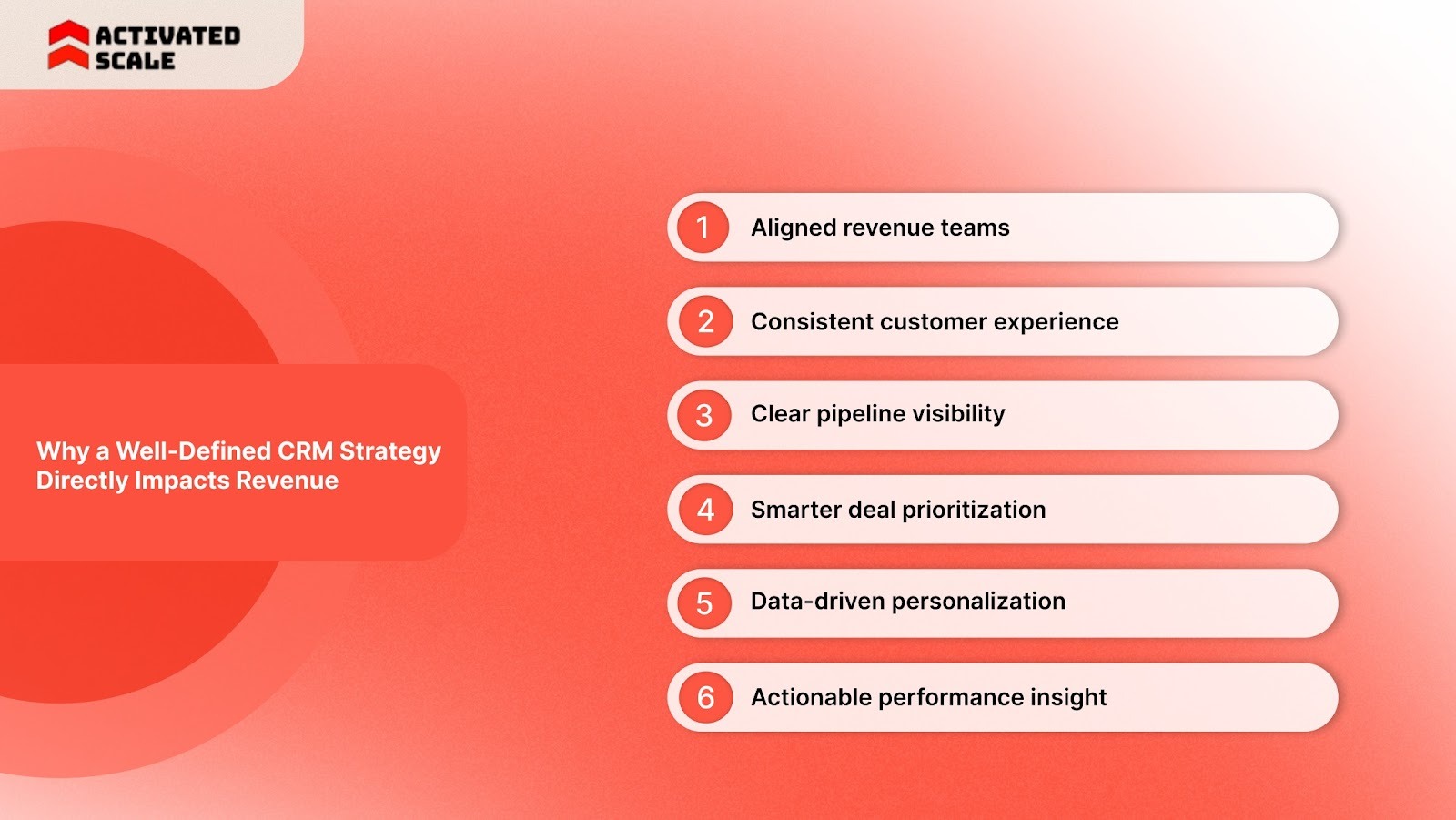
- Aligned revenue teams: Sales, marketing, and customer success operate from shared data, defined stages, and consistent reporting, eliminating silos and conflicting metrics.
- Consistent customer experience: Every interaction is informed by full engagement history, ensuring conversations are relevant and continuous rather than repetitive.
- Clear pipeline visibility: Defined stages and structured data expose bottlenecks early, strengthen forecasting accuracy, and improve accountability.
- Smarter deal prioritization: Qualification standards and buying signals help teams focus on high-intent opportunities instead of low-probability prospects.
- Data-driven personalization: Campaigns and outreach are guided by behavior and lifecycle stage, not assumptions.
- Actionable performance insight: Reliable reporting transforms activity tracking into strategic decision-making that directly supports revenue growth.
A CRM should function as a revenue engine, not a contact repository. That difference comes from strategy, not software.
Must read: Best Outbound Sales Tools for Software Teams in 2026
Turning CRM Strategy Into Revenue Execution
Designing a CRM strategy is one challenge. Enforcing it consistently across a revenue team is another. CRM frameworks fall apart for the same reasons: no clear owner of pipeline discipline, inconsistent stage criteria, and loose forecasting standards. Adoption drops. Reports lose credibility. Reps start working outside the system.
That’s exactly where Activated Scale comes in.
We connect you with vetted, U.S.-based sales professionals who turn CRM strategy into daily execution through:
- Fractional Sales Leadership: Experienced VPs of Sales who define stage exit criteria, run disciplined pipeline reviews, tighten forecast accuracy, and embed CRM standards into weekly rhythms.
- Contract-to-Hire Sales Recruiting: A flexible model that lets you validate performance and process alignment before committing full-time.
- Fractional SDRs and AEs: Industry-experienced operators who qualify rigorously, maintain clean CRM data, and advance opportunities within defined lifecycle rules.
Our model prioritizes speed and proof:
- <7 days to connect with qualified sales talent
- 20+ hours saved per headcount in interview time
- 80% retention beyond 8 months
- 200+ growing companies supported
When experienced operators own pipeline hygiene and forecast discipline, your CRM stops being documentation. It becomes your revenue operating system.
Conclusion
A CRM strategy defines how revenue moves through your organization. It clarifies ownership, standardizes lifecycle stages, strengthens forecasting, and aligns teams around measurable outcomes.
But design alone is not enough. Without consistent enforcement, experienced leadership, and disciplined pipeline management, even a well-architected CRM system will degrade over time. Reporting loses credibility. Adoption drops. Revenue predictability suffers.
Activated Scale connects companies with pre-vetted fractional sales leaders and experienced sales professionals in under seven days, helping organizations maintain pipeline discipline and accelerate revenue without extended hiring cycles.
To explore whether this model aligns with your growth goals, visit Activated Scale and review how our sales talent network supports scalable revenue execution.
FAQs
1. What is a CRM strategy?
A CRM strategy is a structured plan that defines how customer data, pipeline stages, and revenue processes are designed and managed to support measurable business growth. It aligns marketing, sales, and customer success around shared lifecycle definitions and forecasting standards.
2. Why do most CRM strategies fail?
Most failures stem from unclear objectives, inconsistent lifecycle ownership, weak data governance, and a lack of leadership enforcement. When teams do not follow defined processes, reporting becomes unreliable, and pipeline discipline deteriorates.
3. How often should a CRM strategy be reviewed?
At a minimum, quarterly. Revenue goals, customer segments, and go-to-market models evolve. Regular audits ensure lifecycle definitions, KPIs, and automation workflows remain aligned with business growth.
4. How does a CRM strategy improve forecasting accuracy?
By enforcing standardized pipeline stages, mandatory data fields, and defined ownership. Structured governance ensures opportunities are consistently updated, making revenue projections more reliable.
5. What metrics matter most in a CRM strategy?
Key metrics include stage conversion rates, sales cycle length, deal velocity, retention rate, expansion revenue, and forecast accuracy. Each metric should directly support revenue objectives.
6. Does a CRM strategy require external support?
Not always. However, companies scaling quickly or facing execution gaps often benefit from experienced sales leadership or vetted revenue talent to reinforce pipeline standards and maintain accountability.
The Ultimate Guide to Hiring a Salesperson!
Get the step-by-step guide to hiring, onboarding, and ensuring success!