_edi.png)
Sales hiring fails most often when companies jump to vendors before getting clear on context. What you sell, who you sell to, and how your sales motion works should always dictate the recruitment model you choose. A fast-growing SaaS company testing outbound has very different needs from a business making a single, senior revenue hire.
Once you understand the trade-offs between headhunters, executive search, staffing firms, and flexible models, the decision becomes less about reputation and more about risk, speed, and execution. The goal isn’t to hire perfectly on paper, it’s to hire people who can perform in your real selling environment.
What you need to know
- What you sell, who you sell to, and whether you’re validating or scaling a sales motion should determine the hiring model, not agency reputation or role titles.
- Successful AI sellers must navigate technical buyers, long deal cycles, governance concerns, and evolving products, making specialist AI-focused recruiters far more effective than generalists.
- Executive search fits senior, strategic hires; staffing and flexible models suit execution roles where speed, iteration, and real-world performance matter more than resumes.
- Fractional and contract-to-hire models allow teams to test sales talent in live deals, reduce mis-hire risk, and scale only after results are proven.
- By providing experienced, US-based sales professionals in flexible roles, Activated Scale helps companies execute immediately, validate GTM fit, and commit to long-term hires with confidence.
Why AI Sales Recruiting Is a Category of Its Own in 2026
Hiring sales talent for AI products isn’t the same as hiring for traditional SaaS. AI solutions are harder to explain, buyers ask sharper questions, and deals take longer to close. Sales teams are expected to turn concepts like machine learning, data pipelines, and automation into outcomes business leaders can trust and justify.
That shift exposes a real gap. Many generalist sales recruiters still screen for quota history and logos, but AI sales requires a different kind of readiness. Reps need to navigate technical buying groups, handle objections around accuracy and governance, and adapt as products evolve faster than standard sales playbooks.
This is why companies selling AI are moving toward specialized recruiters. These firms understand both the technical context and the go-to-market reality of AI products. They assess whether candidates can explain value, manage long sales cycles, and earn confidence from enterprise buyers, not just whether they’ve carried a number before.
That difference in judgment is what separates general staffing firms from the leading companies for AI sales tech recruiting in 2026.
10 Leading AI Sales Recruiting Agencies to Watch in 2026
Hiring for AI sales in 2026 is less about volume and more about judgment. The agencies below stand out because they understand how AI products are sold, how technical buyers think, and how go-to-market teams evolve as companies scale. Each brings a different strength to AI sales hiring, execution speed, strategic depth, or niche expertise.
1. Activated Scale
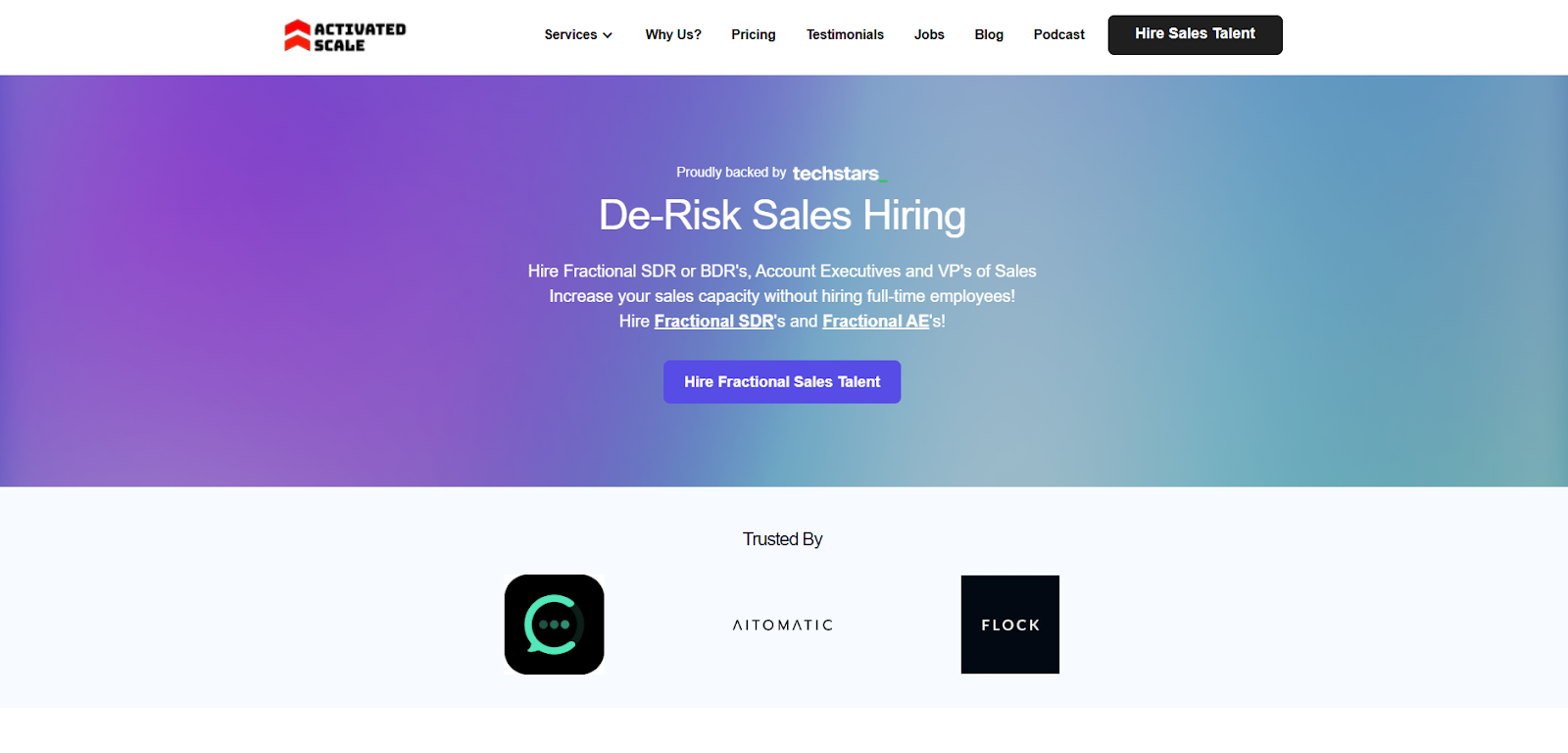
Activated Scale is designed for AI companies that need sales execution before committing to permanent headcount. Instead of relying on resumes and interviews alone, companies work with experienced, US-based sales professionals in live selling environments.
What Activated Scale specifically delivers:
- Fractional and contract-to-hire sales talent who actively sell in real deals, not simulated interviews
- Ability to validate ICP, messaging, pricing, and GTM motion alongside experienced operators
- Reduced mis-hire risk by tying hiring decisions to observed performance, not assumptions
- Particularly effective for AI startups iterating outbound, entering new verticals, or pressure-testing demand
This model aligns closely with AI sales reality, where products, buyers, and positioning evolve quickly.
2. Betts Recruiting
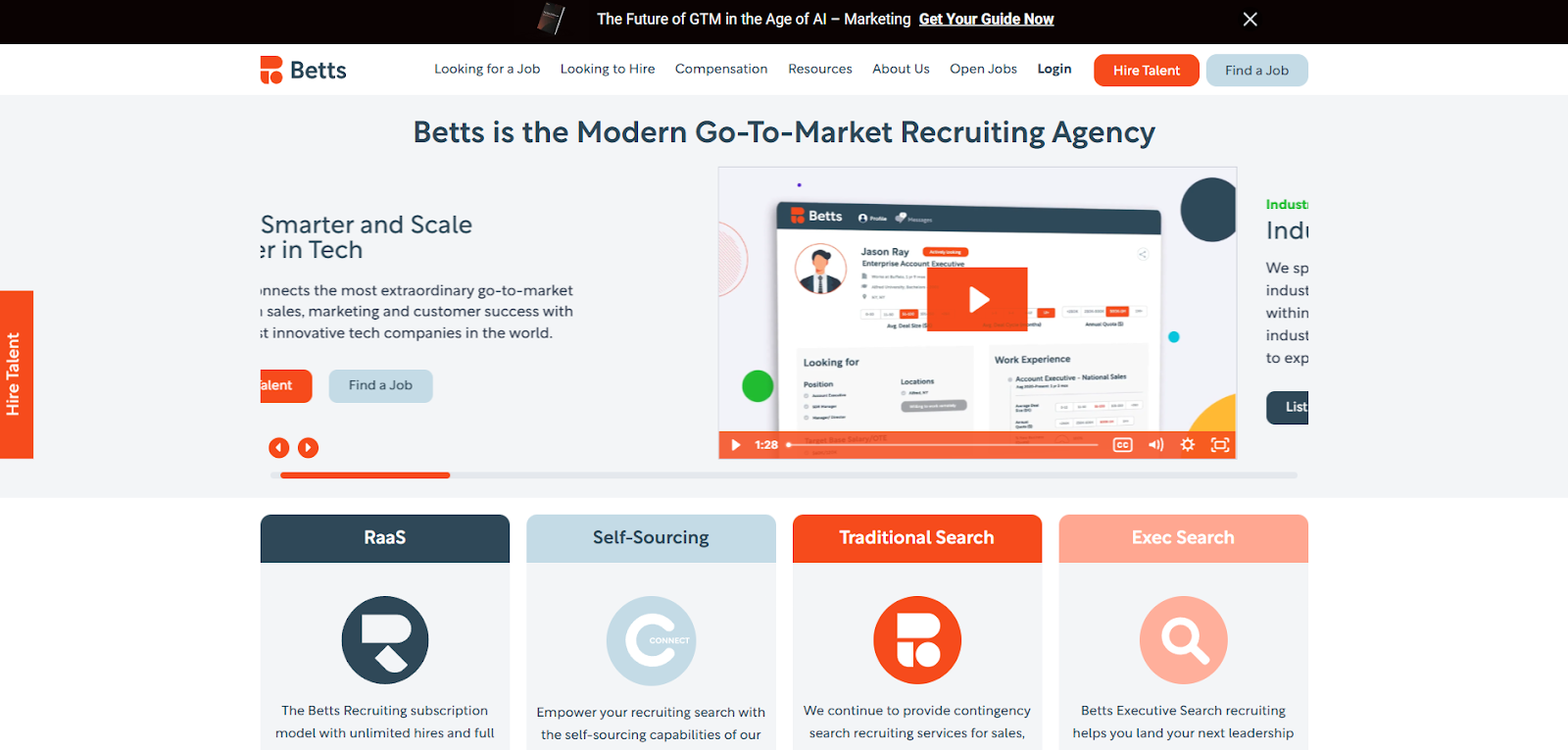
Betts Recruiting operates at scale while retaining GTM specialization. Their strength lies in placing AI sales talent across multiple roles simultaneously, particularly when companies need consistency across hiring waves rather than one-off placements.
What Betts is particularly strong at:
- Market-level compensation calibration for AI and deep-tech sales roles
- Parallel hiring across SDR, AE, and SE roles without profile drift
- Recruitment-as-a-Service models that flex with hiring velocity
- Leveraging proprietary market data to reduce offer rejections
Betts is often brought in when companies need to scale multiple GTM roles with consistency.
3. Formative Search Partners
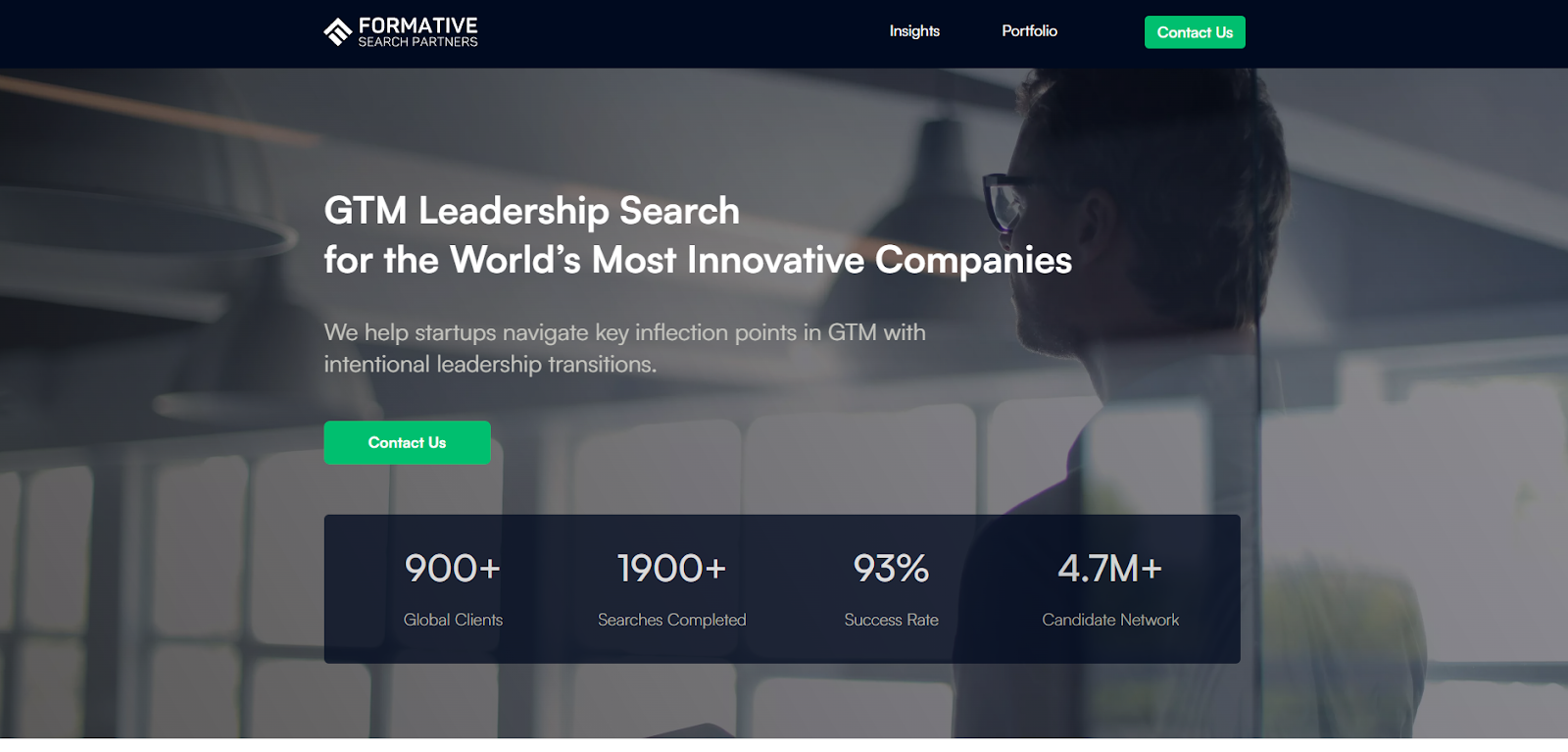
Formative Search Partners is built for early-stage precision. They work best when the cost of a wrong hire is existential, not inconvenient, especially for AI startups defining their first repeatable sales motion.
Where Formative adds real value:
- Deep founder alignment on what success actually looks like in the role
- Translating ambiguous GTM needs into hireable profiles
- Avoiding premature “enterprise seller” hires before product readiness
- Supporting role definition as much as candidate sourcing
Formative’s value shows up in moments where clarity matters more than speed.
4. Sales Talent Inc.
Sales Talent Inc. is engineered for companies that already know how they sell and need disciplined execution. Their process favors repeatability, making them a fit for AI companies moving from experimentation to operational scale.
What differentiates Sales Talent Inc.:
- Structured evaluation of deal complexity and buying committee navigation
- Sales methodology alignment (MEDDICC, Challenger, etc.) baked into screening
- Enterprise sales benchmarking rather than startup-style intuition
- Emphasis on forecast accuracy and pipeline hygiene experience
5. Peak Sales Recruiting
Peak Sales Recruiting focuses on high-impact sales leadership hires where mistakes compound quickly. Their approach resonates with AI companies moving upmarket or expanding internationally.
Where Peak excels:
- Predictive modeling for leadership performance in new markets
- Benchmarking leadership profiles against comparable revenue stages
- Reducing executive mis-hire risk during inflection points
- Supporting board-visible revenue leadership searches
6. OutScout
OutScout blends technology and search to control signal quality. Their value shows up when hiring managers are overwhelmed by volume but still need precision.
What OutScout does differently:
- High signal-to-noise candidate curation for technical GTM roles
- Tighter candidate shortlists with higher interview-to-offer ratios
- GTM profile refinement before sourcing begins
- Reduced time lost to low-fit interview cycles
They work closely with founders and hiring managers to refine profiles and narrow searches, which often results in higher interview-to-offer conversion rates. OutScout is commonly used by AI companies hiring technical sellers, RevOps professionals, or GTM talent with infrastructure or platform experience.
7. Rainmakers
Rainmakers is built for speed and transparency. It works best when companies already know what “good” looks like and want fast access to sellers with provable outcomes.
Where Rainmakers fits best:
- Rapid outbound team scaling using performance-visible profiles
- Clear visibility into quota attainment and deal history
- Shortened hiring cycles for SDRs and mid-market AEs
- Self-serve hiring without recruiter dependency
The platform is especially effective for scaling outbound SDRs and AEs, where speed and volume matter. While it’s less tailored than boutique firms, Rainmakers excels when teams already know what they’re hiring for and need execution quickly.
8. Hunt Club
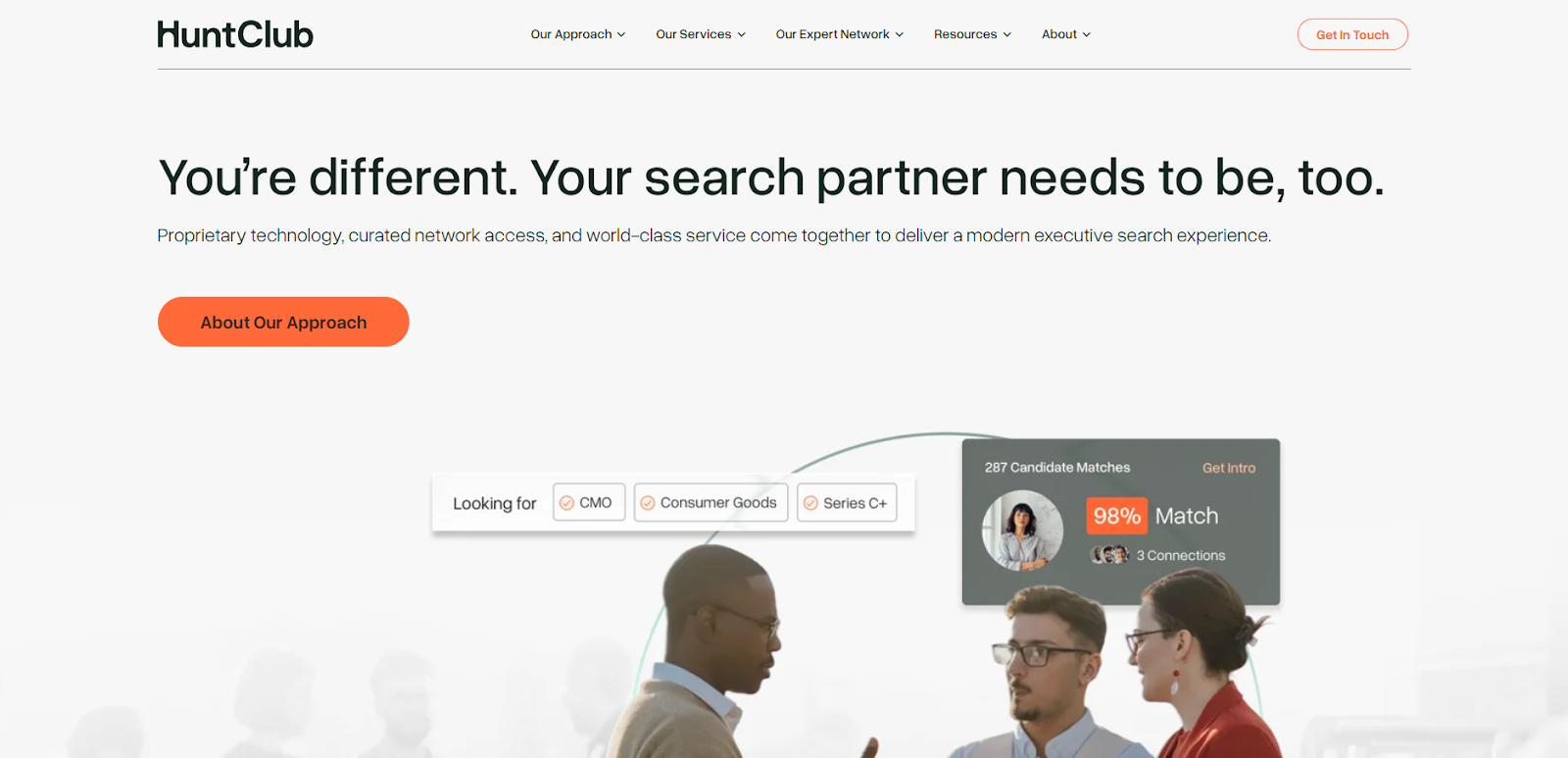
Hunt Club unlocks passive talent through trusted referrals, making it effective for strategic and leadership GTM roles that rarely appear on job boards.
What Hunt Club uniquely offers:
- Access to sellers and leaders not actively job-seeking
- Network-driven sourcing for niche domain expertise
- Higher trust signals earlier in the hiring process
- Reduced reliance on inbound applications
AI companies turn to Hunt Club when they need access to candidates who are not actively job-seeking, often experienced sales leaders or enterprise sellers with niche domain expertise. Their approach blends relationship-driven sourcing with technology-enabled matching.
9. theLIONS
theLIONS is built for ambiguity. Their recruiters understand what it takes to sell when messaging, pricing, and ICP are still evolving.
Where theLIONS stands out:
- Identifying sellers comfortable building while selling
- Hiring for adaptability over polished playbook experience
- Supporting zero-to-one GTM team formation
- Strong alignment with founder-led sales transitions
They are often involved in zero-to-one sales hires, early AEs, first sales managers, and GTM leaders who can build while selling. This operator-led perspective resonates strongly with founders navigating ambiguity.
10. Teamable (TopFunnel)
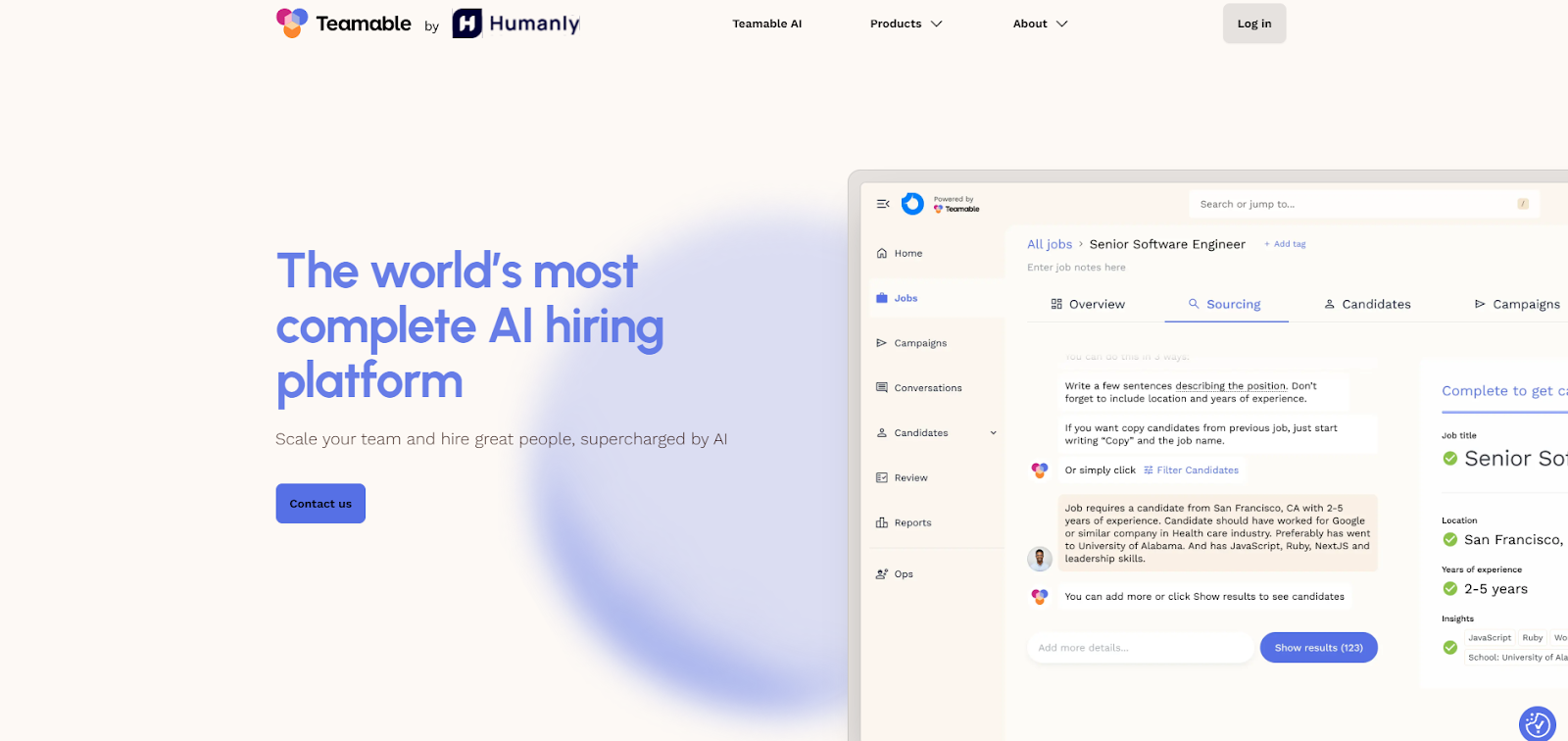
Teamable focuses on referral-based recruiting, using automation to unlock passive candidates through employee networks. This approach is particularly effective for AI companies hiring repeatable GTM roles while prioritizing diversity and engagement.
Teamable turns internal networks into a recruiting engine. Its strength lies in scaling referral-driven hiring without manual overhead.
What Teamable enables:
- Systematic access to passive candidates via employee networks
- Automation that increases referral participation
- Reduced dependency on inbound applicants
- Improved diversity reach through network expansion
Learn more about: Sales Workforce Trends and AI Integration Insights
Where AI Is Actually Making Recruiting Better
AI hasn’t transformed recruiting by replacing recruiters. It’s improved hiring by removing friction from the parts of the job that slow teams down and distract them from decision-making. When used well, AI creates leverage, less noise, cleaner pipelines, and better signals earlier in the process.
Faster sourcing, cleaner pipelines, fewer wasted hours
High-performing recruiting teams now use AI to take over repetitive, low-judgment tasks that once consumed hours each week.
- Smarter sourcing: Modern tools search beyond resumes and job boards, identifying candidates through public work, talks, open-source contributions, and career signals, not just keywords.
- Faster screening: Research from Talent Board and Phenom shows AI screening can cut resume review time by up to 75%, allowing recruiters to focus on qualified conversations instead of manual filtering.
- Pipeline prioritization: AI helps surface which candidates are most likely to progress, so recruiters spend time where it actually matters.
This impact is most visible in technical and AI-related roles, where signal-to-noise ratios are traditionally low.
Better predictions: fit, performance, and retention risk
AI is also improving hiring decisions by spotting patterns humans can’t easily see at scale.
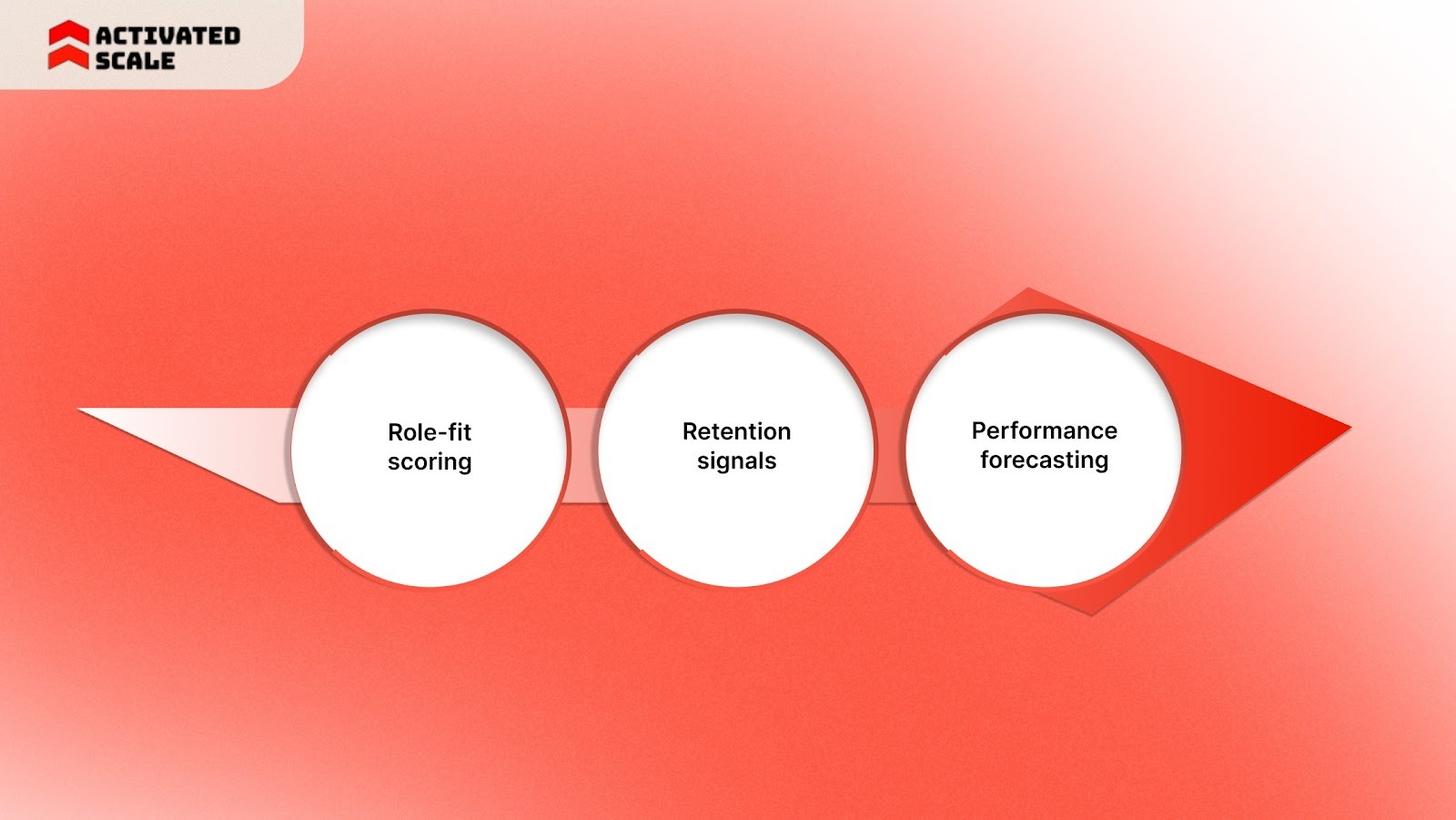
- Role-fit scoring: By analyzing outcomes from past hires, systems can flag candidates more likely to succeed in similar roles or environments.
- Retention signals: Some platforms identify early indicators of turnover risk during hiring, helping teams avoid costly short-term placements.
- Performance forecasting: Companies using machine learning in hiring report up to 25% improvement in predicting on-the-job success.
These insights don’t replace judgment, they sharpen it.
Automation where it actually helps
The best AI implementations focus narrowly on tasks that are high-volume and low-value when done manually.
- Interview scheduling without back-and-forth
- Automated status updates to candidates
- Real-time visibility into funnel health and bottlenecks
Phenom reports that organizations using AI for interview scheduling save 36% of the time previously spent coordinating calendars. That time goes back into interviews, alignment, and hiring quality.
Tools that don’t create more work
The most effective AI recruiting tools don’t feel like “another system to manage.” They work quietly in the background.
Strong platforms:
- Integrate into existing workflows
- Improve automatically based on recruiter behavior
- Explain recommendations clearly
- Adapt to different hiring contexts without heavy setup
As MIT Sloan research has shown, AI works best when it supports human decision-making instead of attempting to replace it. The real win isn’t automation, it’s amplification.
What’s the Difference Between Sales Staffing and Sales Recruitment?
The real difference between sales staffing and sales recruitment isn’t about the firm you choose; it’s about who employs the salesperson and how much flexibility you need.
Sales staffing: flexibility first
With sales staffing, the agency employs the salesperson, not you. You get access to experienced sales talent while the agency handles payroll, benefits, and HR. This setup makes it easier to scale headcount up or down without committing to long-term employment.
Staffing models are commonly used when speed or flexibility matters, such as:
- Short-term coverage for campaigns or seasonal spikes
- Temp-to-hire roles where fit is tested before making a permanent offer
- Contract-based sales teams assembled for specific initiatives
Many staffing providers also act as an Employer of Record (EOR), which is especially useful when hiring remote or offshore sales talent. They manage compliance, taxes, and employment regulations so companies don’t have to navigate complex labor laws.
Sales recruitment: long-term ownership
Recruitment agencies help you hire salespeople as direct employees. They source, vet, and introduce candidates, but once the hire is made, you take over compensation, management, and development.
Recruitment services typically cover:
- Permanent, full-time sales roles
- Contingent or retained searches, depending on urgency and role level
- Executive search for senior sales leadership
Executive search firms sit at the top end of recruitment, focusing on confidential hires for roles like VP of Sales or CRO. These searches take longer and cost more, but they’re designed for high-impact leadership hires.
The part most people miss
Most firms don’t offer just one model. Many provide staffing, recruitment, and executive search under one roof. The decision isn’t about picking the “right” company, it’s about choosing the right hiring model for your situation.
If you need flexibility or fast coverage, staffing makes sense.
If you’re building for the long term, recruitment is usually the better fit.
That distinction matters far more than the name on the contract.
This distinction becomes even more important in modern sales hiring, where execution speed and adaptability often outweigh rigid headcount plans. Activated Scale’s services are built around this reality. Through contract-to-hire sales recruiting, fractional selling, and fractional sales leadership, companies can begin executing immediately, test performance in real sales environments, and transition to full-time hires only once fit and results are clear.
By structuring hiring around proven execution rather than assumptions, Activated Scale removes pressure from early decisions and allows performance to guide long-term commitment.
What Sales Roles Can Recruiting Agencies Help You Hire?
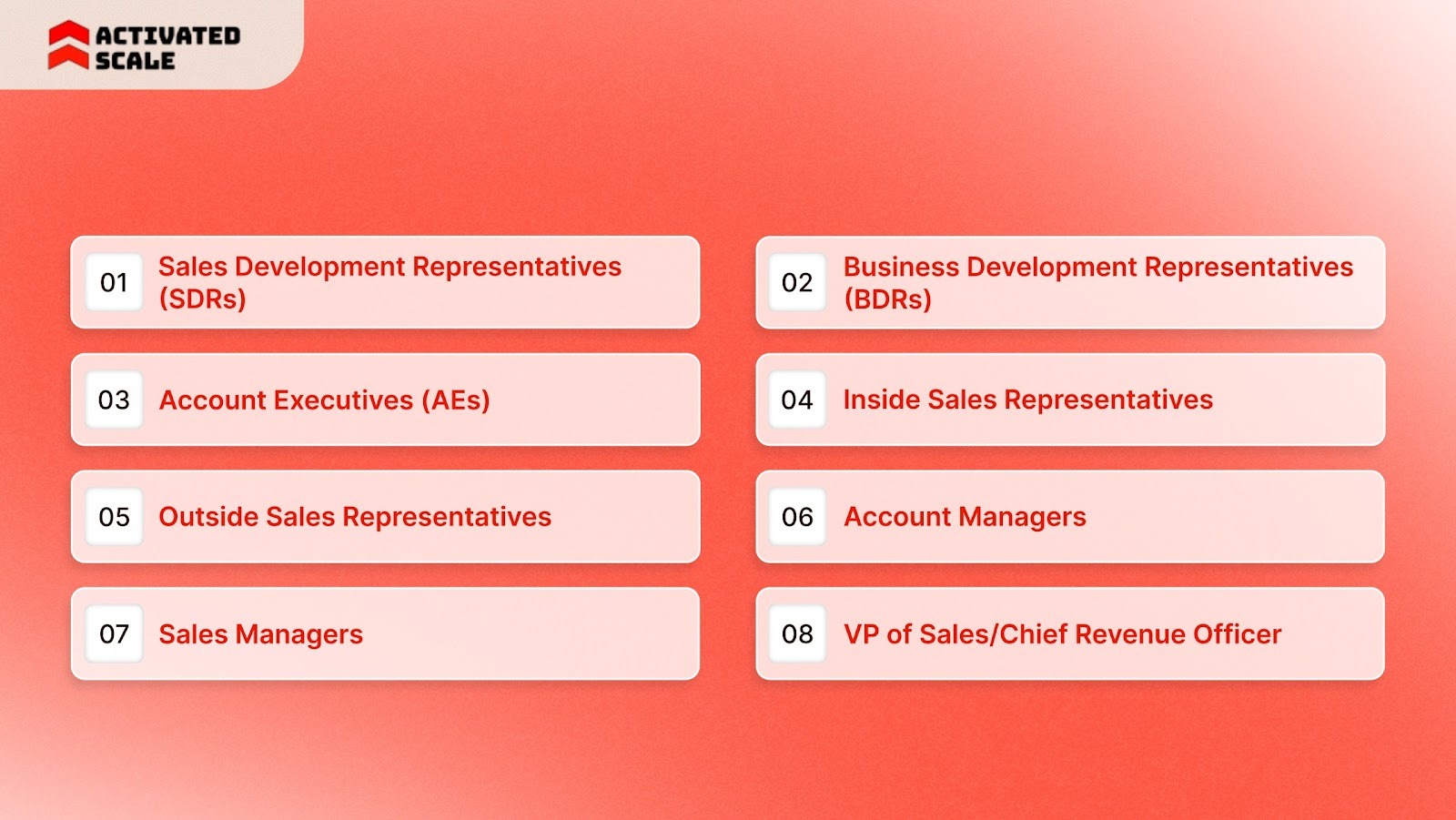
Sales recruiting agencies don’t just fill one type of role. They support hiring across the entire sales org, from early pipeline builders to revenue leaders, each with very different success profiles.
Here’s how those roles typically break down:
- Sales Development Representatives (SDRs)
Build a pipeline through outbound prospecting, cold calls, and lead qualification. This role demands consistency, resilience, and comfort with high activity.
- Business Development Representatives (BDRs)
Focus on opening new opportunities through targeted research and outbound outreach. Strong BDRs know how to start conversations, not just send messages.
- Account Executives (AEs)
Own deals end to end, from discovery to close. The best AEs combine consultative selling with disciplined deal management.
- Inside Sales Representatives
Sell remotely via calls, email, and video. Success here depends on clear communication, follow-up discipline, and handling higher deal volume.
- Outside Sales Representatives
Manage in-person selling, usually for larger or more complex deals. This role requires strong relationship skills and comfort navigating longer sales cycles.
- Account Managers
Grow and retain existing customers through renewals, upsells, and expansion. Trust-building and long-term thinking matter more than net-new hunting.
- Sales Managers
Lead teams, coach performance, and translate strategy into daily execution. Great managers elevate the entire team, not just their own numbers.
- VP of Sales/Chief Revenue Officer
Set revenue strategy, build org structure, and align sales with company goals. This role demands experience, judgment, and the ability to scale what works.
Strong recruitment partners understand that each role requires a different skill set, mindset, and screening approach. The more clearly an agency distinguishes between these roles, the better your chances of hiring people who perform, and stay.
Knowing which sales roles you need is only half the equation. The harder part is hiring people who have already performed that exact role in similar sales environments.
Activated Scale focuses on role-specific sales hiring through its contract-to-hire sales recruiting model, matching companies with SDRs, AEs, and sales leaders who have proven experience in comparable GTM motions.
For companies hiring across multiple sales roles, this approach reduces guesswork and speeds up execution, without overcommitting early.
Also Read: What is Outbound Sales? Key Steps and Strategies Guide
How to Choose the Right Sales Recruitment Solution
Choosing a sales recruitment solution isn’t about picking the “best” agency, it’s about choosing the right hiring model for what you’re selling and how fast you need results. Sales roles are highly contextual. Someone who excels at selling enterprise SaaS may struggle in hardware, services, or transactional models.
Salespeople don’t transfer seamlessly across industries or motions. The closer the match between your product, buyer, and sales role, the better your hiring outcome.
Below are the core recruitment models, each with clear trade-offs.
Traditional Sales Headhunters
Best used when: You need senior, industry-specific sales leaders.
Headhunters excel at sourcing experienced sellers with deep domain knowledge. They’re effective for strategic hires where background and relationships matter more than speed. The trade-off is cost and time, searches are slower and fees are high.
Executive Search Firms
Best used when: You’re hiring C-suite sales leadership.
Executive search firms are built for confidential, high-stakes hires. They focus on precision and discretion, making them suitable for VP of Sales or CRO roles that shape long-term direction. Expect long timelines and premium pricing.
Sales Recruitment & Staffing Firms
Best used when: You need qualified sales hires quickly.
These firms maintain active pipelines of pre-screened candidates and handle early-stage vetting. They’re efficient for filling SDR, AE, and mid-level sales roles, especially when you need speed without building an internal hiring engine.
Specialist firms outperform generalists when they understand your market and sales motion.
Nearshore Sales Recruitment
Best used when: Cost efficiency matters and roles can be remote.
Nearshore recruitment (often in LatAm) offers lower costs and overlapping time zones. It works well for clearly defined roles but requires careful management to ensure communication quality and sales execution align with your market.
In practice, most companies rely on multiple hiring models as they scale. When speed and adaptability matter, Activated Scale's fractional sales leadership allow teams to access experienced guidance immediately, stabilize execution, and make permanent hiring decisions only after direction and performance are clear.
Conclusion
There’s no single “best” sales recruitment solution, only the one that fits your stage, sales motion, and tolerance for risk. Traditional recruiters and executive search firms still play an important role for senior, long-term hires. But for companies that need speed, flexibility, and proof before commitment, modern sales hiring models offer a clear advantage.
This is where Activated Scale fits naturally. Instead of locking into full-time hires upfront, teams can work with experienced, US-based sales professionals on a flexible basis, see how they perform in live deals, and scale only when the fit is clear.
If you’re building or scaling a sales team and want to reduce hiring risk while moving faster, connect with Activated Scale to hire sales talent that’s ready to execute.
FAQs
1. How do I know which sales recruitment model is right for me?
Start with clarity on your sales motion, role seniority, and urgency. The tighter your timeline, the more flexibility matters.
2. Are traditional recruiters still relevant?
Yes, especially for executive or highly specialized roles where background and relationships are critical.
3. What’s the risk of hiring sales talent too early?
Mis-hires delay pipeline, increase churn, and lock you into fixed costs before revenue is predictable.
4. Can flexible sales hiring work for complex B2B sales?
Yes. When done right, it allows teams to validate fit and execution in real sales conditions.
5. How is Activated Scale different from a typical recruitment firm?
Activated Scale focuses on execution-first hiring, letting teams work with proven sales professionals before making long-term commitments.
The Ultimate Guide to Hiring a Salesperson!
Get the step-by-step guide to hiring, onboarding, and ensuring success!