_edi.png)

Marketing teams don't fail because of weak ideas. They fail when execution can't keep up with growth. According to Gartner, poor data quality costs organizations an average of $12.9 million per year, largely due to inefficiencies, rework, and unreliable reporting.
For marketing teams, this results in unclear attribution, conflicting reports, and decisions based on incomplete information. As tools and channels multiply, these issues compound unless someone understands how systems, data, and processes work together.
That's why a clear marketing operations strategy matters. It brings structure to execution, ensures data can be trusted, and helps teams scale without losing control.
Core Insights:
- Marketing operations defines how marketing work is structured, executed, and measured, so growth does not create reporting conflicts or process breakdowns.
- Clean system integration across CRM, automation, and analytics determines attribution accuracy, forecasting reliability, and confident budget decisions.
- Revenue-focused metrics such as CAC, MQL-to-SQL conversion rate, sales velocity, MER, and ROI expose inefficiencies better than activity-based reports.
- Clear ownership of workflows, tool governance, and decision rights prevents execution drift as teams expand.
What is Marketing Operations (MOPs)?
Marketing operations (MOPs) is the function responsible for translating marketing strategy into consistent, repeatable execution. It brings structure to how marketing work is planned, delivered, measured, and improved.
At its core, marketing operations sits at the intersection of people, process, and technology. It defines how campaigns are organized, how tools are used, how data flows across systems, and how performance is evaluated. Without it, even strong strategies struggle to scale.
MOPs exist to keep marketing efficient as complexity grows. As teams add channels, tools, and stakeholders, operations ensures nothing breaks quietly in the background. Planning stays organized. Reporting stays reliable. Execution stays aligned with business goals.
In short, marketing operations isn't about doing more marketing. It's about ensuring marketing works effectively as the business expands.
Why Marketing Operations Matters, Trends & Benchmarks (2026)
Marketing operations are central to how modern teams operate and deliver value.
According to research from the State of the Marketing Ops Professional, the role has matured rapidly as organizations expect more strategic impact from operations professionals. The discipline is evolving from behind-the-scenes support into a driver of alignment, data quality, and cross-team execution integrity.
Key trends from this industry study include:
- Experienced operators dominate the field: 61% of marketing ops professionals report six or more years of experience, and most hold multiple certifications, showing the function isn't entry-level but strategic and specialized.
- Integration is a top priority: 81% of marketing ops leaders say integration capabilities are their top criterion when evaluating new tools, highlighting how data flow and connected systems affect operational effectiveness.
- Role visibility continues to grow: Marketing ops functions are becoming more visible and vital, signalling that companies recognize the role as foundational, not just functional, in scaling modern marketing execution.
These benchmarks show that as marketing becomes more data-driven and complex, operations is a core pillar, not a back-office task.
What a Marketing Operations Team Is Responsible For
A marketing operations team owns the infrastructure that keeps marketing running smoothly. While campaigns, content, and growth efforts are visible, marketing ops works behind the scenes to ensure systems, data, and processes function as intended.
The structure of a marketing operations team varies by company size and industry, but the responsibility stays consistent: make marketing execution reliable, measurable, and scalable.
Core Marketing Operations Responsibilities
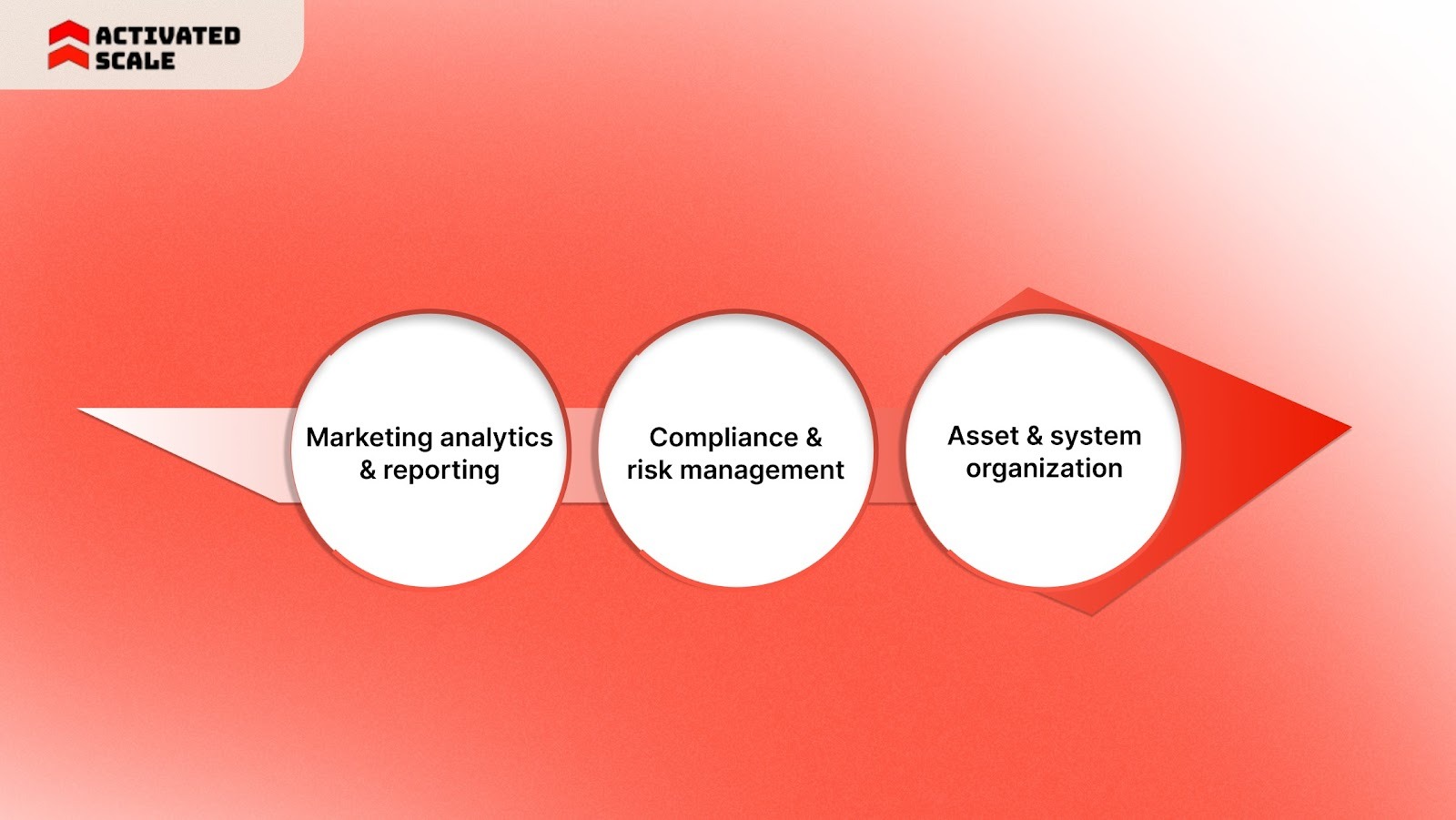
Marketing analytics and reporting: Marketing ops manages how data is tracked, connected, and reported. This includes integrating tools, maintaining dashboards, and ensuring teams rely on consistent metrics when making decisions.
Compliance and risk management: In regulated industries, marketing ops helps design systems and workflows that reduce risk and support compliance requirements. This includes oversight of data usage, permissions, and marketing technology configurations.
Asset and system organization: Marketing ops often oversees how digital assets and tools are structured and accessed. This ensures teams can find, use, and distribute resources without creating version issues or operational friction.
Common Roles Within a Marketing Operations Team
On smaller teams, marketing operations may be handled by one experienced operator. As organizations grow, responsibilities typically expand into specialized roles.
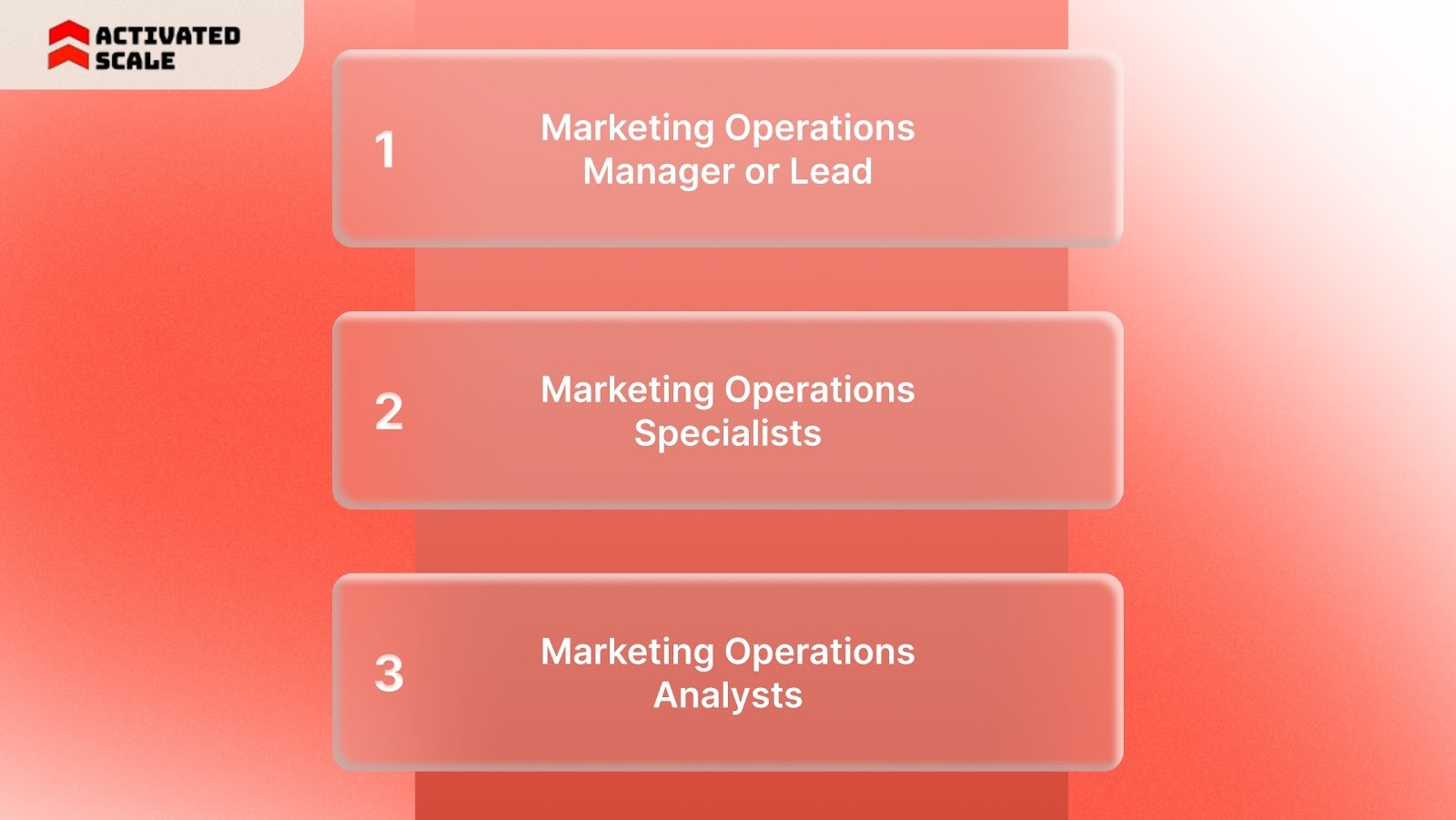
Marketing Operations Manager or Lead: Owns overall marketing infrastructure and process decisions. This role works closely with leadership and other teams to ensure systems scale without breaking execution.
Marketing Operations Specialists: Support day-to-day operations across tools, workflows, and integrations. On larger teams, specialists may focus on specific areas such as CRM connections, website integrations, or campaign systems.
Marketing Operations Analysts: Focus on collecting, validating, and analyzing data. Their work supports forecasting, performance reviews, and future strategy decisions.
How Marketing Operations Works With Other Teams
Marketing operations enable collaboration by keeping systems aligned across functions.
Common examples include:
- Supporting lifecycle marketing by ensuring email platforms integrate cleanly with CRM systems
- Helping content teams connect lead capture forms to tracking and reporting tools
- Working with data and analytics teams to validate data accuracy across sources
When marketing ops functions well, other teams spend less time troubleshooting systems and more time executing their work effectively.
Learn more about: Sales compensation plans for startups
4 Common Marketing Operations Strategy Frameworks
A marketing operations strategy needs structure. Without it, planning drifts, execution becomes inconsistent, and improvements rely on guesswork.
There isn't one single framework that fits every team. Some organizations use Campaign-to-Cash (C2C) models. Others rely on traditional waterfall planning. But most modern marketing operations teams operate alongside marketers and use Agile frameworks that support flexibility and iteration.
Below are the most practical frameworks marketing operations teams use today.
1. Lean
Lean focuses on eliminating waste and improving workflow efficiency. In marketing operations, this typically means identifying steps, tools, or approval layers that don't directly drive measurable outcomes.
Lean encourages teams to:
- Define the outcome before building the process
- Remove redundant tools or duplicate reporting
- Simplify handoffs between teams
- Continuously refine workflows based on results
Lean works best when marketing operations focus on stabilizing complex systems and reducing operational friction before scaling operations.
2. Scrum
Scrum structures work into defined time blocks called sprints, usually lasting one to four weeks. Each sprint includes planning, daily check-ins, and a review or retrospective at the end.
For marketing operations, Scrum adds:
- Predictable execution cycles
- Clear workload visibility
- Regular performance reviews
- Faster identification of bottlenecks
Scrum works well when marketing teams are running campaigns in cycles and need tighter alignment between planning and reporting.
3. Kanban
Kanban focuses on continuous workflow rather than time-boxed sprints. Work is visualized on a board, with tasks moving through stages such as backlog, in progress, review, and completed.
In marketing operations, Kanban helps by:
- Making workload visible
- Limiting work in progress (WIP)
- Preventing bottlenecks from building quietly
- Supporting ongoing operational tasks like reporting or automation management
Kanban is particularly useful when marketing ops handles steady, continuous responsibilities rather than campaign bursts.
4. Scrumban (Hybrid)
Scrumban blends Scrum's sprint structure with Kanban's visual workflow. Teams often use sprint cycles to manage tasks on a Kanban board.
This hybrid model works well for marketing operations because it allows:
- Structured planning cycles
- Visual workflow tracking
- Ongoing process refinement
- Flexibility without losing discipline
Many growing marketing teams prefer Scrumban because it balances structure and adaptability.
The best framework is often the one your marketing team already uses. Marketing operations work best when they operate alongside marketing, not separately from it.
The goal isn't to adopt a framework for its own sake. It's to create predictable execution, measurable progress, and continuous improvement without slowing teams down.
How to Build a Marketing Operations Strategy That Actually Holds
A marketing operations strategy only works when it's grounded in how teams operate today, not how they wish they did. The goal isn't to document the process for its own sake, but to clarify ownership, execution, and measurement.
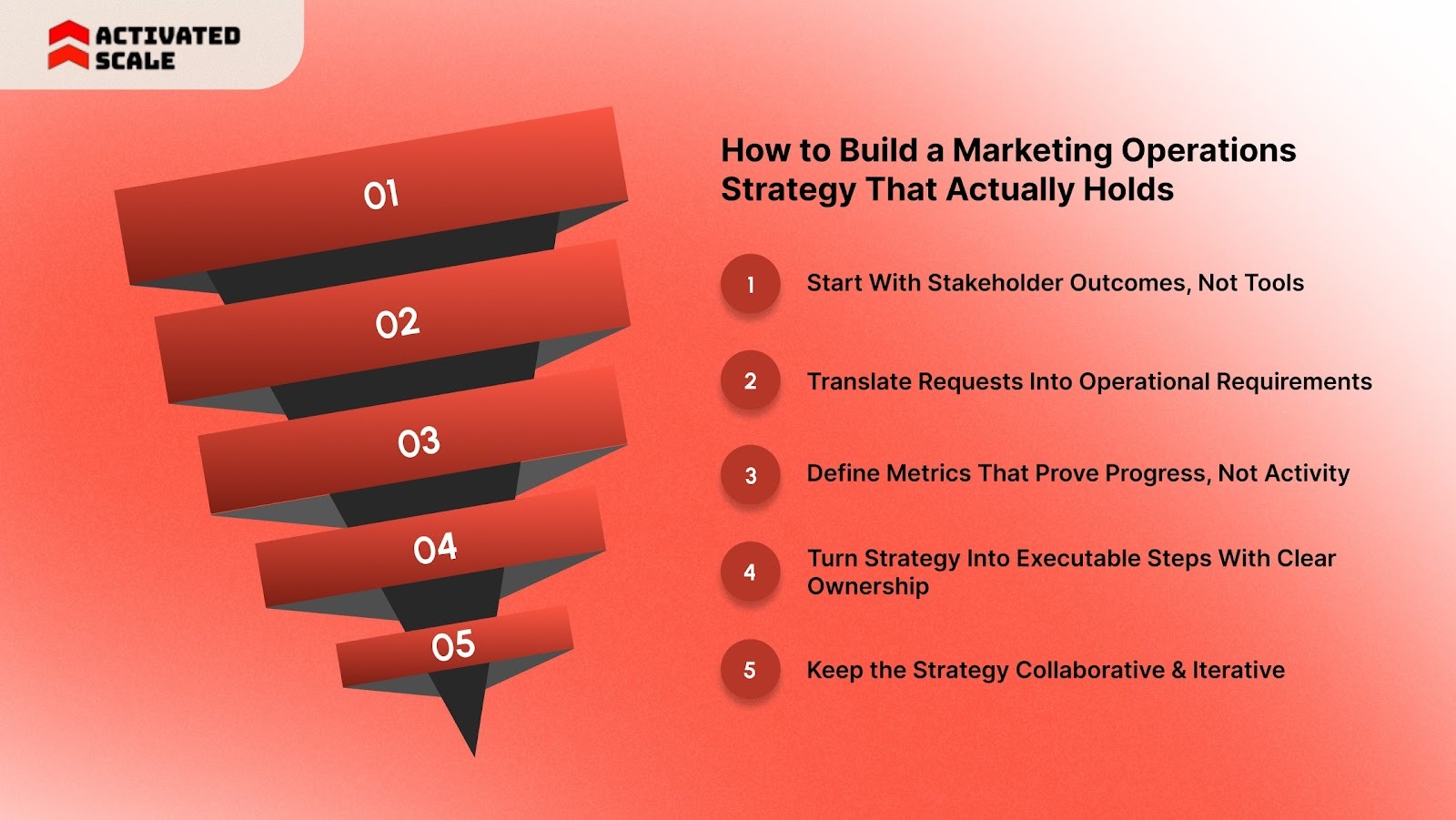
1. Start With Stakeholder Outcomes, Not Tools
Marketing operations exist to support cross-team execution. Before defining workflows or dashboards, clarify what stakeholders need to achieve.
This means understanding:
- What different teams are trying to influence, such as pipeline, attribution, or efficiency
- Where decisions are currently blocked or delayed
- Which outcomes matter most to leadership
Clear stakeholder outcomes prevent ops from becoming reactive or driven by tooling decisions.
2. Translate Requests Into Operational Requirements
Most requests fail because they're framed as solutions instead of needs. A strong marketing ops strategy reframes them into clear operational requirements.
That includes defining:
- What data needs to be captured
- Where it should live
- Who needs access, and when
- How success will be evaluated
This step ensures the strategy reflects real constraints rather than assumptions.
3. Define Metrics That Prove Progress, Not Activity
A strategy without measurable outcomes doesn't hold up under pressure. Marketing operations metrics must connect execution to revenue impact, not just campaign output.
Strong marketing ops KPIs track how efficiently demand turns into revenue and where friction appears in the system.
Effective marketing ops metrics typically include:
- Customer Acquisition Cost (CAC): Measures how efficiently marketing spend converts into new customers. Rising CAC often signals targeting or process misalignment.
- Customer Lifetime Value (CLV): Reveals whether acquisition quality supports long-term revenue, not just short-term wins.
- Lead-to-Customer Conversion Rate: Shows how effectively leads move through the funnel into closed deals.
- MQL-to-SQL Conversion Rate: Highlights alignment between marketing qualification criteria and sales acceptance.
- Conversion Rate (CVR): Tracks performance at critical funnel stages, identifying drop-off points.
- Marketing Efficiency Ratio (MER): Compares total revenue to marketing spend, helping leadership evaluate overall return.
- Return on Marketing Investment (ROI): Quantifies the profitability of campaigns relative to cost.
- Sales Velocity: Measures how quickly revenue moves through the pipeline, surfacing bottlenecks in execution.
- Bounce Rate and Click-Through Rate (CTR): Provide early-stage signals about messaging and targeting effectiveness.
The difference between activity metrics and operational metrics is clarity. Activity reports tell you what happened. Operational KPIs tell you whether the system is improving.
The goal is shared visibility, not more reporting.
4. Turn Strategy Into Executable Steps With Clear Ownership
Once goals and metrics are clear, the strategy has to translate into action. This requires breaking work into defined steps and assigning ownership that sticks.
That includes:
- Sequencing what needs to happen first versus later
- Assigning responsibility for each step
- Establishing how progress is reviewed and adjusted
This is often where teams struggle, not because the strategy is unclear, but because they lack experienced operators to own execution.
Many teams struggle at this stage, not because the strategy is unclear, but because no one internally has the time or experience to own operational execution. In those cases, founders often bring in experienced operators through Activated Scale.
Activated Scale connects companies with vetted, U.S.-based fractional sales leaders and operators who can step in to define workflows, align reporting, enforce process discipline, and stabilize execution, without requiring an immediate full-time hire. This allows teams to validate structure, fix operational gaps, and measure impact before committing to permanent headcount.
5. Keep the Strategy Collaborative and Iterative
Marketing operations don't succeed in isolation. The strategy should be refined based on input from marketing, sales, and leadership as execution progresses.
Regular check-ins help teams:
- Adjust assumptions
- Refine metrics
- Resolve friction before it compounds
A strong marketing operations strategy is both stable and adaptable.
This approach keeps marketing operations strategy focused on outcomes, execution, and accountability, rather than documentation or frameworks. It helps teams move from intent to action while preserving flexibility as the organization scales.
Also read: Guide to Hiring the Right Salesperson for your Business
Turning Strategy Into Action: A Practical Marketing Ops Roadmap
A marketing operations strategy only delivers value when it's implemented with clear ownership and a steady cadence. The goal here isn't a big rollout. It's controlled progress that removes friction as teams execute.
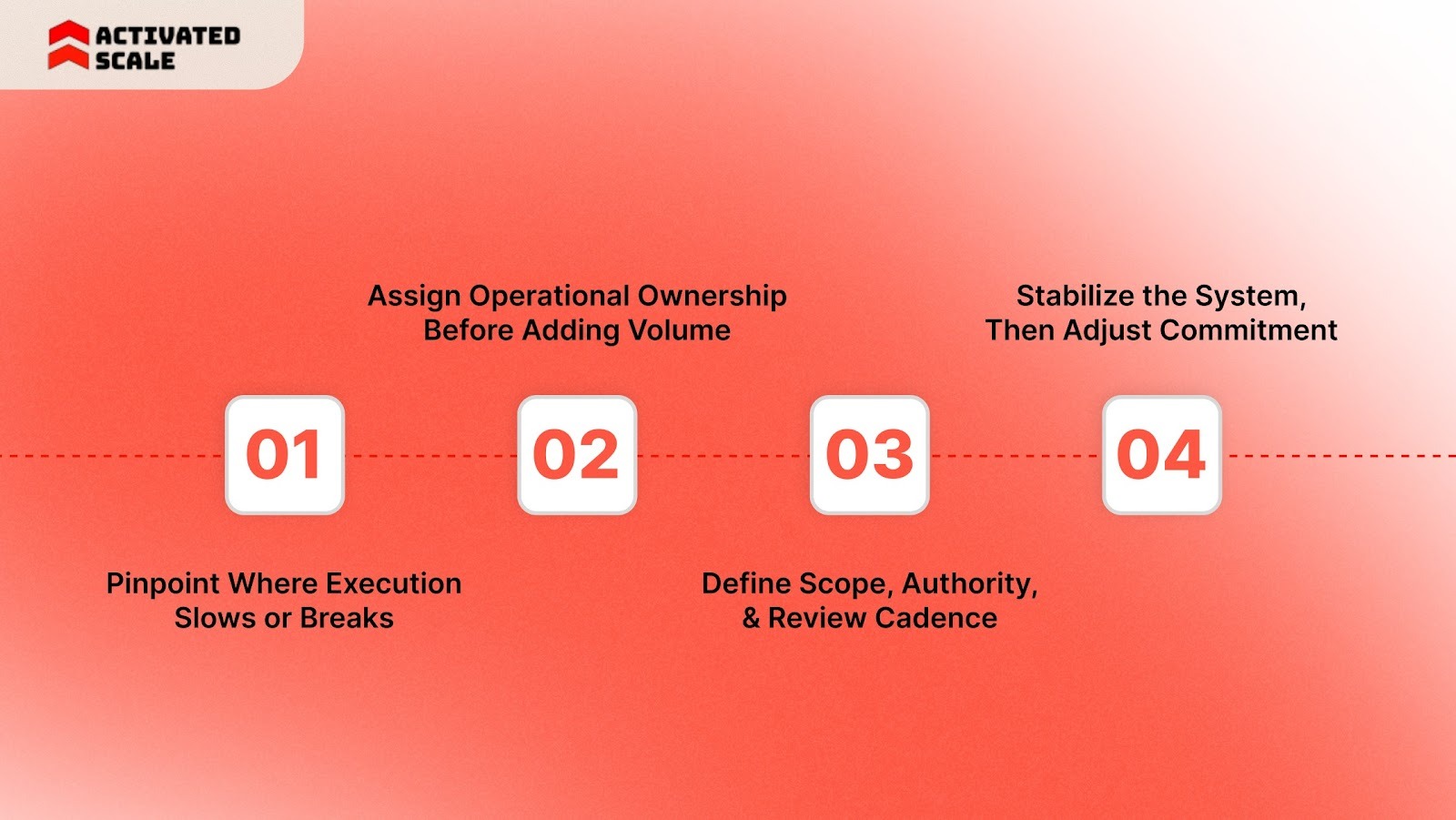
Step 1: Pinpoint Where Execution Slows or Breaks
Start with recent work. Identify moments where campaigns stalled, reports were questioned, or handoffs required follow-ups to clarify responsibility.
Focus on:
- Intake and prioritization of requests
- Approval paths and dependencies
- Data gaps that delay decisions
- Friction between marketing and sales
This keeps implementation grounded in real problems rather than assumptions.
Step 2: Assign Operational Ownership Before Adding Volume
Separate direction from execution. Strategy sets priorities; marketing ops owns how work moves and how performance is measured.
Ownership should be explicit across:
- Process design and enforcement
- Tool configuration and usage rules
- Data flow, attribution, and reporting standards
Without this clarity, even good strategies drift.
Step 3: Define Scope, Authority, and Review Cadence
Keep the rollout focused. Agree on what's in scope, who decides, and how progress is reviewed.
Be clear about:
- Systems and processes under ops control
- Decision rights versus escalation paths
- Metrics used to evaluate progress
- Review rhythms to surface issues early
This prevents scope creep and keeps momentum steady.
Step 4: Stabilize the System, Then Adjust Commitment
Once execution becomes predictable, reassess resourcing. Some teams internalize parts of the role; others keep it flexible as complexity changes.
Many founders prefer validating execution before committing long-term, which is why they work with platforms like Activated Scale to access experienced operators through contract-to-hire and fractional models. This approach preserves flexibility while the operating model proves itself.
Marketing Operations in Action: Practical Examples
Marketing operations become most visible when execution slows down or performance disconnects from spending.
Example 1: Streamlining a Slow Content Engine
Imagine your team produces a weekly founder podcast to build authority. The strategy is strong, but each episode takes three weeks to move from planning to publishing. Deadlines slip. Promotion lags. Momentum fades.
Marketing operations steps in and analyzes the workflow. It might uncover:
- Too many episodes in production at once, creating excessive work in progress
- Manual handoffs between recording, editing, and publishing
- Disconnected tools for project management and asset storage
Instead of pushing the team to "work faster", marketing ops restructures the system. It limits concurrent episodes, standardizes templates, aligns tools, and defines clear stage ownership. The result isn't more effort, it's shorter production cycles and predictable output.
Example 2: Increased Budget, Flat Results
Now consider a different situation. Leadership increases the marketing budget by 20% year over year. Six months later, pipeline and revenue remain largely unchanged.
Rather than blaming campaign performance, marketing operations investigates allocation and workflow patterns. The data reveals:
- Additional budget was poured into existing campaigns
- No testing cadence was introduced
- Reporting focused on activity volume, not efficiency metrics like CAC or conversion rate
Marketing operations reframes the approach. It introduces structured experimentation, defines ROI benchmarks, and builds clearer attribution models. Budget allocation becomes performance-driven rather than habitual.
The result isn't just better reporting. It's smarter investment decisions.
Conclusion
A marketing operations strategy isn't about adding layers or slowing teams down. It's about creating clarity around how work gets done, how success is measured, and who owns fixing what breaks.
When operations are well-defined, marketing becomes easier to manage and scale. Decisions rely less on assumptions and more on reliable systems. Teams spend less time coordinating and more time executing.
Many founders apply this same discipline when building revenue teams. Rather than hiring full-time before execution is stable, they bring in experienced operators through flexible models like Contract-to-Hire or Fractional Sales Leadership.
Activated Scale supports that approach by connecting companies with vetted sales talent in under a week, often saving 20+ hours of interview time per hire. With 200+ companies served and 80% of placements lasting more than 8 months, the focus is on demonstrating impact before committing to a long-term relationship.
If you're building or refining your marketing operations strategy, let's connect to discuss which support makes sense for your team.
FAQs
1. What is a marketing operations strategy?
A marketing operations strategy defines how marketing work is structured, executed, and measured. It outlines process ownership, tool usage, reporting standards, and performance tracking to enable marketing to scale without losing control.
2. How do you measure marketing operations effectiveness?
Marketing operations effectiveness is measured by execution reliability and data accuracy. Key indicators include campaign delivery timelines, attribution clarity, reporting consistency, system adoption rates, and reduced operational friction across teams.
3. What roles belong to a marketing operations team?
A marketing ops team may include a Marketing Operations Manager, CRM or automation specialist, data analyst, and systems administrator. In smaller companies, one experienced operator may manage process design, tool integration, and reporting oversight.
4. When should a company hire a marketing operations manager?
Companies should consider hiring when reporting becomes inconsistent, tool integrations break, campaign execution slows, or marketing and sales disagree on metrics. These signals usually indicate growing operational complexity.
5. Is marketing operations only for large organizations?
No. Early and growth-stage companies often benefit the most. Establishing marketing operations early prevents rework, improves attribution, and creates structure before scale amplifies inefficiencies.
6. What does marketing operations typically oversee?
Marketing operations oversees campaign workflows, marketing technology management, CRM integrations, attribution models, reporting infrastructure, and coordination with sales or revenue teams to ensure execution aligns with business goals.
The Ultimate Guide to Hiring a Salesperson!
Get the step-by-step guide to hiring, onboarding, and ensuring success!