_edi.png)
The outsourcing landscape continues to grow steadily as companies look for ways to accelerate growth, access specialized skills, and stay competitive. In fact, 66% of U.S. companies outsource at least one function, showing how mainstream this strategy has become for operational and strategic tasks.
In addition to saving money, outsourcing now directly affects scalability and access to talent that may be hard or slow to hire locally. Partnerships with outsourcing firms are strategically valuable. They enable businesses to swiftly meet demand without overtaxing internal teams.
Core takeaways
- In 2026, outsourcing success depends more on partner fit and execution clarity than on price alone.
- Define exactly what you’re outsourcing before vendor outreach to avoid scope drift and poor outcomes.
- High-trust discovery channels include vetted review platforms, founder referrals, and niche U.S.-based providers.
- The best outsourcing companies support pilot projects, transparent metrics, and gradual scale.
- Flexible models, such as contract-to-hire or fractional leadership, reduce risk and improve decision quality before long-term commitments.
Why Finding the Right Outsourcing Partner Matters
Outsourcing mistakes are more expensive in 2026 than they used to be. Teams are leaner, timelines are shorter, and tolerance for inefficiency is low. A misaligned partner doesn’t just slow progress, it creates operational drag.
What’s changed:
- Less buffer, more pressure
Companies no longer have excess headcount to manage underperforming vendors or fix repeated handoff issues.
- Execution speed matters more than cost
Delays, rework, and missed context often cost more than higher hourly rates.
- Outsourcing now touches core workflows
Vendors are no longer handling side projects. They’re embedded in product, revenue, and operations.
- Accountability is harder to enforce
Many outsourcing companies look similar on paper. Real differences show up only after work starts.
- US-based outsourcing is chosen for alignment, not labor savings
If communication, ownership, and responsiveness don’t improve, the model fails.
In 2026, the right outsourcing partner doesn’t reduce involvement, they reduce friction. That’s the standard teams should be evaluating against.
Define What You’re Outsourcing Before You Start Searching
Outsourcing decisions break down when companies search for vendors before defining the work. In 2026, that approach leads to mismatched expectations and slow execution.
Before reaching out to any outsourcing company, lock in these basics:
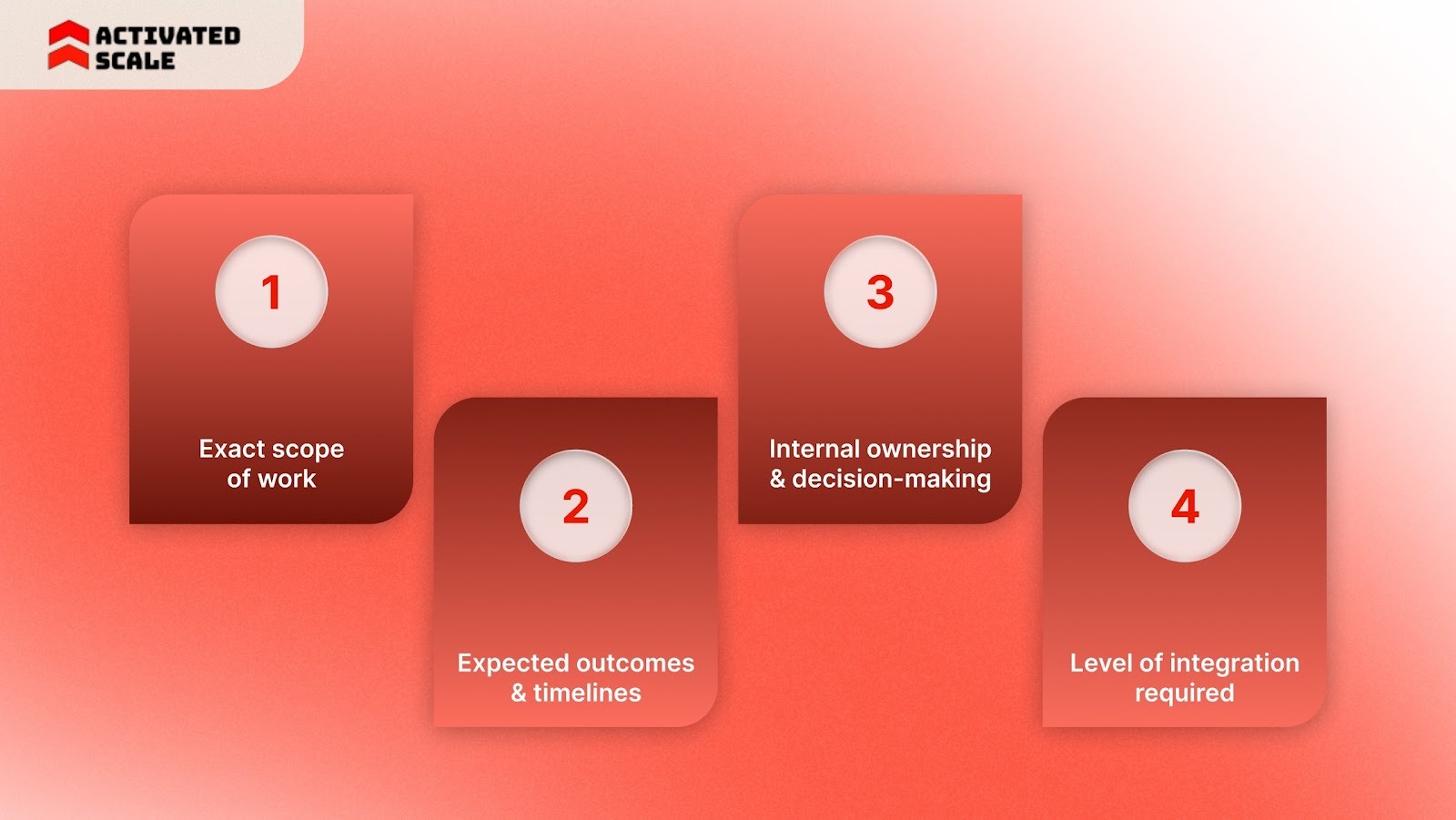
- Exact scope of work
Be specific about what is included and what is not. “Development,” “support,” or “operations” are not scopes. Tasks, dependencies, and handoffs should be clear.
- Expected outcomes and timelines
Vendors need to know what success looks like. This includes delivery milestones, quality standards, and how work will be reviewed.
- Internal ownership and decision-making
Decide who owns priorities, approvals, and changes. Outsourcing fails when vendors are expected to make strategic calls without context.
- Level of integration required
Some work needs daily collaboration. Other work does not. Set expectations early to avoid friction later.
When scope and ownership are clear, vendor evaluation becomes easier. You can compare providers on execution capability instead of promises.
Where to Find Reliable US-Based Outsourcing Companies
Finding outsourcing companies isn’t hard. Finding reliable ones is.
In 2026, the strongest US-based providers are usually discovered through channels where real performance is visible, not just marketing.
Focus on:
- Review platforms with detailed feedback
Clutch and GoodFirms are useful when you read beyond ratings. Look for consistency in delivery, communication quality, and repeat engagements.
- Industry referrals and founder networks
Recommendations from operators who recently worked with a provider often surface issues you won’t see in sales calls. Ask what required the most oversight.
- Specialized marketplaces and niche providers
Companies that focus on a specific function, stage, or industry tend to have tighter vetting and clearer delivery models than broad agencies.
Be cautious with directories that list hundreds of providers without context. In many cases, the best US-based outsourcing companies aren’t aggressively advertised, they’re reused quietly by teams that value reliability.
Must read: The Complete Guide to Sales Talent Marketplace Solutions
How to Evaluate Outsourcing Companies (2026 Checklist)
Once you narrow down a shortlist, surface-level comparisons stop working. In 2026, most outsourcing companies can “do the work.” The real difference is how they operate once execution starts.
Use this checklist to evaluate whether a provider will reduce friction, or add to it.
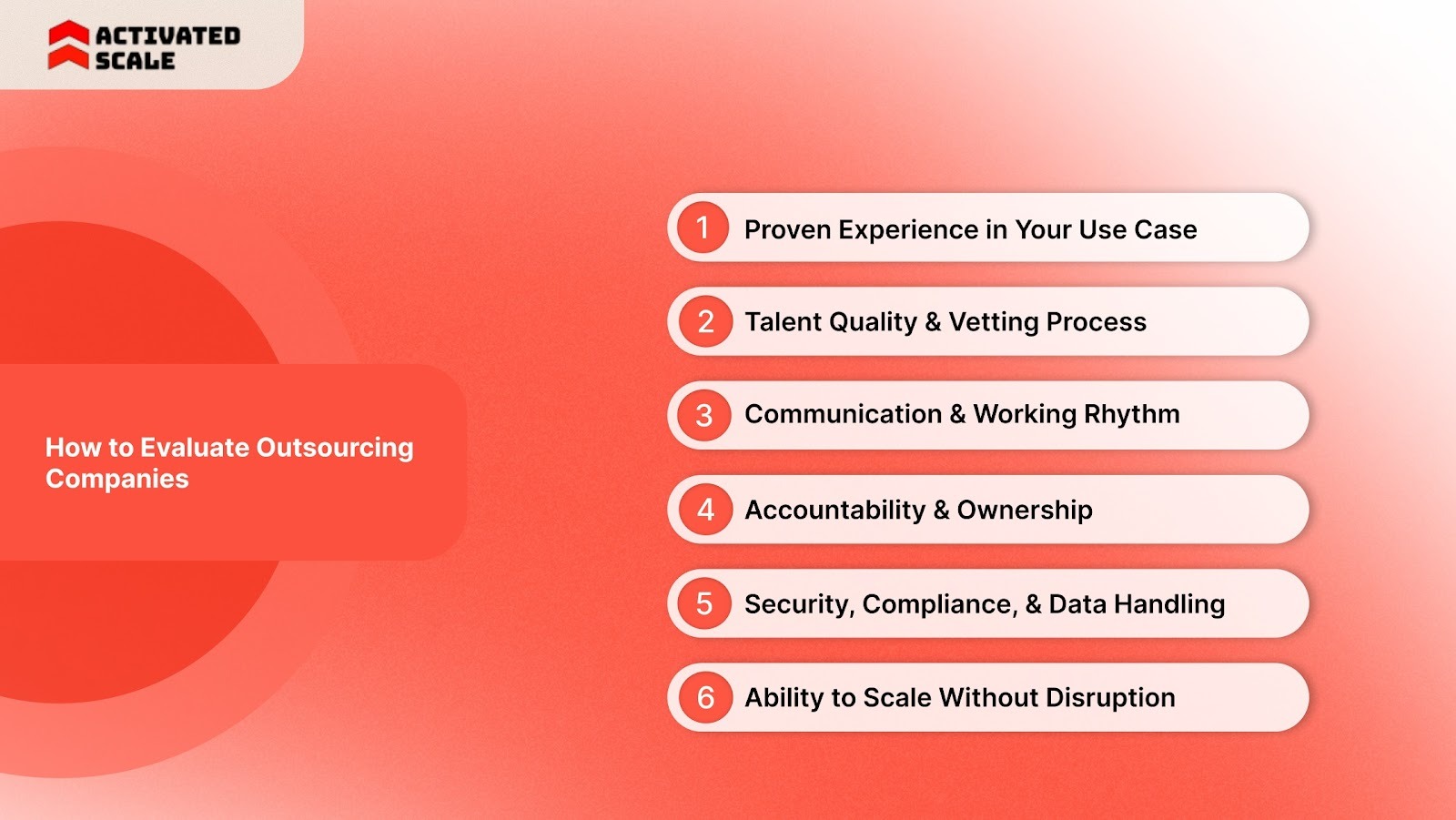
1. Proven Experience in Your Use Case
Experience matters, but relevance matters more. A provider may have strong credentials and still struggle with your context.
Look for work that aligns with:
- Your company size or growth stage
- Similar delivery timelines and constraints
- Recent engagements, not legacy case studies
If they can’t clearly explain how they handled tradeoffs in similar situations, that experience won’t transfer cleanly.
2. Talent Quality and Vetting Process
Most problems trace back to who actually does the work. Titles and resumes don’t tell the full story.
Ask how talent is:
- Screened before being assigned
- Evaluated once work begins
- Replaced if performance slips
Strong outsourcing companies manage talent quality proactively. Weak ones react after delivery issues appear.
3. Communication and Working Rhythm
Execution slows down when communication is unclear. This shows up early.
Clarify:
- How often updates happen
- Who flags blockers and when
- How scope changes are communicated
If answers sound flexible but vague, expect delays and misalignment later.
4. Accountability and Ownership
Good outsourcing partners don’t wait for direction on everything. They know what they own.
You should hear clear answers on:
- Who is responsible for delivery outcomes
- How missed deadlines are handled
- What escalation looks like when priorities shift
Ambiguity here usually turns into finger-pointing mid-project.
5. Security, Compliance, and Data Handling
For US-based outsourcing, this isn’t optional. It should be explicit and documented.
Look for clarity around:
- Access control and data boundaries
- Industry-specific compliance standards
- Intellectual property ownership
If security is explained in broad terms, it likely isn’t well-governed.
6. Ability to Scale Without Disruption
Outsourcing rarely stays static. Scope changes. Teams grow. Priorities shift.
Ask how the provider handles:
- Adding or reducing capacity
- Knowledge transfer as people rotate
- Maintaining quality as work expands
The best companies design for change instead of improvising when it happens.
Many teams apply this same evaluation logic beyond traditional outsourcing. When execution quality matters but long-term commitment feels premature, they look for models that allow real-world testing before scaling.
That’s why approaches like those used by Activated Scale resonate with this checklist. Their hiring models let companies assess execution, communication, and ownership in live environments, before making permanent decisions.
US-Based vs Offshore Outsourcing , What Works Best in 2026
There’s no universal “better” option anymore. In 2026, the right choice depends on what you’re outsourcing, how closely it ties to core workflows, and how much coordination the work requires.
When US-Based Outsourcing Makes More Sense
US-based partners tend to work best when alignment and speed matter more than raw cost savings.
Typical use cases include:
- Work that requires frequent collaboration with internal teams
- Projects involving sensitive data, compliance, or IP
- Functions tied closely to product, revenue, or customer experience
- Teams operating on tight timelines with low tolerance for rework
The advantage isn’t just location. It’s shared working hours, clearer communication, and faster decision loops.
When Offshore Outsourcing Still Works Well
Offshore models remain effective for clearly defined, execution-heavy work.
They’re often a good fit when:
- Scope is stable and well-documented
- Output is measurable and repeatable
- Cost efficiency is a primary constraint
- Time-zone leverage adds value rather than friction
Offshore outsourcing struggles when requirements shift frequently or when work depends on constant context sharing.
Hybrid Models Are Becoming the Default
Many teams now combine both approaches.
A common setup:
- US-based partners handle leadership, coordination, and high-context decisions
- Offshore teams support execution where process is clear and repeatable
This model reduces risk while preserving cost efficiency, but only when ownership and handoffs are clearly defined.
In 2026, the best outsourcing strategy isn’t about geography. It’s about choosing the model that minimizes friction for the work you’re actually outsourcing.
Learn more about: 7 Essential Steps for Successful Outsourcing Strategies
Common Red Flags to Avoid When Choosing an Outsourcing Company
This section exists for one reason: most outsourcing failures are predictable. The warning signs usually appear early, but they’re easy to ignore when timelines are tight or pitches sound convincing.
Knowing what not to overlook can save months of rework and internal frustration.
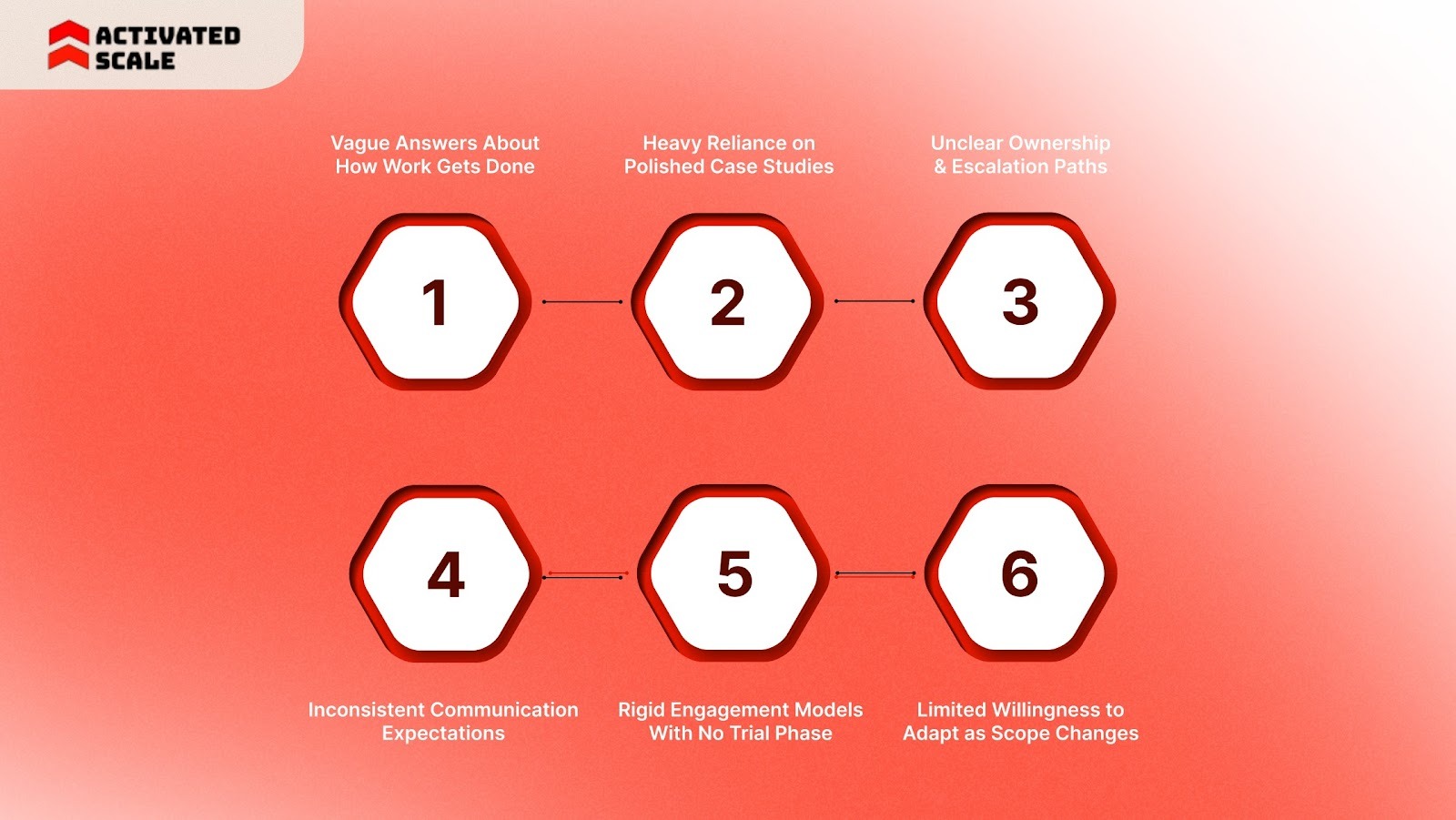
Vague Answers About How Work Gets Done
If a provider struggles to explain their delivery process in plain terms, that ambiguity will show up during execution. You should clearly understand how tasks are assigned, reviewed, and completed. A lack of clarity here often leads to missed expectations and slow progress.
Heavy Reliance on Polished Case Studies
Case studies are useful, but they shouldn’t replace real discussion. Strong outsourcing partners can talk openly about what didn’t go perfectly and how they handled constraints. When everything sounds flawless, it usually means details are being skipped.
Unclear Ownership and Escalation Paths
Outsourcing works only when responsibility is defined. If it’s unclear who owns delivery, quality, or timelines, problems will bounce between teams. You should know exactly who steps in when priorities change or blockers appear.
Inconsistent Communication Expectations
Execution slows when communication rules aren’t set early. If update frequency, response times, or points of contact vary by situation, coordination will break down. Clear communication standards are a requirement, not a preference.
Rigid Engagement Models With No Trial Phase
Long-term commitments without a validation phase increase risk. One-size-fits-all contracts often benefit the provider more than the client. In 2026, flexibility is a signal of confidence, not weakness.
Limited Willingness to Adapt as Scope Changes
Outsourcing rarely stays static. Providers who resist scope changes, team adjustments, or evolving priorities often become bottlenecks instead of partners.
The common thread across these red flags is lack of accountability. When execution can’t be tested early, companies end up paying for assumptions instead of results.
That’s why many teams now prefer outsourcing models that allow real-world validation before long-term commitment. This mindset applies across functions. For example, some companies approach sales execution the same way, using contract-to-hire or fractional roles, such as those offered by Activated Scale, to evaluate performance before scaling engagement.
How Flexible Talent Models Complement Modern Outsourcing
In 2026, many teams are rethinking outsourcing as a rigid, all-or-nothing decision. Instead of handing off entire functions, they’re separating strategy, execution, and commitment, and scaling each at a different pace.
That’s where flexible talent models come in.
Rather than outsourcing broadly, companies increasingly test execution in smaller, controlled ways. This reduces risk, shortens feedback loops, and makes performance easier to evaluate. The same logic applies whether the work is technical, operational, or revenue-driven.
Activated Scale operates on this principle for sales and go-to-market roles. Instead of pushing companies into long-term hires, it allows teams to engage experienced, U.S.-based sales professionals through flexible formats:
- Contract-to-Hire Sales Recruiting – Test real sales execution before making a full-time decision
- Fractional Selling – Add experienced SDRs or AEs to drive pipeline without expanding permanent headcount
- Fractional Sales Leadership – Bring in senior sales leadership to set direction, build process, and guide teams during key growth phases
This model aligns with what companies increasingly expect from outsourcing partners: clear ownership, measurable outcomes, and the ability to scale only when results justify it.
For teams evaluating outsourcing companies in 2026, the takeaway is simple. The best partners don’t ask for blind commitment. They create room to validate execution first, then earn the right to grow the relationship.
Choose Partners That Earn Scale, Not Promise It
Finding the right outsourcing company in 2026 is less about chasing cost savings and more about reducing risk. The strongest partnerships start with clarity, move through small, testable engagements, and scale only after results are visible. U.S.-based providers stand out when accountability, communication, and data security matter, but even then, selection discipline matters more than logos or rankings.
The goal isn’t to outsource faster. It’s to outsource smarter.
If part of what you’re evaluating includes revenue execution or go-to-market support, Activated Scale follows the same principle modern buyers expect from outsourcing partners: validate performance first, then commit.
Explore how Activated Scale helps teams test execution before making long-term hiring decisions.
FAQs
1. What should I define before looking for outsourcing companies?
You should lock scope, ownership, success metrics, and decision authority first. Vendors perform better when expectations are concrete and measurable from day one.
2. Are U.S.-based outsourcing companies worth the higher cost?
Often, yes, when work involves sensitive data, close collaboration, or fast iteration. Higher hourly rates can be offset by fewer rework cycles and stronger accountability.
3. How do I verify an outsourcing company’s credibility?
Look beyond testimonials. Ask for recent case studies, client references in similar industries, and clarity on team structure, not just company branding.
4. Should I start with a long-term contract?
No. Pilot engagements or phased rollouts reduce risk and reveal execution quality early, before deeper commitment.
5. When does a flexible talent model make more sense than full outsourcing?
When outcomes are uncertain or leadership is still evolving. Fractional and contract-to-hire models allow validation without locking into long-term overhead.
The Ultimate Guide to Hiring a Salesperson!
Get the step-by-step guide to hiring, onboarding, and ensuring success!