_edi.png)
Most SaaS GTM plans don't fail because the product isn't strong. They fail because execution isn't structured.
According to McKinsey, companies with strong go-to-market alignment are up to 2.4 times more likely to outperform competitors in revenue growth.
For SaaS teams, this gap shows up as slow pipeline velocity, poor handoffs, and wasted spend across marketing and sales. A structured GTM strategy addresses this by aligning people, processes, and execution from the start.
This guide breaks down what a structured SaaS GTM approach delivers and why it's critical for predictable growth.
TL;DR
- A structured SaaS GTM strategy turns launches and campaigns into a repeatable revenue system.
- Clear lead ownership and routing reduce response time and accelerate pipeline creation.
- Buyer-aligned messaging improves full-funnel conversion and reduces early deal drop-off.
- Focused targeting lowers CAC by concentrating spend on high-LTV, ICP-fit segments.
- Flexible GTM execution allows teams to adapt quickly as markets, products, or sales motions change.
What a SaaS Go-to-Market Strategy Actually Defines
A SaaS go-to-market strategy explains how a product reaches the right customers and turns demand into revenue. It sets the structure for who you target, how you position the product, and how prospects move from first interaction to long-term customer.
A strong GTM strategy connects product-market fit to execution. It aligns messaging, channels, buyer journeys, and pipeline expectations so marketing and sales operate with the same assumptions. Without that alignment, growth depends on guesswork instead of repeatable motion.
Unlike a launch plan, a SaaS GTM strategy is designed to change. Teams refine it as segments evolve, pricing shifts, or data reveals what actually drives conversions. The focus stays on learning fast and adjusting before inefficiencies scale.
The most effective GTM strategies function as shared operating systems. Product, marketing, sales, and RevOps operate within the same framework, keeping execution clear as the business grows.
The Building Blocks of a High-Performing SaaS GTM System
A strong SaaS GTM strategy works as a system, not a checklist. Each element reinforces the next, targeting informs messaging, messaging shapes channels, channels drive pipeline, and data closes the loop. When these pieces connect, GTM becomes repeatable instead of reactive.
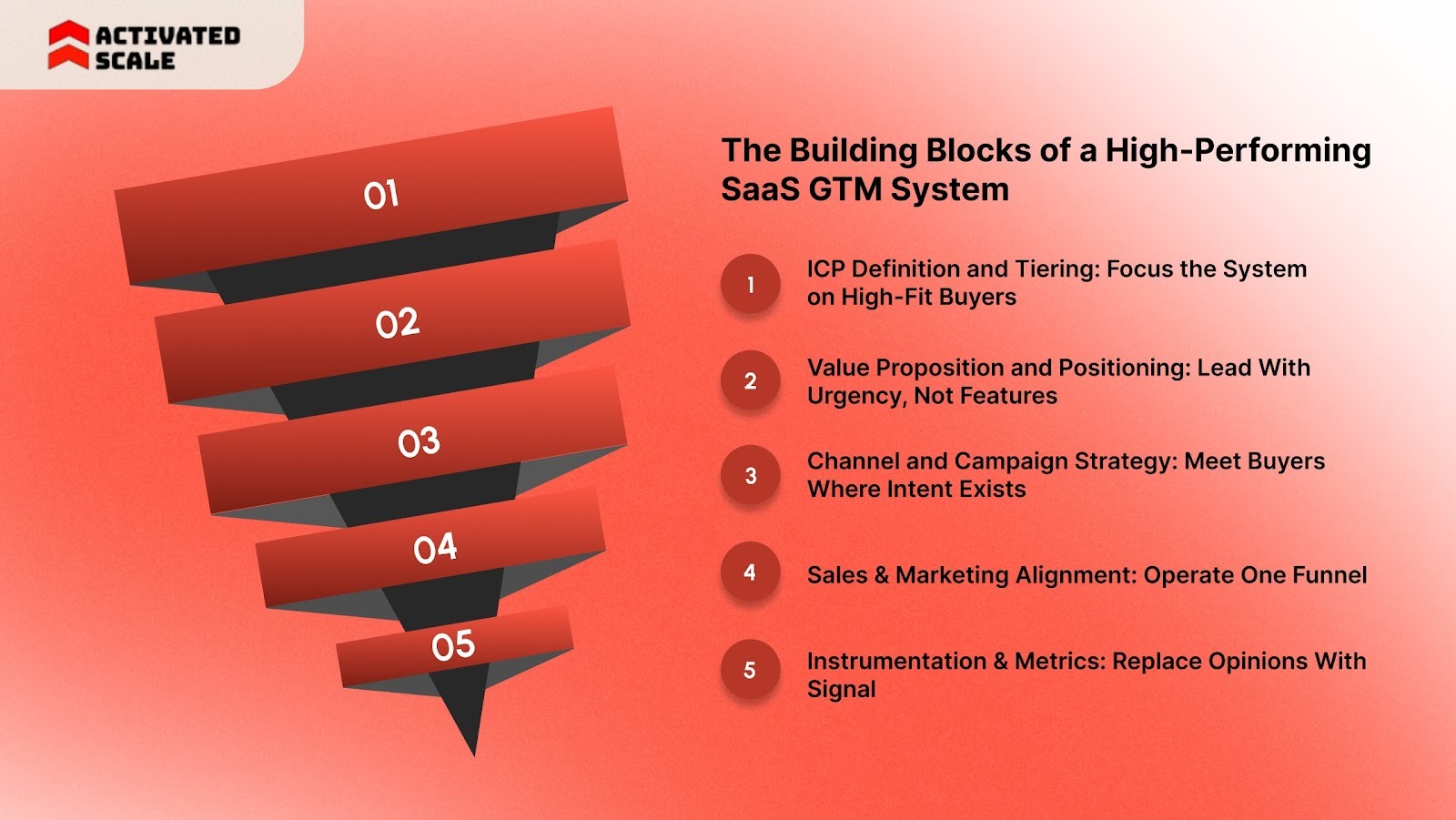
1. ICP Definition and Tiering: Focus the System on High-Fit Buyers
Everything in GTM depends on knowing who you're selling to. A clear ICP model defines the traits, signals, and context that separate high-fit buyers from the rest of the market.
High-performing teams go further by tiering their ICP. Tier 1 accounts get priority outreach and sales coverage. Tier 2 accounts are worked on selectively. Tier 3 accounts enter nurture flows only. This keeps messaging, routing, and effort aligned with revenue potential.
Ownership: Marketing, RevOps
Supports: Targeting, routing, campaign sequencing
2. Value Proposition and Positioning: Lead With Urgency, Not Features
Positioning answers a simple question: why buy now? It connects your product to a real problem, a clear outcome, and a moment of urgency.
Strong GTM teams ground messaging in customer language and real buying triggers. Sales should be able to explain the value in seconds without listing features. When positioning is clear, campaigns convert better, and sales conversations stay focused.
Ownership: Product marketing, sales enablement
Supports: Messaging, sales narratives, conversion
3. Channel and Campaign Strategy: Meet Buyers Where Intent Exists
Effective GTM isn't about being everywhere. It's about choosing channels that match your ICP and sales motion, then tailoring messages to each stage of the journey.
Whether inbound, outbound, or product-led, campaigns should be tested by segment and doubled down where the signal is strongest. The goal isn't reach. Its relevance at the right moment.
Ownership: Demand generation, lifecycle marketing, SDR leadership
Supports: Pipeline creation, experimentation, scale
4. Sales and Marketing Alignment: Operate One Funnel
Misalignment creates friction fast. Leads stall, attribution breaks, and teams debate definitions instead of moving deals forward.
Top GTM teams define shared funnel stages, entry and exit criteria, and SLAs across marketing, sales, and RevOps. The pipeline becomes a single motion with shared accountability, not a series of handoffs.
Ownership: RevOps
Supports: Conversion, forecasting, execution clarity
5. Instrumentation and Metrics: Replace Opinions With Signal
GTM only improves when performance is visible. That means defining KPIs across each funnel stage and segmenting results by ICP tier, channel, and motion.
Dashboards should explain what's working, where deals slow down, and why. Teams that build feedback loops early fix issues before they show up in missed targets.
Ownership: RevOps, GTM leadership
Supports: Decision-making, optimization, scale
Learn more about: International Sales Representative Career Progression Guide
A Practical Process for Building a SaaS GTM Strategy
A GTM strategy doesn't come together in a single planning session. It's built by validating who actually buys, aligning execution to real buyer behavior, and tightening the system as signals emerge. The process below reflects how SaaS GTM and RevOps teams scale what works and course-correct early.
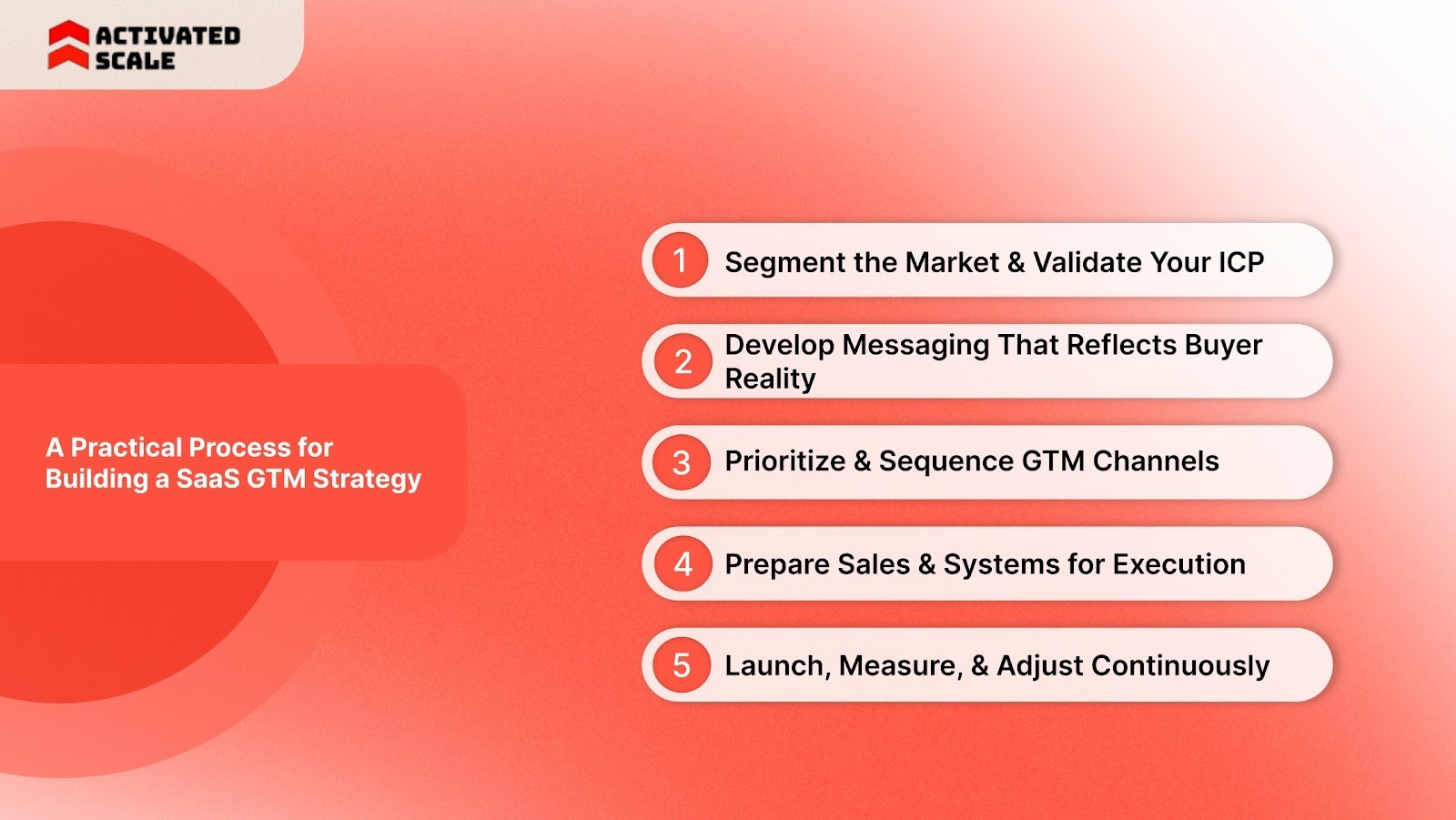
1. Segment the Market and Validate Your ICP
Start by breaking your total addressable market into usable segments, not theoretical ones. Use firmographics, technographics, and observable intent signals to narrow focus.
Then analyze your most recent closed-won deals. Look for shared patterns such as time-to-close, expansion potential, support load, and lifetime value. This keeps the ICP grounded in buyer reality rather than assumptions.
A tiered ICP model helps prioritize effort:
- Tier 1: High urgency, high LTV, sales-led focus
- Tier 2: Moderate fit or interest, nurture or product-led paths
- Tier 3: Low fit or low intent, deprioritize
The goal is clarity on where GTM resources should, and should not, be spent.
2. Develop Messaging That Reflects Buyer Reality
Effective GTM messaging starts with buyer problems, not product features. Use sales calls, discovery notes, and customer interviews to understand what buyers are trying to solve and what blocks progress.
Create a small set of messaging pillars per ICP segment, each tied to a specific, urgent outcome. Messaging should be simple enough that a champion can repeat it internally without translation.
Validate messaging through:
- SDR and AE adoption in live conversations
- Outbound and ad performance
- Discovery calls and objection handling
If sales teams won't use the language, it won't convert.
3. Prioritize and Sequence GTM Channels
Channel success depends on fit, not volume. Before launching, assess where each ICP segment actually engages and whether the channel supports your GTM motion.
Focus on one or two primary channels per segment. Measure early indicators such as response rates, demo conversions, or qualified pipeline before expanding.
Channel discipline matters more than channel count. One well-matched channel with the right message will outperform broad, unfocused distribution.
4. Prepare Sales and Systems for Execution
A GTM strategy fails when execution isn't operationally supported. Sales teams need clear deal stages, defined entry and exit criteria, and immediate access to the right content.
Operational readiness includes:
- Lifecycle stages that match buyer behavior
- Clear ownership across marketing, SDRs, and AEs
- Routing rules based on ICP fit and intent
- Visibility into stalled deals and drop-offs
This is often where teams bring in experienced GTM operators to quickly install structure. Flexible models, such as those offered by Activated Scale, help teams strengthen execution without committing to full-time hires before the motion is proven.
5. Launch, Measure, and Adjust Continuously
Start with a controlled GTM pilot. Limit scope by segment, region, or use case, and instrument the full funnel from first touch to close.
Review performance weekly with GTM leadership. Look for conversion gaps, velocity slowdowns, and signals that indicate whether a motion should scale or stop.
GTM success comes from learning faster than the market, not from launching perfectly.
How GTM Execution Differs Between B2B and B2C SaaS
The fundamentals of a GTM strategy, defining your ICP, sharpening your value proposition, and choosing the right channels, remain the same across SaaS. What changes is how those elements are executed, depending on whether you sell to businesses or consumers.
This distinction matters early. GTM assumptions that work in B2C often break in B2B, and vice versa. The difference shows up in sales motion, success metrics, tooling, and team structure.
B2B SaaS GTM Execution
B2B SaaS GTM is built around complex buying processes and longer decision cycles. Deals often involve multiple stakeholders across functions, with security, legal, and budget reviews shaping velocity.
Key characteristics include:
- Multi-threaded sales cycles with defined buying committees
- Account-based marketing, outbound SDR motions, partner channels, and enterprise sales teams
- Strong sales enablement tied to the deal stage and persona needs
- Focus on pipeline coverage, sales velocity, win rate, and expansion paths
- GTM stacks centered on CRM, sales engagement, intent data, and deal collaboration tools
Execution here depends heavily on sales discipline and cross-team coordination.
B2C SaaS GTM Execution
B2C SaaS GTM prioritizes speed and scale. The goal is to reduce friction, accelerate adoption, and convert usage into revenue through product-led growth.
Typical traits include:
- High-volume, self-serve onboarding with short conversion cycles
- Freemium models, viral loops, paid acquisition, and creator or influencer partnerships
- Heavy emphasis on activation, retention, and monetization experiments
- Core KPIs centered on user growth, churn, CAC: LTV, and time-to-value
- Analytics and product usage tools form the backbone of the GTM stack
Here, the product carries most of the GTM load.
B2B vs B2C SaaS GTM: Quick Comparison
Most SaaS companies blend B2B and B2C motions over time. But early GTM success depends on knowing which motion you're leading with. Clarity here prevents channel confusion, misaligned KPIs, and premature hiring decisions.
Also read: Market Development Representative vs Other Sales Roles
Why a Structured SaaS GTM Strategy Delivers Better Results
A structured go-to-market strategy is more than a launch checklist. It's the operating system that helps SaaS teams turn demand into repeatable revenue. When GTM is designed intentionally, teams move faster, spend smarter, and stay aligned as they scale.
Faster Time to Revenue Through Clear Lead Ownership
Speed improves when lead routing, qualification, and follow-up are defined upfront. High-intent prospects reach the right reps quickly, SDRs focus on ICP-fit accounts, and handoffs don’t stall in queues. The result is shorter response times and faster pipeline creation.
This is often where teams lean on fractional or contract-to-hire sales models to avoid delays caused by understaffed or misaligned sales functions.
Stronger Funnel Conversion From Buyer-Aligned Messaging
When messaging reflects real buyer behavior, fewer deals drop off early. Content, campaigns, and outreach align with each segment's journey stage. Buyers get relevance sooner, and sales enter conversations with context instead of guesswork.
A clear GTM structure makes it easier for SDRs and AEs, whether full-time or fractional, to execute consistently without reinventing the pitch.
Lower CAC and Quicker Payback Through Focused Targeting
A structured GTM approach forces clarity on who converts, who doesn't, and why. Teams invest in segments with strong lifetime value and predictable sales cycles. Spend shifts from volume to efficiency, reducing wasted effort across marketing and sales.
Many SaaS teams apply this discipline by testing execution before committing to permanent hires, using flexible models like contract-to-hire recruiting to validate impact early.
Cross-Functional Clarity That Prevents Friction
Shared funnel definitions, clear SLAs, and consistent metrics keep marketing, sales, product, and RevOps aligned. Pipeline reviews focus on improvement instead of blame. Ownership stays clear, and execution becomes more disciplined.
This is where experienced sales leadership matters. Teams often bring in fractional sales leaders to establish cadence, define ownership, and keep GTM execution tight across functions.
Built-In Flexibility as the Market Changes
A well-structured GTM system is testable by design. Teams can adjust positioning, channels, or sales motion without resetting everything. Whether launching a new product or shifting from PLG to sales-assisted growth, decisions are guided by data, not assumptions.
That flexibility is why many SaaS founders work with platforms like Activated Scale to scale GTM execution without locking into decisions too early.
Structure Is What Makes GTM Scale
A strong SaaS GTM strategy isn't about doing more. It's about doing the right things consistently, with clear ownership and tight execution.
When GTM is structured, teams move faster without chaos. Spend becomes intentional. Pipeline reviews become feedback loops rather than post-mortems. Most importantly, growth becomes easier to predict and easier to repeat.
Many founders apply this same discipline when scaling sales execution. Instead of committing too early, they validate what works first and scale with clarity.
If you're building or refining your SaaS GTM strategy, let's connect to discuss which execution support makes sense for your stage.
FAQs
1. What is a SaaS GTM strategy?
A SaaS go-to-market strategy defines how a company brings its product to market, including targeting, positioning, demand generation, sales motion, and execution ownership.
2. Why do SaaS GTM strategies fail?
Most fail due to misalignment between marketing, sales, and product. Without a clear structure, handoffs break down and execution becomes inconsistent.
3. How early should SaaS companies define a GTM strategy?
As soon as there's real customer traction. Waiting too long leads to reactive decisions, wasted spend, and slower learning.
4. Can the GTM strategy change over time?
Yes. Strong GTM strategies are designed to be testable. Teams often evolve from founder-led sales to SDR-led or from PLG to sales-assisted models.
5. How do SaaS teams resource GTM execution?
Some hire full-time early. Others use fractional or contract-to-hire models to validate roles, messaging, and the sales motion before committing to a long-term engagement.
The Ultimate Guide to Hiring a Salesperson!
Get the step-by-step guide to hiring, onboarding, and ensuring success!