_edi.png)
Onboarding used to be straightforward. Teams sat in the same room, processes evolved organically, and new hires learned by osmosis. That reality no longer exists for fast-scaling startups and SaaS companies. Distributed teams, tighter hiring timelines, and pressure to show results early have made onboarding harder to execute and costlier to get wrong.
As a result, more companies are turning to outsourced onboarding to move faster, stay flexible, and reduce the risk of early mis-hires. But this introduces a real trade-off: efficiency versus control. Handing off onboarding can save time, yet poor execution can dilute accountability and slow ramp-up.
This guide is built for founders and revenue leaders who want practical answers on how to implement outsourced onboarding, avoid common pitfalls, and make it work for them.
Quick Overview
- Outsourced onboarding is a strategic way to increase speed and consistency during growth, not a replacement for internal ownership.
- It works best when success is defined upfront and tied to real business outcomes, not onboarding checklists.
- Repeatable, revenue-impacting roles, especially sales, benefit the most from structured external onboarding support.
- Standardizing tools and processes while customizing role-specific context shortens ramp time and reduces early friction.
- Teams that measure time-to-productivity and stay actively involved see better results than those that fully hand off onboarding.
What Is Outsourced Onboarding?
Outsourced onboarding is the practice of partnering with an external provider to manage parts of the onboarding process, while the company retains ownership of performance and outcomes. Instead of building every workflow internally, teams rely on proven frameworks to handle setup, training structure, and early enablement.
The goal isn’t to remove leadership from onboarding, but to reduce friction and shorten ramp time, especially when hiring quickly. For startups and SaaS teams, outsourced onboarding brings consistency and speed to a process that often breaks under growth pressure.
Also, Check: The New Rules for Recruiting Salespeople for 2026.
Is Outsourced Onboarding Right for Your Business?
Outsourced onboarding makes sense when speed, consistency, and focus matter more than building everything internally. For founders and revenue leaders, the decision usually comes down to a few aspects mentioned below:
Ask yourself:
- How fast do new hires need to become productive? If delays affect pipeline, revenue, or delivery, structured onboarding helps.
- Do we have the time and people to onboard well today? Onboarding often suffers when teams are stretched thin.
- Are the roles repeatable? Standardized roles benefit more from external onboarding support than highly bespoke ones.
If your team is scaling quickly, juggling multiple hires, or onboarding revenue roles under tight timelines, outsourced onboarding can remove friction and create consistency where ad-hoc processes fall short.
A Step-by-Step Framework for High-Impact Outsourced Onboarding
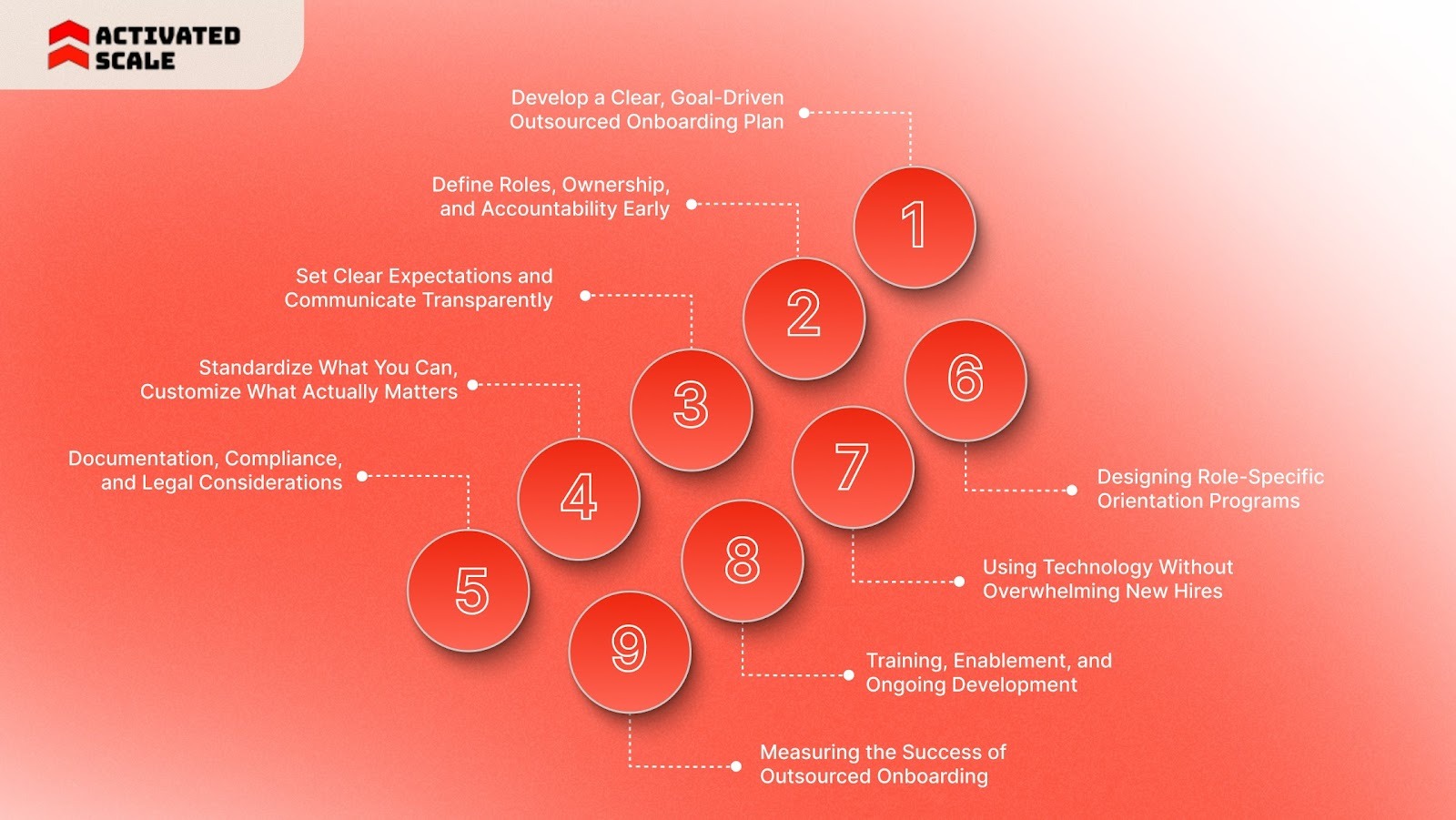
Outsourced onboarding delivers results when it’s built with intention. This framework breaks the process into clear, actionable steps that help teams move fast, stay aligned, and keep ownership where it matters.
Step 1: Develop a Comprehensive Outsourced Onboarding Plan with Clear Objectives
Outsourced onboarding breaks down when companies start with activities instead of outcomes. Before anyone joins, define what success actually looks like in the role apart from what needs to be “covered” during onboarding.
Start by working backward from business goals:
- What should this hire own within the first quarter?
- Which activities directly move revenue, delivery, or customer outcomes?
- What knowledge is essential versus “nice to have”?
For revenue roles, vague goals slow ramp. Be explicit about expectations at each stage:
- 30 days: Systems access, process understanding, first execution attempts
- 60 days: Independent execution, early pipeline or output
- 90 days: Predictable performance tied to targets
A clear plan keeps outsourced onboarding focused on speed to impact, not completeness.
Step 2: Define Roles, Ownership, and Accountability Early
Outsourced onboarding doesn’t eliminate internal responsibility, but it changes how it’s shared. Without clear ownership, feedback gets delayed and progress stalls.
Establish ownership upfront:
- Internal onboarding owner: Accountable for results and decision-making
- Direct manager: Sets priorities, reviews performance, and unblocks issues
- HR or Ops: Manages access, contracts, and compliance
- External partner: Executes onboarding tasks and enablement workflows
One practical rule to remember is that if something goes wrong, there should be no confusion about who fixes it. Assign one owner per onboarding outcome, not per task.
Recommended: 6 Steps to Managing a Remote Sales Team.
Step 3: Set Clear Expectations and Communicate Transparently
Outsourced hires don’t benefit from hallway conversations or passive context. Everything important must be made explicit.
On day one, clarify the following:
- What success looks like in practical terms
- Which decisions can they make independently
- Where should they escalate questions or blockers
Communication often fails when teams assume “we’ll figure it out as we go.” Instead, define:
- Weekly check-ins with a clear agenda
- Early feedback loops during the first 30 days
- A process for correcting misalignment quickly
Clear expectations reduce rework and prevent early frustration on both sides.
Step 4: Standardize What You Can, Customize What Actually Matters
Standardization saves time, but only when applied to the right areas. Over-standardizing role context creates confusion instead of clarity.
Standardize foundational elements:
- Tools and system access
- Policies and security requirements
- Core workflows that don’t change by role
Customize high-impact areas:
- Role-specific training
- Sales motions and handoff points
- Buyer personas and messaging
The goal is consistency without rigidity. When onboarding ignores role nuance, ramp time stretches, and performance suffers.
Also Read: Pros and Cons of Staffing Agencies.
Step 5: Documentation, Compliance, and Legal Considerations
Outsourced onboarding adds complexity to documentation and compliance, especially for U.S.-based teams. Assumptions here create risk.
Key areas to lock down:
- Contracts, NDAs, and role scope clarity
- Proper worker classification and access controls
- Documentation, ownership, and storage
Even with an external partner, the company remains responsible for compliance. Clear handoffs and documented processes reduce errors that often surface later, when they’re harder to fix.
Step 6: Designing Role-Specific Orientation Programs
Orientation should prepare hires to perform, not overwhelm them with information. Generic orientation fails outsourced hires because it ignores role reality.
For example:
- Fractional SDR: Outreach tools, ICP clarity, messaging frameworks, meeting criteria
- Fractional VP of Sales: Revenue goals, team structure, decision authority, reporting expectations
Effective orientation answers one question: What do I need to succeed in this role right now? Everything else can wait.
Step 7: Using Technology Without Overwhelming New Hires
Technology should support onboarding, not dominate it. Too many tools, too early, slow momentum.
Best practices include:
- Sequencing tool access based on role readiness
- Using onboarding platforms for structure, not micromanagement
- Offering self-service resources alongside guided sessions
Avoid dumping logins and documentation on day one. Introduce systems as responsibility grows to keep focus on execution.
Recommended read: 24 Best Tools for Effective Sales Outsourcing.
Step 8: Training, Enablement, and Ongoing Development
Onboarding sets the foundation, but proper training and enablement help sustain the performance. This is especially true for outsourced sales roles.
Strong enablement includes:
- Role-specific training tied to real scenarios
- Shadowing and live feedback, not just recorded content
- Regular reviews to reinforce what’s working and adjust fast
Ongoing development keeps outsourced hires aligned with evolving goals and prevents early drop-off in performance.
Step 9: Measuring the Success of Outsourced Onboarding
If onboarding success isn’t measured, it’s guessed. Completion metrics alone don’t reflect impact.
Track important outcomes such as :
- Time-to-productivity
- Ramp speed compared to internal benchmarks
- Early performance indicators
- Retention in the first 90 days
Use these insights to refine onboarding and improve future hires. Measuring outcomes also signals trust, showing outsourced talent that performance, not process, is what drives decisions.
A well-built onboarding framework creates clarity, accountability, and momentum. It helps teams move faster without losing control. But for sales hiring, the starting point matters as much as the process itself.
What if, instead of outsourcing onboarding from scratch, you started with pre-vetted sales professionals who already know how to operate?
Where Activated Scale Fits into Outsourced Onboarding
Onboarding sales talent comes with a different set of pressures. Ramp time affects pipeline, early misalignment shows up in missed targets, and poor onboarding compounds quickly when teams are scaling. Unlike many roles, sales hires need to understand buyers, messaging, tools, and internal processes almost immediately to be effective.
This is why, instead of outsourced onboarding, you can opt for pre-vetted, U.S.-based sales professionals. Experienced reps require less foundational training, adapt faster to American buyers, and integrate more smoothly into existing sales motions.
Activated Scale supports smoother onboarding by matching companies with sales talent that’s already familiar with modern GTM environments:
- Fractional SDRs who can plug into outreach tools, follow defined ICPs, and contribute to the pipeline quickly
- Fractional AEs who understand full-cycle sales and reduce dependency on heavy hand-holding
- Contract-to-hire sales roles that allow teams to validate fit and performance before committing long-term
The outcome is a shorter ramp, fewer onboarding gaps, and sales hires who contribute faster, without forcing teams to build everything from scratch. Let’s talk today to help you get a qualified sales team!
Final Thoughts
Outsourced onboarding reflects how teams scale faster, leaner, and with less room for error. When approached deliberately, it brings structure, shortens ramp time, and protects internal focus without losing accountability.
Execution still matters most. Clear ownership, aligned expectations, and outcome-based measurement determine whether onboarding accelerates growth or creates friction. For teams expanding sales capacity, starting with experienced professionals can reduce onboarding lift altogether.
Activated Scale connects companies with pre-vetted, U.S.-based sales talent built for faster impact and lower hiring risk. If you’re planning your next sales hire, schedule a meeting with our team to explore how this approach can work for your team.
FAQs
1. How long does outsourced onboarding typically take?
Outsourced onboarding timelines vary by role and experience level. For standardized roles, initial onboarding can take one to two weeks, followed by a defined ramp period. Experienced sales professionals often reach productivity faster because they require less foundational training.
2. Does outsourced onboarding work for early-stage startups?
Yes, but only when expectations are clear. Early-stage teams benefit most when outsourced onboarding brings structure they don’t yet have, rather than trying to replace leadership or strategy that’s still forming.
3. Can outsourced onboarding be scaled across multiple hires at once?
Outsourced onboarding is particularly effective during hiring bursts. Structured processes and repeatable frameworks make it easier to onboard multiple roles consistently without overwhelming internal teams.
4. How do you protect company culture during outsourced onboarding?
Culture isn’t transferred through documentation alone. Companies should retain ownership of values, decision-making norms, and team interactions, while using outsourced onboarding for execution and enablement support.
5. What should be in place before starting outsourced onboarding?
At a minimum, teams should have defined role expectations, success metrics, and an internal owner. Without these, even the best onboarding support will struggle to deliver results.
The Ultimate Guide to Hiring a Salesperson!
Get the step-by-step guide to hiring, onboarding, and ensuring success!