_edi.png)

As companies scale, revenue costs typically don't spike due to overspending. They rise because execution becomes inefficient. Disconnected teams, inconsistent data, and manual work quietly increase the cost of acquiring and retaining revenue.
According to IBM, poor data quality costs organizations an average of $12.9 million per year due to inefficiencies, rework, and missed opportunities.
In a growing business, these costs often fall within revenue operations, overly complex tech stacks, unreliable forecasts, wasted pipeline effort, and duplicated work across sales, marketing, and customer success.
Revenue operations strategies focus on reducing this hidden cost. By aligning execution, standardizing processes, and creating a single source of truth, RevOps helps companies lower revenue-related expenses while continuing to scale.
Core takeaways
- Revenue operations costs increase as companies scale because execution becomes fragmented, not because teams intentionally overspend.
- Hidden costs often come from duplicated work, inefficient pipeline effort, unreliable forecasts, and bloated tool stacks.
- Revenue operations reduces cost by standardizing ownership, improving qualification, tightening handoffs, and governing data at the source.
- The biggest cost savings show up in lower CAC, reduced cost per deal, shorter sales cycles, and improved revenue per rep.
- RevOps cost control works best when focused on execution discipline rather than adding more tools or processes.
- Flexible execution models help scaleups improve RevOps efficiency without locking into high fixed overhead too early.
Why Revenue Costs Increase as Companies Scale
Revenue costs rise with growth because execution gets heavier, not because teams are careless. More deals, more tools, and more people introduce friction that's easy to miss.
As teams scale, work gets duplicated. The same data is pulled into different reports. The same deals are reviewed multiple times. Each handoff adds effort without adding value.
The pipeline effort also becomes less efficient. Without clear qualification rules, teams spend time on deals that stall or churn, quietly increasing the cost of revenue without improving results.
Forecasting adds another layer. When forecasts can't be trusted, companies over-hire, over-spend, or react too late. Those decisions drive revenue operations costs well before they appear on the balance sheet.
Without a system to control execution, growth amplifies waste. RevOps exists to keep that waste from becoming permanent.
What "Revenue Operations Cost" Actually Refers To
Revenue operations cost is the price of friction in revenue execution. It's what you pay when revenue doesn't move cleanly from first touch to renewal.
Some costs are obvious: licenses, headcount, and vendors. The more expensive ones are embedded in daily work. They show up when teams spend hours reconciling numbers before a forecast call, when reps chase deals that were never a fit, or when closed customers stall because expectations weren't handed off correctly.
In real terms, revenue operations cost includes:
- Tools exist because teams don't trust shared systems.
- Time lost correcting CRM data, rebuilding reports, or rechecking the pipeline.
- Sales effort wasted on deals that should have been disqualified earlier.
- Revenue delays are caused by slow approvals or unclear ownership.
- Margin erosion from churn or expansion is tied to poor transitions.
These costs don't spike overnight. They accumulate quietly as volume grows. RevOps exists to surface and remove this friction before it becomes structural.
Understanding revenue operations costs means tracking the effort required to drive revenue, not just the revenue that comes in.
Also read: What is a Sourcing Agency and Why You Need One
How Revenue Operations Reduces Cost Leakage
Revenue operations reduces cost leakage by fixing the points where execution quietly becomes expensive. It doesn't lower costs by cutting resources; it lowers costs by preventing wasted effort.
The biggest cost leaks RevOps addresses include:

- Poor qualification alignment: When teams don't agree on what a qualified deal looks like, sales time and marketing spend are wasted on opportunities that stall or churn early. RevOps enforces shared criteria so effort is focused on deals with real revenue potential.
- Broken or slow handoffs: Lost context between marketing, sales, and customer success leads to rework, delays, and customer friction. RevOps defines what must transfer at each stage, reducing downstream fixes that increase cost per deal.
- Process drift and exceptions: As scale increases, approvals, pricing, and deal workflows often become inconsistent. RevOps standardizes execution so deals move without unnecessary delays or manual intervention.
- Unreliable data and reporting rework: Manual cleanup before forecasts and reviews consumes leadership time and slows decisions. RevOps governs data at the source, reducing late-stage corrections that drive poor spending decisions.
- Late discovery of inefficiency: Without a full lifecycle view, waste goes unnoticed. RevOps connects activity to outcomes, making it easier to identify where spending, time, and tools aren't producing returns.
By closing these gaps, RevOps lowers the true cost of revenue, not by doing less, but by making every unit of effort count.
Key Revenue Operations Cost-Reduction Levers
Revenue operations reduces cost by fixing the points where execution quietly becomes inefficient. The goal isn't complexity; it's control.
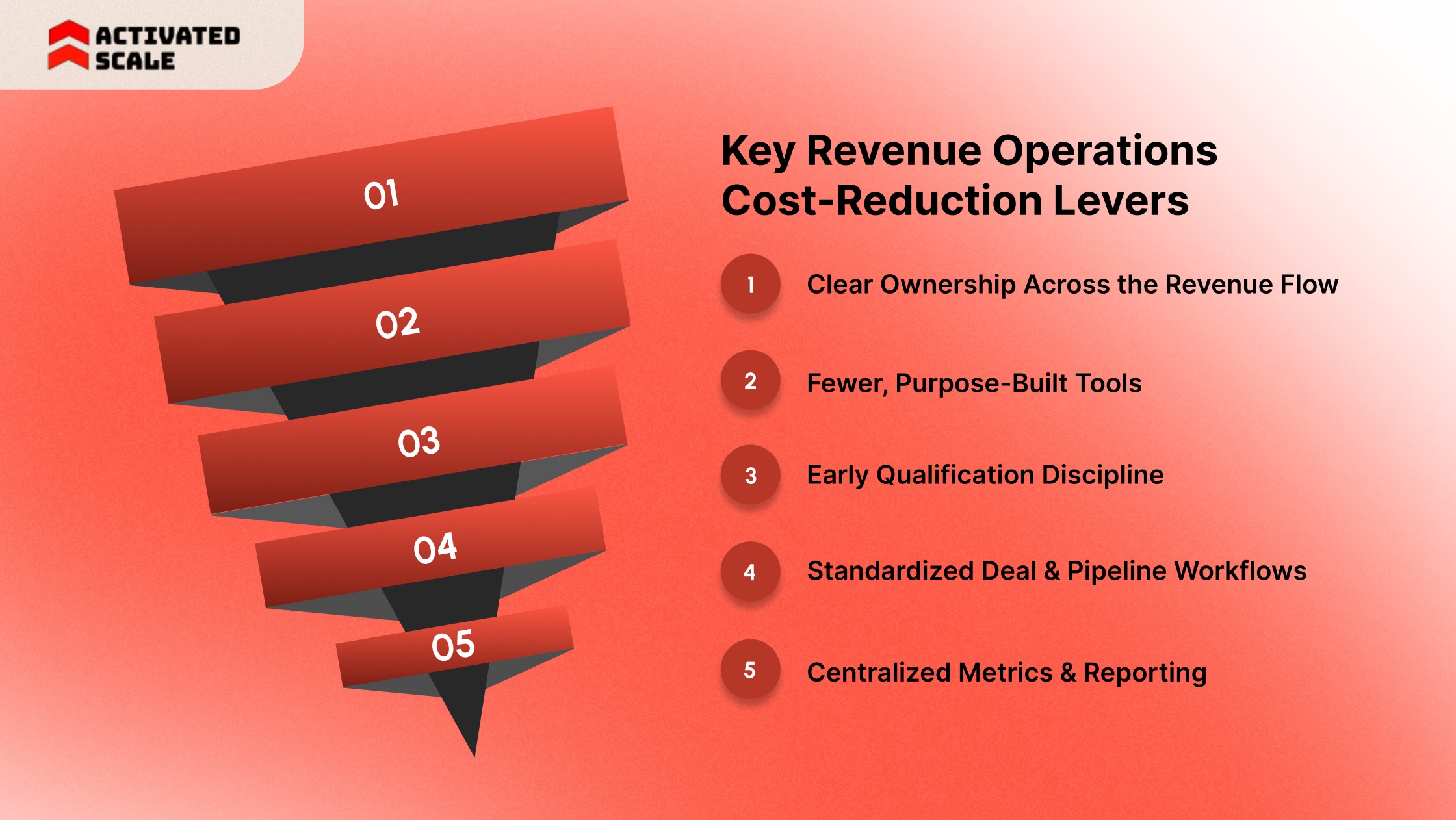
Clear Ownership Across the Revenue Flow
When ownership is unclear, work gets repeated, and decisions stall. RevOps defines who owns qualification, deal movement, forecasting, and post-sale handoffs. This alone reduces rework and shortens internal cycles that drive up costs as teams grow.
Fewer, Purpose-Built Tools
Many revenue teams overspend on tools because processes were never defined first. RevOps aligns tools to actual workflows, reducing license overlap and the ongoing cost of maintaining systems teams don't fully trust or use.
Early Qualification Discipline
Poorly qualified deals are expensive. They consume sales time, distort forecasts, and often churn after close. RevOps enforces shared qualification rules, so effort is focused on revenue that's more likely to convert and stick.
Standardized Deal and Pipeline Workflows
Exceptions slow everything down. RevOps standardizes how deals move, reducing approval delays, shortening sales cycles, and lowering the operational cost per deal.
Centralized Metrics and Reporting
When teams build their own reports, costs show up as time lost and slower decisions. RevOps defines metrics once and uses them consistently across the organization, reducing manual effort and preventing costly late-stage corrections.
These levers don't reduce cost by doing less. They reduce cost by making revenue execution cleaner, faster, and easier to manage as scale increases.
Learn more about: Remote Staff Augmentation for Future Work Strategies
Cost Metrics Revenue Operations Helps Improve
Revenue operations doesn't reduce cost in theory; it shows up in specific metrics that become easier to control once execution is aligned. These metrics make revenue cost visible and manageable as scale increases.

- Customer Acquisition Cost (CAC): RevOps lowers CAC by tightening qualification, reducing wasted pipeline effort, and improving handoffs. Fewer low-fit deals enter the funnel, and sales time is spent on higher-conversion opportunities.
- Cost per Deal Closed: Standardized workflows and faster approvals reduce the effort required to close each deal. When exceptions decline, the per-win operational cost decreases.
- Sales Cycle Cost: Shorter, more predictable sales cycles reduce the time and resources spent per opportunity. RevOps identifies where deals stall and removes friction that lengthens the deal cycle.
- Revenue per Rep: Clear processes and trusted data allow reps to spend more time selling and less time fixing issues. This increases output without increasing headcount.
- Churn-Related Cost: Better handoffs and clearer expectations reduce early churn and expansion misses. RevOps links post-sale outcomes to acquisition decisions, reducing the cost of lost revenue.
Together, these metrics show whether revenue is becoming more efficient, not just larger. RevOps helps teams improve them by design, not by accident.
When Flexible RevOps Execution Further Reduces Cost
For many scaleups, revenue operations costs rise not because teams are inefficient, but because execution outpaces internal capacity. The strategy is clear, but no one has the time or seniority to own RevOps day-to-day.
.jpg)
Activated Scale helps scaleups control RevOps cost by providing experienced, U.S.-based revenue operators without forcing premature full-time hires. Instead of adding fixed overhead, teams get targeted execution where it's needed most.
Their services support cost control by:
- Fractional Sales Leadership, giving scaleups senior ownership over RevOps execution without full-time expense.
- Contract-to-Hire Sales Recruiting, allowing teams to prove RevOps or revenue leadership impact before committing long-term.
- Fractional Selling, maintaining pipeline discipline and execution consistency while processes are being standardized.
This approach helps scaleups improve efficiency, protect margins, and scale RevOps deliberately, without locking in costs before the model is proven.
Conclusion
Reducing revenue operations cost isn't about cutting budgets or slowing growth. It's about removing the friction that makes revenue harder and more expensive to generate as complexity increases.
When teams share definitions, trust their data, and follow consistent workflows, less effort is wasted across the revenue lifecycle. Deals move faster. Forecasts improve, and spending decisions become more deliberate instead of reactive.
The companies that manage revenue cost well don't optimize everything at once. They focus on the points where execution leaks the most and fix those first. Over time, those improvements compound into stronger margins and more predictable growth.
Explore how Activated Scale supports scaleups with experienced, flexible RevOps execution by visiting our website.
FAQs
1. What does revenue operations cost actually include?
Revenue operations cost includes the effort, tools, and time required to run revenue execution across sales, marketing, and customer success, not just headcount or software spend.
2. Why does revenue cost increase as companies scale?
As teams grow, misalignment, duplicated work, and manual processes increase. Without a RevOps model, growth amplifies inefficiencies rather than output.
3. How does RevOps reduce customer acquisition cost?
RevOps improves qualification, handoffs, and pipeline focus so teams spend less time and budget on deals that won't convert or retain.
4. Can RevOps reduce cost without slowing growth?
Yes. RevOps reduces waste, not activity. By improving execution efficiency, companies can grow revenue with less incremental spending.
5. When should scaleups invest in RevOps cost optimization?
When forecasting becomes unreliable, reporting turns manual, or pipeline effort feels misaligned with outcomes, it’s usually time to optimize RevOps.
The Ultimate Guide to Hiring a Salesperson!
Get the step-by-step guide to hiring, onboarding, and ensuring success!