_edi.png)
Revenue operations (RevOps) has moved from a buzzword to a strategic necessity for startups aiming to scale predictably. It's not just about dashboards or tools; RevOps formalizes how revenue-generating teams align, plan, and execute.
According to Forrester, companies that adopt a structured RevOps approach report a 19% improvement in revenue growth, largely because teams eliminate handoff friction and make better, data-driven decisions.
For startups, building RevOps at the right time and in the right way can mean the difference between chaotic execution and predictable outcomes.
Quick snapshot
- RevOps is a strategic operating model that aligns sales, marketing, and customer success functions around unified revenue goals.
- Startups should introduce RevOps once growth friction appears, such as inconsistent forecasting, poor handoffs, or misaligned priorities across teams.
- Implementation begins with clarity and ownership: define roles, funnel stages, handoffs, and decision rights before choosing tools.
- Processes must come first, tools second. Overloading on software without process clarity leads to fragmentation and low adoption.
- Flexible leadership models help early-stage startups build RevOps foundations without prematurely hiring full-time leaders.
- Successful RevOps leads to cleaner forecasts, stronger cross-functional alignment, and predictable revenue execution that scales with the business.
What RevOps Really Means for Growing Teams
Revenue Operations (RevOps) is the operating model that aligns sales, marketing, and customer success around a single revenue system. Instead of each team running its own processes, data, and goals, RevOps creates shared ownership over how revenue is generated, tracked, and scaled.
In practice, RevOps connects three things that often drift apart as startups grow:
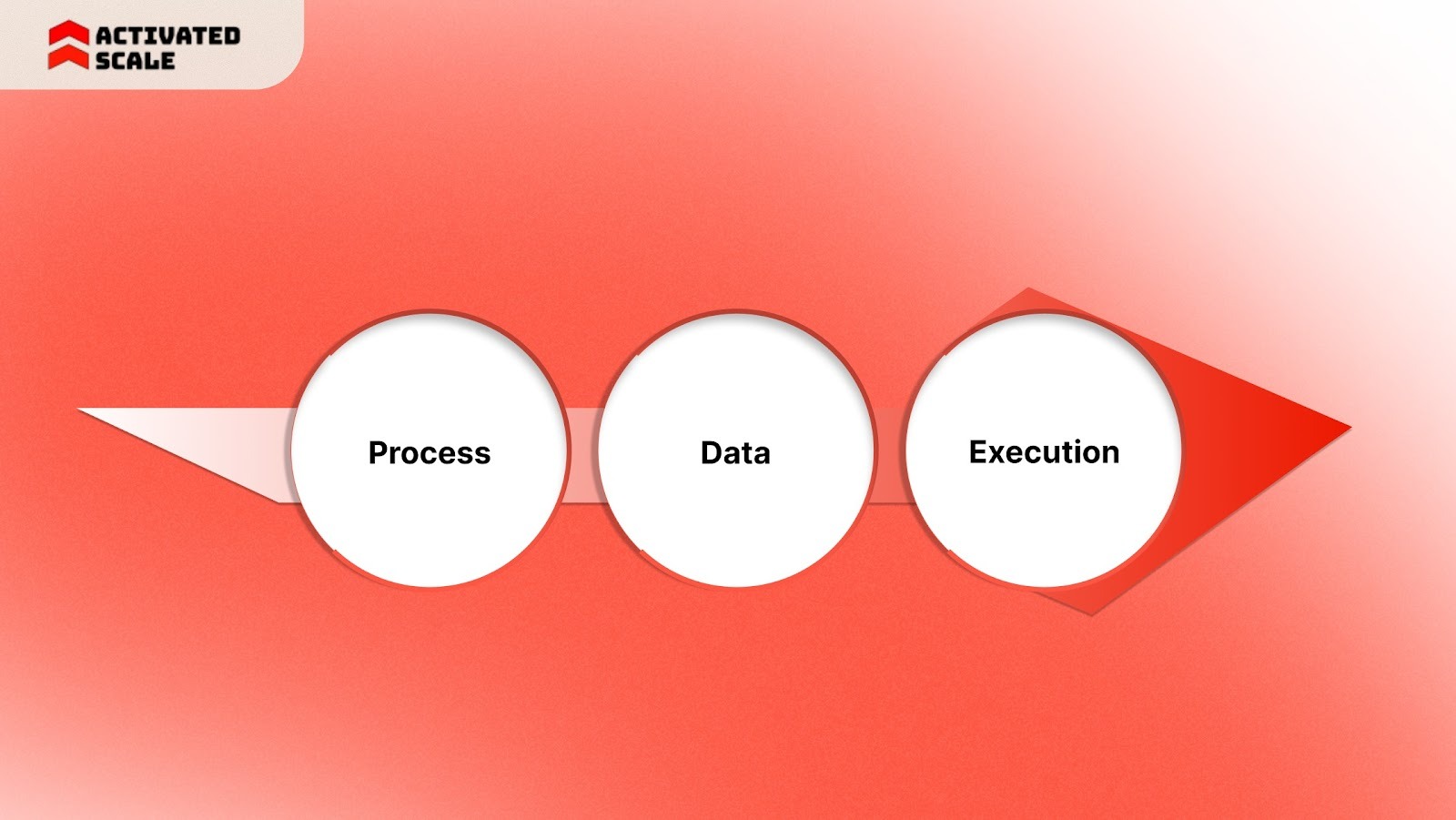
- Process -- how leads move, deals close, and customers expand
- Data -- how revenue performance is measured and forecasted
- Execution -- how teams make decisions and adjust based on what's happening
RevOps is not a team that just builds dashboards or manages tools. Its role is to reduce friction between functions, eliminate conflicting metrics, and ensure everyone operates from the same definitions and priorities.
RevOps becomes useful for startups when growth slows, not because demand is weak, but because handoffs fail, data are inconsistent, and accountability is unclear. At that point, RevOps provides structure so revenue no longer depends on individual effort and instead relies on repeatable systems.
Why Startups Bring RevOps In Earlier Than Planned
Most startups don't add RevOps to create more processes. They add it when execution starts, causing issues that are hard to pinpoint.
Common signs appear fast:
- Different teams are reporting different numbers for the same funnel stage
- Leads stalling between marketing and sales with no clear owner
- Forecasts change week to week without a clear explanation
- Deals closing that don't retain, creating downstream churn
- Time spent debating data instead of fixing problems
RevOps addresses these issues by aligning funnel definitions, ownership, and revenue data across teams. Without this layer, teams optimize locally and miss system-wide problems.
For startups, the risk isn't adding RevOps too early. It's waiting until misalignment becomes expensive to unwind. Early clarity makes growth easier to manage and harder to derail.
A Practical RevOps Implementation Framework for Startups
RevOps implementation works best when it follows a clear sequence. Rushing into tools or dashboards without understanding where revenue breaks down usually creates more friction than progress. This phased approach keeps implementation grounded in real problems and measurable outcomes.
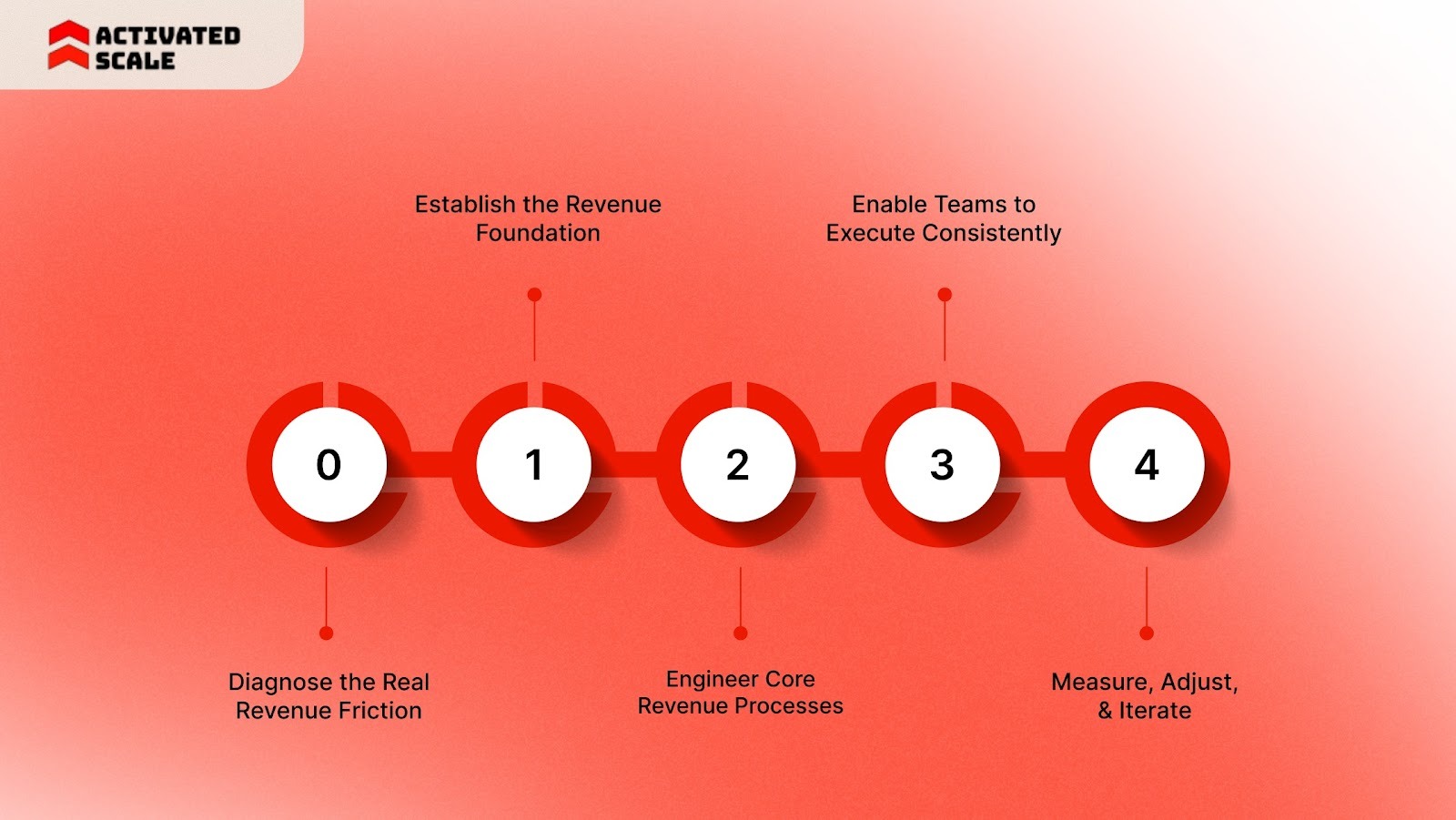
Phase 0: Diagnose the Real Revenue Friction
Before building anything, startups need a clear view of where revenue execution is failing today.
This phase focuses on:
- Identifying where deals stall, drop, or slow down
- Documenting breakdowns between marketing, sales, and post-sale
- Understanding where teams lose time due to manual work or unclear ownership
At this stage, many startups surface issues they don't yet have the internal bandwidth or expertise to fix. That's often when teams bring in experienced operators, sometimes through flexible models like Activated Scale, to help diagnose problems without committing to full-time hires too early.
Phase 1: Establish the Revenue Foundation
Once problems are visible, the next step is to create a stable foundation to support RevOps execution.
Key actions in this phase include:
- Defining a unified revenue data model across teams
Designing a centralized view of the revenue tech stack - Documenting current-state processes before optimization
Clarity matters more than sophistication here. A simple, shared foundation prevents misalignment as systems scale.
Phase 2: Engineer Core Revenue Processes
With the foundation in place, teams can standardize how revenue actually moves.
This phase focuses on:
- Defining revenue KPIs tied to execution quality
- Establishing service-level agreements between teams
- Automating critical handoffs to reduce delays
For example, a $2M ARR analytics company reduced lead response time by over 25% after replacing manual routing with automated assignment rules tied to clear ownership.
Phase 3: Enable Teams to Execute Consistently
Process changes only work if teams know how to operate within them.
This phase includes:
- Creating clear sales and marketing ops playbooks
- Rolling out focused training tied to new workflows
- Building dashboards that support real decisions, not vanity reporting
Some startups use fractional sales or RevOps leadership during this phase to ensure adoption stays consistent as systems change.
Phase 4: Measure, Adjust, and Iterate
RevOps is not a one-time setup. It's an operating model.
This phase includes:
- Defining change management rules
- Setting clear iteration timelines
- Creating feedback loops between frontline teams and operators
Teams that succeed treat iteration as part of the system, not a reaction to missed targets.
This approach keeps RevOps focused on execution instead of abstraction. Each phase builds on the last, preventing premature optimization and helping teams solve real revenue problems with the right level of support at each stage.
Also read: International Sales Representative Career Progression Guide
RevOps Setup Mistakes That Slow Startups Down
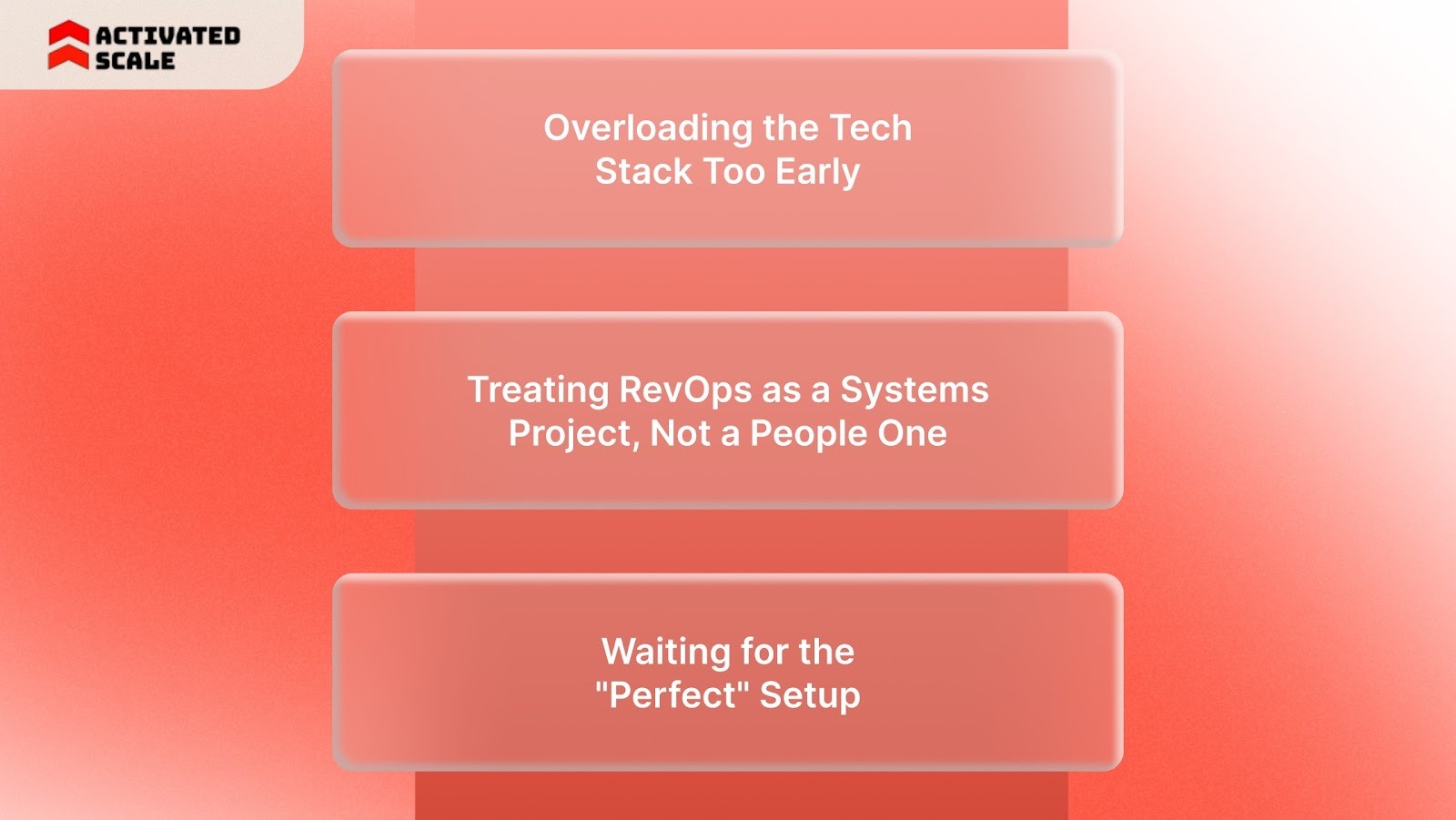
Setting up RevOps can unlock alignment and scale, but only if early missteps are avoided. These are the most common issues that quietly derail RevOps efforts at startups.
Overloading the Tech Stack Too Early
Buying tools before processes are clear creates more friction than leverage. Startups often deploy software faster than teams can adopt it, leading to low adoption and fragmented data. Focus on the few tools you actually need today, and think through how each one fits into daily workflows. Adding tools is easy. Removing them later rarely is.
Treating RevOps as a Systems Project, Not a People One
RevOps only works if teams use it consistently. New processes, dashboards, or workflows won't stick without clear training, early feedback, and buy-in across sales, marketing, and customer teams. Adoption matters more than documentation. If people don't trust or understand the system, it won't scale.
Waiting for the "Perfect" Setup
RevOps isn't static. Processes evolve as customers, markets, and sales motions change. Teams that wait to perfect every workflow usually stall progress altogether. Start with what's workable, then iterate based on real signals like forecast accuracy, lead response times, revenue leakage, and handoff quality. Progress compounds faster than perfection.
Learn more about: 6 Essential Closing Skills for Startup Sales Teams in 2026
When Flexible RevOps Leadership Makes Sense
Many startups hit a point where RevOps is clearly needed, but hiring a full-time RevOps leader feels premature. The scope is still forming, priorities are shifting, and committing too early can lock teams into the wrong structure.

Activated Scale supports this approach by giving startups access to senior revenue operators without forcing long-term commitments.
- Fractional Sales Leadership to define revenue processes, align teams, and establish operating cadence.
- Contract-to-Hire Sales Recruiting to validate RevOps or revenue leadership impact before committing full-time.
- Fractional Selling support when pipeline execution needs structure alongside systems.
This approach keeps RevOps implementation moving while preserving flexibility. Teams gain clarity and momentum now without incurring the cost of getting the structure wrong too early.
RevOps Works When Ownership Comes First
RevOps isn't a switch you flip. It's a system you build gradually, based on how your business actually sells, markets, and retains customers.
The startups that succeed with RevOps don't try to solve everything at once. They focus on clarity first, clear ownership, clear processes, and clear signals. From there, tools, dashboards, and automation start to make sense.
Many teams reach a point where RevOps needs senior ownership, but a full-time hire still feels premature. Platforms like Activated Scale support startups by providing experienced revenue operators, helping teams build RevOps foundations without committing too early.
If RevOps is becoming a priority for your startup, now is a good time to explore what structure actually fits your stage.
FAQs
1. What does RevOps implementation actually include?
RevOps implementation includes defining revenue ownership, aligning funnel stages, standardizing handoffs, establishing data governance, and setting a consistent operating cadence across teams. Tools support the system, but they don't define it.
2. When is a startup ready to implement RevOps?
Startups are typically ready when forecasting becomes unreliable, sales and marketing disagree on pipeline definitions, or execution slows despite strong demand. RevOps adds value only when complexity arises, not before.
3. Do startups need a full-time RevOps hire?
Not always. Many startups benefit from fractional or interim RevOps leadership to define structure and test what works before committing to a full-time role.
4. What are the biggest mistakes startups make with RevOps?
Common mistakes include adding too many tools too early, treating RevOps as a reporting-only function, ignoring adoption and training, and waiting to "perfect" systems before acting.
5. How long does it take to see impact from RevOps?
Early impact often shows up in clearer forecasting, cleaner pipelines, and faster decision-making within the first few months. Deeper results compound as processes stabilize and teams align.
The Ultimate Guide to Hiring a Salesperson!
Get the step-by-step guide to hiring, onboarding, and ensuring success!