_edi.png)
Scaling a SaaS company used to mean hiring more reps and increasing spend. Today, growth depends on operational alignment.
According to Gartner, by 2026, nearly 75% of the highest-growth companies will adopt a Revenue Operations (RevOps) model, up from less than 30% just a few years ago. RevOps is quickly becoming the standard for companies that want predictable, efficient revenue.
Revenue operations brings sales, marketing, and customer success into one coordinated system. Shared KPIs replace disconnected dashboards. Unified data replaces conflicting reports. Defined processes replace handoff friction.
When RevOps is structured correctly, revenue becomes measurable, scalable, and easier to forecast.
Before we dive in:
- Revenue operations is the operating system that aligns sales, marketing, and customer success around shared processes, data, and revenue goals.
- Best practices begin with shared definitions and ownership, ensuring teams measure success with the same KPIs throughout the customer lifecycle.
- Centralized data and disciplined reporting reduce friction and accelerate decision-making.
- SaaS-specific metrics such as CAC, NRR, pipeline health, and forecast accuracy provide insight into execution effectiveness.
- Common mistakes to avoid include tool overload, siloed reporting, and misaligned incentives that drive up costs and slow growth.
- Flexible execution support, such as fractional leadership and hiring models, helps SaaS teams implement RevOps without premature full-time commitments.
What Revenue Operations Means for SaaS Companies
Revenue operations in SaaS is a cross-functional operating model designed to align every revenue-driving function around a shared growth objective. Instead of optimizing sales, marketing, or customer success in isolation, RevOps ensures these teams operate as one system across the full customer lifecycle.
In a SaaS business, misalignment creates real risk. Leads convert but don't retain. Customers close but don't expand. Forecasts look strong but miss reality. Revenue operations exists to prevent these breakdowns by aligning infrastructure, execution, and accountability to revenue outcomes.
RevOps is not a standalone department. It's a coordinated system of processes, ownership, and data that supports revenue generation, retention, and scaling.
At a practical level, SaaS revenue operations typically span four core areas:

- Operations: Defines how revenue work is executed day to day and how it scales over time. This includes process design, ownership, forecasting structure, and operating cadence.
- Enablement: Supports teams with onboarding, training, and ongoing development to ensure consistent execution as the business grows.
- Insights: Connects customer behavior and sales activity to performance data, enabling informed decisions across acquisition, retention, and expansion.
- Tools: Manages the systems and integrations that support revenue execution, ensuring data reliability and workflow consistency without unnecessary complexity.
For SaaS companies, revenue operations creates the structure needed to grow without introducing friction, inefficiency, or blind spots as scale increases.
Why RevOps Matters as SaaS Companies Scale
As SaaS companies grow, revenue becomes harder to manage, not because demand drops but because visibility breaks. Sales, customer success, and leadership often rely on data from different systems, which slows decision-making and creates risk.
Revenue operations for SaaS solve this by creating a unified view of the customer lifecycle. RevOps connects CRM data with subscription and billing systems so teams understand not just what's closing but also what's renewing, expanding, or at risk.
This visibility matters because SaaS revenue compounds over time. Forecasts don't just influence sales targets; they shape hiring plans, expansion strategy, and board expectations. RevOps ensures those forecasts are grounded in real customer behavior, not fragmented data.
For growing SaaS companies, RevOps isn't an analytics layer. It's the operating foundation that keeps growth profitable, predictable, and aligned across teams.
7 Revenue Operations Best Practices That Support Long-Term SaaS Growth
Sustainable SaaS growth depends on execution discipline, not just strategy. The most effective RevOps teams operate on a few core principles that keep revenue predictable, efficient, and scalable as complexity increases.
.jpg)
1. Create a Single, Trusted Revenue Data Foundation
Predictable revenue starts with trusted data. When sales, marketing, and customer success rely on different datasets, reporting breaks down, and decision-making slows. RevOps establishes a centralized, governed data foundation so everyone works from the same numbers.
This requires clear data standards, ownership, and ongoing hygiene. Without that commitment, even the best tools produce unreliable insights.
2. Focus on SaaS Metrics That Signal Real Performance
Strong RevOps teams avoid vanity metrics. They track a small set of SaaS indicators that reflect revenue health and efficiency, including:
- Annual Recurring Revenue (ARR) to measure growth momentum
- Net Revenue Retention (NRR) to understand expansion versus churn
- LTV: CAC to assess profitability and capital efficiency
- Sales velocity to identify execution friction
- Forecast accuracy to support planning and hiring decisions
These metrics reveal how the revenue engine is actually performing, not just how busy teams appear.
3. Build Data Fluency Across Revenue Teams
RevOps isn't effective if data lives only with analysts or ops specialists. SaaS companies that scale well invest in making data understandable and usable across revenue teams.
That means training teams to interpret dashboards, understand data flow, and question inconsistencies. Data fluency turns reporting into action instead of noise.
4. Shift From Annual Planning to Continuous Planning
Static annual plans break quickly in fast-moving SaaS markets. RevOps teams adopt continuous planning to enable territories, quotas, and GTM focus to adjust throughout the year.
This flexibility improves efficiency and reduces the cost of missed assumptions, especially when market conditions or customer behavior change mid-cycle.
5. Enforce Discipline Around the Ideal Customer Profile
Not all growth is healthy. RevOps plays a critical role in keeping sales and marketing aligned on the Ideal Customer Profile so acquisition, onboarding, and expansion stay efficient.
Strong ICP discipline reduces churn, lowers support costs, and increases lifetime value by focusing effort where the product delivers the most value.
6. Consolidate the Tech Stack Around Revenue Execution
A fragmented stack obscures the customer journey and slows teams. RevOps aligns technology around the full revenue lifecycle so planning, execution, and reporting connect cleanly.
The goal isn't more tools, but fewer systems used consistently and integrated around shared workflows.
7. Replace Silos With Shared Accountability
RevOps succeeds when revenue teams operate as one system. That requires shared KPIs, integrated workflows, and accountability tied to customer outcomes, not individual team targets.
When collaboration is built into execution, SaaS companies see fewer handoff failures and more predictable growth.
4 Core Pillars of an Effective RevOps Strategy
A strong RevOps strategy creates predictable growth by tightening execution across the revenue lifecycle. While tools and frameworks differ, effective RevOps programs consistently rely on four core pillars: team alignment, execution structure, connected systems, and disciplined use of data.
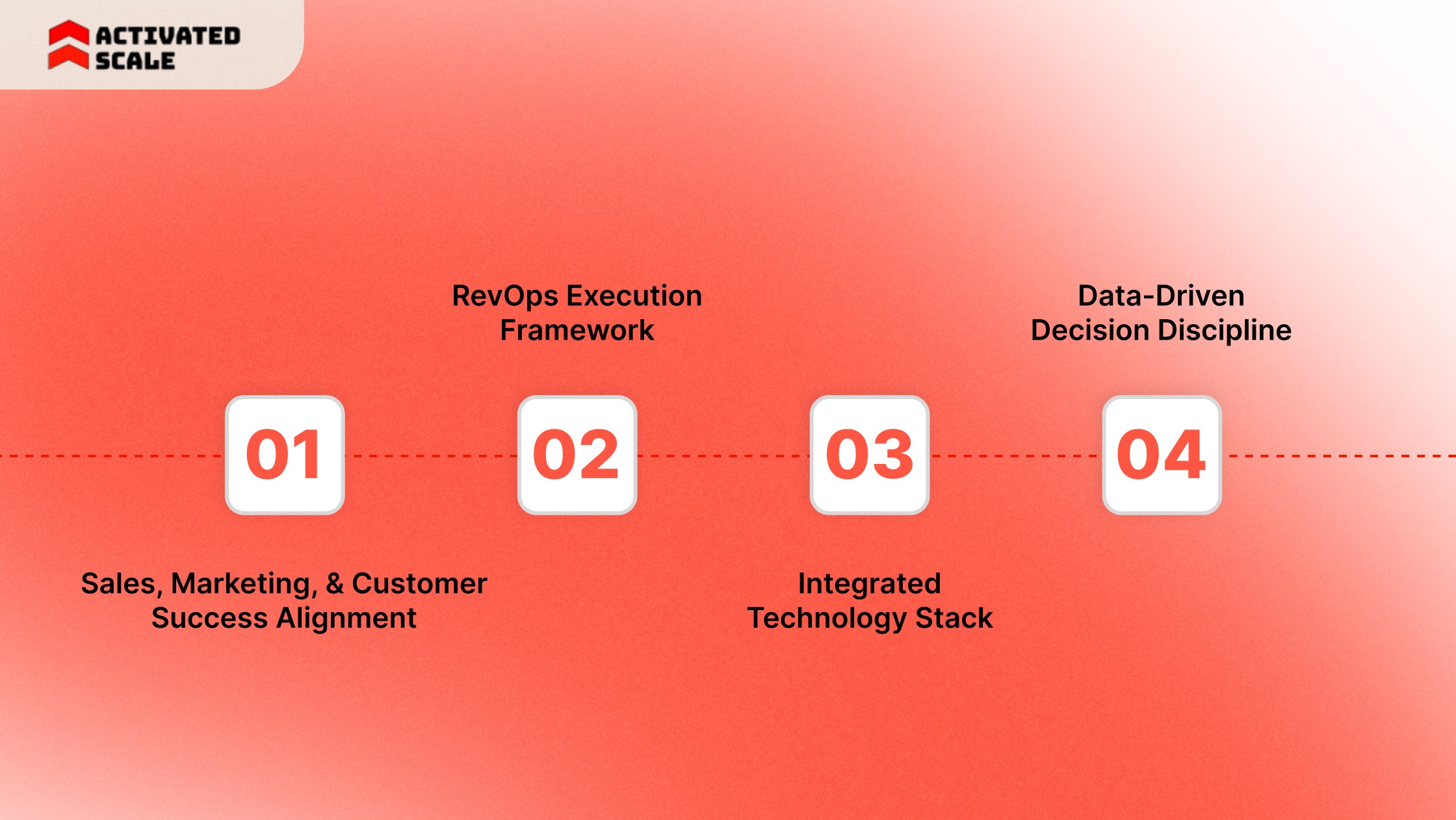
1. Alignment Across Sales, Marketing, and Customer Success
In SaaS, revenue rarely declines due to a lack of demand. It breaks where teams hand off work without shared context or ownership.
RevOps brings sales, marketing, and customer success into a single operating model. Lead qualification becomes consistent, sales-to-CS handoffs improve, and onboarding and expansion are no longer treated as afterthoughts. This alignment reduces friction and prevents revenue from stalling after the close.
Through Fractional Sales Leadership, teams gain experienced operators who establish shared revenue definitions, align execution across functions, and ensure handoffs actually work in practice, not just on paper.
2. RevOps Execution Framework
SaaS revenue moves through three connected motions: acquisition, expansion, and retention. A RevOps framework is designed to manage these motions as a single system rather than isolated stages.
Regardless of the framework a company adopts, strong RevOps execution rests on four fundamentals:
- People with clear ownership across the revenue lifecycle
- Processes that define how revenue moves between stages
- Tools that support execution rather than dictate it
- Data that informs decisions consistently across teams
Many scaleups struggle here because they know what needs to change, but lack the leadership bandwidth to implement it. Activated Scale addresses this through Contract-to-Hire Sales Recruiting, allowing companies to validate RevOps or revenue leadership in real operating conditions before making long-term commitments.
3. Integrated Technology Stack
RevOps frameworks only work when systems are connected. Disconnected tools create blind spots that lead to duplicated work, slow decisions, and missed revenue signals.
An integrated stack ensures marketing activity, sales engagement, and customer outcomes are visible across teams. This prevents scenarios where sales pursues accounts already disqualified or customer success misses early expansion indicators.
RevOps doesn't require more tools. It requires fewer tools, shared rules, clean data, and consistent workflows.
4. Data-Driven Decision Discipline
RevOps succeeds when data is treated as an operating signal, not a retrospective report. Centralized revenue data improves forecast accuracy, surfaces execution gaps earlier, and reduces reactive decision-making.
Teams that operate with clean, trusted data adjust sooner, before revenue is lost. This is often reinforced through Fractional Selling support, where Activated Scale helps maintain pipeline discipline and execution consistency while teams mature their RevOps practices.
When data flows cleanly across acquisition, expansion, and retention, RevOps becomes a growth enabler rather than a reporting layer.
Learn more about: How SDR Marketing Drives Success for Your Business in 2026
How to Measure RevOps Performance in SaaS
Measuring RevOps success in SaaS isn't about tracking every possible metric. It's about monitoring the indicators that show whether your revenue engine is efficient, scalable, and improving over time. The most effective SaaS teams group RevOps metrics by cost efficiency, revenue quality, and execution speed.
Below are the core areas that matter most.
Customer Acquisition Efficiency
These metrics show how effectively RevOps turns spend into customers.
- Customer Acquisition Cost (CAC): Measures the total cost required to acquire a new customer. RevOps aims to reduce CAC by improving qualification, handoffs, and pipeline focus.
Formula: CAC = Total Sales & Marketing Costs ÷ New Customers Acquired
- Cost Per Lead (CPL): Indicates how efficiently marketing spend generates leads. Rising CPL often signals targeting or channel inefficiency.
Formula: CPL = Total Marketing Spend ÷ Leads Generated
- Cost Per Opportunity (CPO): Shows the cost to generate a qualified sales opportunity, highlighting marketing–sales alignment.
Formula: CPO = Total Sales & Marketing Costs ÷ Opportunities Created
Revenue Quality and Retention
These metrics show whether revenue growth is durable.
- Lifetime Value (LTV): Estimates total revenue expected from a customer over time. Higher LTV reflects stronger retention and expansion execution.
Formula: LTV = Average Revenue per Customer × Average Customer Lifespan
- Net Revenue Retention (NRR): Measures how revenue from existing customers grows or shrinks, including expansions and churn.
Formula: NRR = (Starting Revenue + Expansion – Contraction – Churn) ÷ Starting Revenue × 100
- Renewal Ratio: Measures the percentage of customers who renew at contract end, indicating long-term value delivery.
Formula: Renewal Ratio = Renewed Customers ÷ Customers Up for Renewal × 100
Pipeline and Sales Execution
These metrics show how efficiently revenue moves through the system.
- Leads Generated: Tracks the volume of new leads entering the funnel. Best used alongside conversion metrics.
Formula: Leads Generated = Total New Leads in a Given Period
- Conversion Rate: Measures how effectively leads convert into customers.
Formula: Conversion Rate = Conversions ÷ Leads × 100
- Pipeline Generation: Indicates how many qualified opportunities are created.
Formula: Pipeline Generation = Total New Opportunities Created
- Win Rate: Shows the percentage of opportunities that close successfully.
Formula: Win Rate = Deals Won ÷ Total Opportunities × 100
Speed, Adoption, and Time to Value
These metrics reflect execution efficiency after a deal is signed.
- Sales Process Velocity: Measures how quickly revenue moves through the pipeline.
Formula: Sales Velocity = (Deals × Average Deal Size × Win Rate) ÷ Sales Cycle Length
- Speed of Implementation: Tracks how fast customers begin using the product after signing.
Formula: Implementation Speed = Time from Contract Signing to First Product Use
- Time to Value (TTV): Measures how long it takes customers to experience meaningful value.
Formula: Time to Value = Time from Onboarding Start to First Value Realization
- Customer Usage Frequency: Indicates product engagement and adoption strength.
Formula: Usage Frequency = Average Actions or Logins per User per Month
The goal isn't to optimize all of these at once. Strong RevOps teams focus on a small, relevant subset aligned with their growth stage and use trends, not snapshots, to guide decisions.
Must read: How to Build a Strong Sales Pipeline: A Sales Leader's Guide in 2026
How Activated Scale Supports RevOps Execution for SaaS Teams
RevOps frameworks often break down at the execution layer. Metrics are defined, dashboards are built, but day-to-day ownership across pipeline, forecasting, and deal execution remains inconsistent. This gap is usually operational, not strategic.
.jpg)
Activated Scale helps SaaS teams close that gap by providing experienced, U.S.-based sales professionals who can step into RevOps-critical roles quickly and flexibly.
Our services are designed to support RevOps execution at different stages:
- Contract-to-Hire Sales Recruiting: For SaaS teams that need to validate sales or revenue leadership before committing full-time. This model allows teams to test real performance against RevOps metrics such as pipeline quality, win rate, and forecast accuracy before committing headcount.
- Fractional Selling: Provides experienced SDRs and AEs who operate within existing RevOps processes. This helps maintain pipeline discipline, consistent follow-ups, and conversion efficiency while teams refine systems, tooling, or GTM motions.
- Fractional Sales Leadership: Offers senior sales leaders who take ownership of execution and align sales activity with RevOps goals, such as CAC control, cycle efficiency, and predictable forecasting. This is especially useful when internal leadership bandwidth is limited.
In practice, this model helps SaaS teams reduce operational friction:
- Under 7 days to connect and hire a salesperson, sometimes the same day.
- 20+ hours of interview time saved per sales hire.
- 80% of customers retain Activated Scale talent for more than 8 months.
- 200+ SaaS teams have used Activated Scale to support revenue execution.
For SaaS companies focused on improving RevOps performance without premature full-time hires, this approach makes execution easier to scale and metrics easier to move.
Conclusion
Revenue operations is more than a functional discipline; it's the operating model that turns a SaaS company's strategy into predictable revenue outcomes. When teams share a common playbook, trust their data, and follow coordinated processes, revenue execution becomes more efficient, forecasts become reliable, and growth becomes sustainable.
The SaaS companies that succeed with RevOps start small, build consistency, and evolve their approach as complexity increases. They don't chase tools or vanity metrics; they focus on execution discipline that moves core KPIs. Over time, these improvements compound into stronger customer retention, lower acquisition costs, and more predictable growth.
Contact us today to see how experienced revenue operators can help your SaaS teams turn RevOps best practices into measurable outcomes.
FAQs
1. What is revenue operations for SaaS?
Revenue operations for SaaS is a strategic operating model that aligns sales, marketing, and customer success around shared data, processes, and goals to drive predictable revenue growth.
2. When should a SaaS company implement RevOps?
SaaS companies typically implement RevOps when growth creates coordination challenges, forecasting becomes unreliable, or teams begin reporting conflicting metrics.
3. How does RevOps reduce SaaS customer acquisition cost (CAC)?
RevOps improves CAC by tightening qualification, standardizing handoffs, and ensuring marketing and sales are aligned around shared definitions and goals.
4. What metrics are most important for SaaS RevOps?
Core SaaS RevOps metrics include CAC, net revenue retention (NRR), pipeline coverage, forecast accuracy, conversion rates, and sales cycle health.
5. Can SaaS companies scale RevOps without full-time hires?
Yes. Many SaaS teams leverage fractional leadership and contract-to-hire models to get RevOps execution support before committing to permanent roles, reducing early overhead while maintaining momentum.
The Ultimate Guide to Hiring a Salesperson!
Get the step-by-step guide to hiring, onboarding, and ensuring success!