_edi.png)
Marketing complexity is increasing faster than most teams can manage. In fact, 93% of B2B marketers say the marketing operations function is important or critical to achieving digital transformation and operational success.
That level of impact comes not from tools, but from processes, clarity, and disciplined execution. A marketing operations playbook captures those processes in a usable way, giving teams a single source of truth they can follow, refine, and build on as the business grows.
This guide shows you how to build a playbook that turns marketing chaos into predictable execution, improves cross-team handoffs, and creates sustainable operational momentum.
Before we dive in
- A marketing operations playbook provides a structured approach to executing work, reducing ambiguity, and aligning teams around shared processes.
- It matters most when teams struggle with inconsistent execution, unclear handoffs, or unreliable reporting.
- Successful playbooks focus on core principles: ownership, funnel stages, workflows, data standards, campaign planning, and reporting.
- Building a playbook involves auditing current practices, documenting key workflows, setting success metrics, and iterating based on performance signals.
- Common pitfalls include starting with tools instead of processes, over-documenting upfront, and hoping for perfection before taking action.
- A minimum viable playbook delivers fast wins, such as shorter cycles, cleaner handoffs, and more reliable reporting that leadership can trust.
- Flexible leadership options, such as fractional or contract-to-hire support, can help teams embed these practices early without over-committing headcount.
What a Marketing Operations Playbook Defines
A marketing operations playbook documents how marketing and sales work together across the funnel. It outlines the processes, rules, and tools that govern how leads and customers move through each lifecycle stage.
It serves as a reference point for the entire organization. New and existing team members should be able to rely on the playbook to understand record ownership, stage definitions, handoffs, and required actions at every step.
The playbook anchors the lifecycle model. It removes ambiguity around how records progress, who is responsible at each stage, and how systems are expected to behave. The result is cleaner execution, fewer handoff issues, and more consistent operations as the team scales.
Why a Marketing Operations Playbook Matters
A marketing operations playbook exists to make teams effective faster. It gives new and existing employees a clear view of the tools, systems, and processes they're expected to use, without relying on tribal knowledge or guesswork.
When expectations are documented, onboarding becomes smoother and ramp time shortens. People spend less time figuring out how things work and more time executing with confidence. That clarity also reduces dependency on managers for day-to-day decisions, allowing teams to operate more autonomously.
At its core, a marketing operations playbook supports speed and consistency. It helps teams move in the same direction, apply processes consistently, and scale execution without slowing down as headcount grows.
What a Marketing Operations Playbook Should Cover
As teams scale, the same questions recur. What qualifies as an MQL? Which tools are the source of truth? How are campaigns tracked, attributed, and reported? Without clear answers, execution slows, and inconsistencies creep in.
A marketing operations playbook exists to remove that friction. It becomes the single place teams go to understand how marketing actually runs.
While every organization will tailor it to their needs, a solid marketing operations playbook consistently covers a core set of elements that guide day-to-day execution and decision-making.
Core Elements of a Marketing Operations Playbook

- Demand Generation Tools: Clear guidance on which tools support lead capture, nurturing, and performance tracking, and how they're used consistently.
- Sales Tools: Defined systems for CRM usage, lead handoff, and visibility into pipeline activity to ensure alignment with sales.
- Internal Communication Tools: Agreed-upon channels for campaign coordination, updates, and issue resolution to avoid fragmented communication.
- Lifecycle Management: Clear definitions for lead stages, transitions, and ownership so teams understand how prospects move through the funnel.
- Lead Source Attribution: Standard rules for capturing and assigning lead sources to maintain accurate reporting and analysis.
- Opportunity Source Attribution: A shared method for tying revenue back to marketing activity without double-counting or confusion.
- Marketing Campaign Management and Reporting: Consistent processes for planning campaigns, tracking performance, and reviewing results.
- Internal Document Management: A clear structure for where processes, templates, and documentation live and how they're maintained.
- Definitions and Index: A centralized glossary that removes ambiguity around terms, metrics, and workflows.
A well-built marketing operations playbook doesn't over-document. It provides clarity where teams need it most, keeps execution consistent, and evolves as the business grows.
How to Build a Practical Marketing Ops Playbook
Building a marketing operations playbook that's both useful and realistic requires a mindset shift. You're not documenting every historical decision or edge case. That level of detail slows progress and is rarely used.
The goal of a first-pass playbook is clarity, not completeness. Think of it as a minimum viable system that supports most day-to-day work. Once those foundations are in place, refinement becomes far easier.
The five sections below form the core of a usable marketing ops playbook because they directly support execution, handoffs, and decision-making.
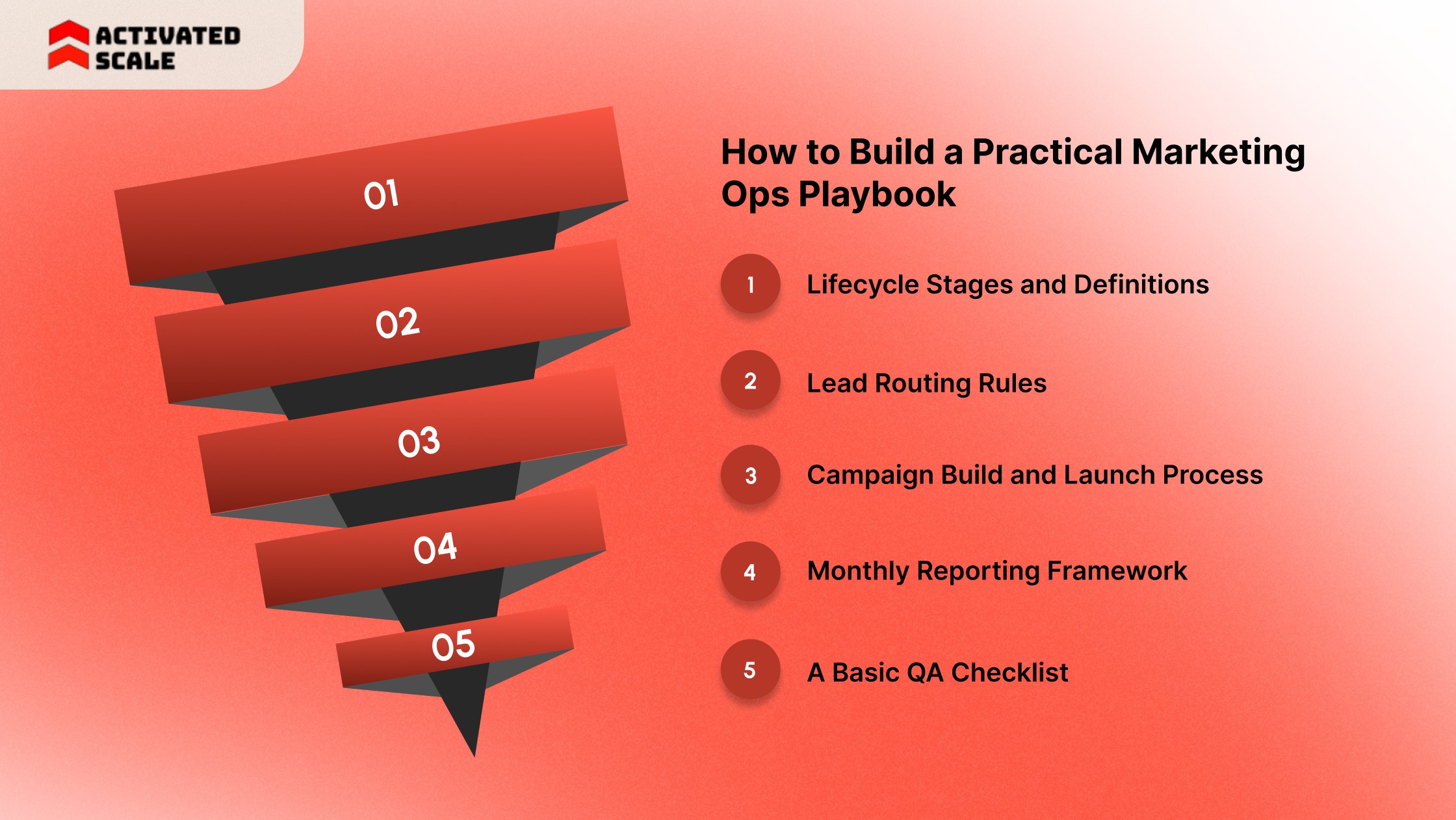
Section 1: Lifecycle Stages and Definitions
Clear lifecycle stages give teams a shared language and prevent inconsistent lead handling. Everyone should understand what each stage means and when a contact should advance or regress.
At a minimum, define:
- The criteria for each lifecycle stage
- Ownership at each stage
- Triggers that move contacts forward
- Rules for recycling or regression
Avoid overengineering early. You don't need complex scoring models or dozens of exceptions yet. The priority is to align on the customer journey so teams can describe and manage it consistently.
Section 2: Lead Routing Rules
Over time, lead routing often turns into a tangled web of workflows built by different people for different reasons. A lightweight routing framework restores order.
Your playbook should clearly outline:
- The required fields that determine ownership
- What happens when data is missing
- A default or fallback owner
- How ownership updates as structures change
Advanced branching logic can wait. Simple, transparent rules reduce delays and prevent qualified leads from being overlooked.
Section 3: Campaign Build and Launch Process
Without a shared process, campaign execution drifts. People rely on habits, steps get skipped, and accountability becomes unclear.
Define a consistent flow for:
- Intake
- Build
- Internal review
- QA
- Launch
- Post-launch review
This doesn't require detailed SOPs per channel. Even a high-level framework can create rhythm, reduce confusion, and improve coordination across teams.
Section 4: Monthly Reporting Framework
Reporting becomes painful when data is unreliable or dashboards don't answer real questions. A strong playbook focuses on signal, not volume.
Document:
- The core metrics leadership needs to assess performance
- How those metrics are visualized
- Ownership and update cadence
- How insights are shared across teams
This is also where experienced operational leadership helps. Teams that don't yet have senior marketing ops or revenue ops ownership often bring in external operators to define reporting standards and governance early, before metrics sprawl sets in. Platforms like Activated Scale support this by connecting companies with experienced, fractional operators who can help establish these foundations without requiring a full-time hire.
Section 5: A Basic QA Checklist
Small errors compound quickly in marketing ops, especially when multiple people are building assets and workflows.
Your initial checklist should cover:
- Emails
- Landing pages
- Forms
- Workflows
This isn't the place for detailed, channel-specific checks. A consistent, high-level review process catches most issues and keeps campaigns moving.
Putting the Playbook Together in 30 Days
A simple weekly cadence keeps momentum high:

- Week 1: Align on lifecycle stages and lead routing
- Week 2: Document campaign build and launch workflows
- Week 3: Define reporting and create a basic QA checklist
- Week 4: Review, refine, and publish the playbook
By the end of this process, you'll have a usable marketing ops foundation your team can rely on immediately. From there, iteration becomes far easier and far more effective.
Learn more about: How SDR Marketing Drives Success for Your Business in 2026
What a Minimum Viable Marketing Ops Playbook Delivers
Once teams work from a single set of operating rules, execution changes quickly. Decisions stop getting revisited. Questions stop circulating in Slack. Work moves forward without constant clarification.
A minimum viable marketing operations playbook isn't intended to be complete. It establishes just enough structure to reduce friction and enable teams to execute with confidence.
Early impact typically shows up as:
- Shorter campaign timelines because workflows are defined.
- Cleaner handoffs between marketing, sales, and agencies.
- Fewer last-minute fixes since answers live in one place.
- Reporting that leadership can review without rework.
- Reduced duplication across assets and processes.
- Faster onboarding because expectations are documented.
- More consistent use of tools like HubSpot, with clear rules.
- Shared terminology across teams that previously operated in isolation.
As ambiguity drops, coordination improves. Teams stop re-solving the same problems and start building on what already works. Even in fast-moving environments, work feels more controlled and intentional.
The most important outcome is momentum. Once a baseline exists, improving it becomes easier. Updates happen incrementally. Collaboration becomes routine. The playbook evolves into a system that supports scale rather than slows it down.
Also read: How to Create a Pipeline for Business Development in Just 7 Stages
Where Activated Scale Fits in Operationalizing Your Playbook
A marketing operations playbook only works if someone owns its rollout, adoption, and iteration. Many teams document processes well but struggle to enforce them consistently as priorities shift and headcount stays lean.
.jpg)
Activated Scale supports teams that need experienced go-to-market operators without hiring full-time too early:
- Fractional Sales Leadership helps align marketing ops processes with downstream sales execution, ensuring handoffs, definitions, and reporting actually hold up in practice.
- Contract-to-hire sales recruiting allows teams to test operational leadership or execution roles before committing to a long-term hire, reducing risk as the playbook evolves.
- Fractional selling support ensures campaigns and processes documented in the playbook translate into real pipeline activity, not just plans on paper.
This model keeps the playbook active and useful. Instead of becoming static documentation, it remains a working system because experienced operators are accountable for applying it in real workflows.
Build Clarity First, Then Scale with Confidence
A marketing operations playbook is not a collection of tools or a long set of rules. It's the operating system that allows your marketing team to work predictably and collaboratively.
The teams that benefit most aren't the ones with the fanciest tech stack, but those that define how work gets done, who owns what, and what success looks like. Once these fundamentals are in place, everything else becomes easier: planning, execution, reporting, and cross-functional alignment.
As you build and refine your playbook, experienced leadership can accelerate adoption and reduce common roadblocks. When you're ready to explore structured support that helps implement and operationalize your playbook without premature full-time hires, visit our website to explore practical, flexible options tailored to your growth stage.
FAQs
1. What exactly is a marketing operations playbook?
A marketing operations playbook is a documented set of processes, workflows, and standards that guide how marketing work is planned, executed, and measured. It serves as a consistent reference that teams use to maintain quality and alignment.
2. When should a team start building a playbook?
Start as soon as execution becomes inconsistent, handoffs break down, or campaign outcomes feel unpredictable. Early playbooks don't need to be perfect; they just need to be useful.
3. Do I need specialized tools to create a playbook?
No. Tools support a playbook, but the playbook itself is about process and clarity. Focus first on documented workflows, ownership, and success metrics; then choose tools to enforce them.
4. How detailed should a playbook be?
Start with enough detail to resolve common questions and repeat key processes reliably. Overly long documentation can bog teams down. A minimum viable playbook evolves over time.
5. How does a playbook improve cross-team alignment?
A playbook creates shared language, clear expectations, and documented handoffs between marketing, sales, and other teams. This reduces miscommunication and ensures work flows smoothly across functions.
The Ultimate Guide to Hiring a Salesperson!
Get the step-by-step guide to hiring, onboarding, and ensuring success!