_edi.png)
You have seen that your sales team is working harder than ever. Marketing just hit a record high in Marketing Qualified Lead (MQL). Customer Success is proactively identifying at-risk accounts, and yet, when you look at the forecast for next quarter, you have no confidence in the number.
This is the reality for many B2B leaders today. Customer Acquisition Cost (CAC) rises without a clear root cause. Every team is pulling in the right direction, but because no one owns the full revenue system, they are pulling against each other.
Companies are increasing tech spend by 7.8% in 2026, driven by AI and data investments. This indicates rising complexity in revenue systems, and talents are falling behind in coping with that.
However, hiring a full-time RevOps leader feels premature, and traditional outsourcing feels too tactical. This blog helps you with a fractional RevOps checklist to help you evaluate your next move. So you can finally get the ownership your revenue engine needs, without slowing down your growth.
Key Takeaways
- A fractional RevOps checklist helps identify gaps before revenue issues appear in forecasts.
- 40% of usage-based sales teams struggle with forecasting, showing how complexity impacts revenue predictability.
- Tech complexity is rising, with 7.8% growth in spend, making RevOps structure more critical.
- Fractional RevOps fits best when you need strategy and clarity without full-time hiring.
- Teams with strong performance are over twice as likely to align sales, marketing, and customer success effectively.
Who are Fractional RevOps?
Fractional RevOps leaders are senior revenue operators who work part-time with your company. They usually step in during growth, transition, or performance breakdown stages. Most come from roles like VP of Sales, Head of RevOps, or Go-to-Market (GTM) Strategy leads.
They have handled forecasting, pipeline design, and cross-team alignment at scale. A key difference shows in how they work. Typical responsibilities include:
- Setting revenue metrics and reporting structure
- Fixing funnel leaks and conversion gaps
- Improving forecast accuracy
- Aligning GTM teams on shared goals
- Defining Customer Relationship Management (CRM) structure and data flow
Please note that the role does not manage daily CRM updates or campaign workflows and does not definitely replace Sales Development Representatives (SDRs), Account Executives (AEs), or marketing ops.
But when should you hire them? Most importantly, do you even need them? A structured fractional RevOps checklist helps you catch those signals early and act before the damage compounds.
Read Also: International Sales Representative Career Progression Guide
When Do You Need Fractional RevOps?
The answer is usually six months before you start asking the question. Most sales leaders wait until revenue gaps show up in forecasts, not when the early signals appear. A structured fractional RevOps checklist helps you catch those signals early and act before the damage compounds.
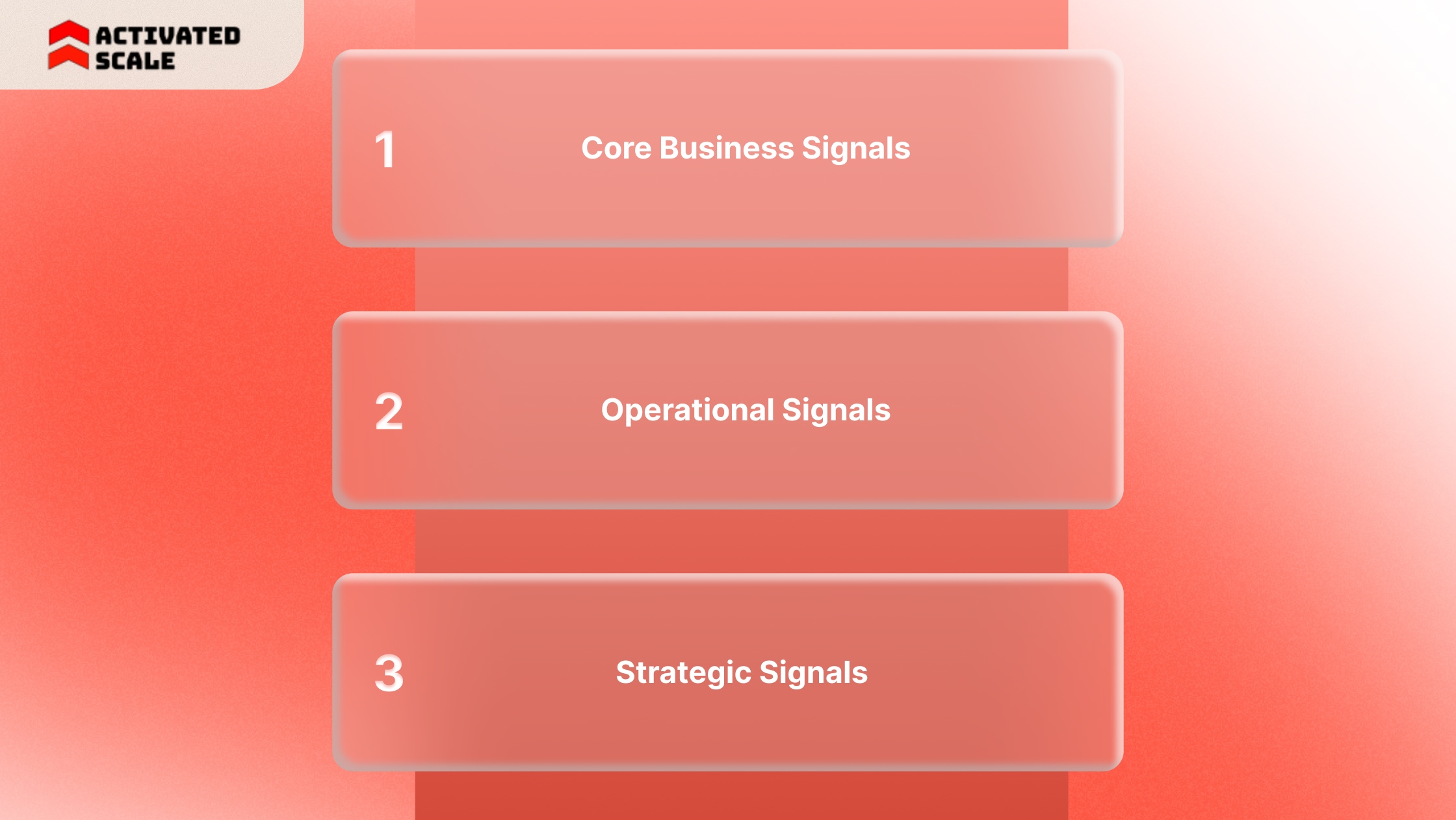
Check the sections below to find your answer:
1. Core Business Signals
- The first set of signals shows up at the business level, where teams appear busy but outcomes lack clarity.
- Sales pushes pipeline growth, marketing reports lead volume, and customer success tracks retention, yet no single view connects these metrics into a reliable revenue story.
- You should consider fractional RevOps if your team operates without shared GTM metrics, which leads to conflicting dashboards and decision delays.
- Revenue forecasting remains difficult for 40% of sales teams operating on usage-based pricing models for most companies. If yours is one of them, then trust projections in leadership reviews.
2. Operational Signals
- Operational gaps tend to surface as the business scales.
- More tools get added, more processes get introduced, but ownership does not scale at the same pace. This creates friction across execution layers.
- Process inconsistency across teams creates different customer experiences, which directly impacts conversion and retention.
- Scaling headcount without systems amplifies these issues. New hires rely on unclear processes, which slows ramp time and reduces overall productivity.
3. Strategic Signals
- Strategic signals appear when leadership decisions slow down despite strong market demand.
- The business has momentum, but lacks the structure to convert that momentum into predictable revenue.
- Post-funding or rapid scaling stages often expose gaps in revenue architecture. Leadership teams push for growth, yet RevOps ownership remains undefined.
- Revenue decisions stall because no single role connects pipeline, conversion, and retention into one system.
- Preparation for acquisition or aggressive expansion also requires clean data, reliable forecasting, and aligned GTM execution. Without these, valuation and scalability both take a hit.
Revenue gaps from poor forecasting don’t fix themselves. You can bring in sales talents from Activated Scale's Fractional Sales Leadership service to get a clear system in place before the next forecast cycle breaks again.
Even if you have decided on the right signal, but choose the wrong model, you either delay impact or lock yourself into unnecessary costs.
Fractional Vs. In-House Vs. Outsourced RevOps
Every RevOps model comes with trade-offs. Fractional gives you executive-level strategy on a flexible basis, but limited bandwidth. In-house offers deep alignment and dedicated focus but requires time to hire and ramp.
So, what to choose? The table below will give you clarity:
Choose In-House RevOps when:
- Processes are stable and need long-term ownership
- You require full-time accountability across systems
- Revenue operations is already defined, but needs scale
Choose Fractional RevOps when:
- You lack strategic clarity across revenue functions
- Forecasting and pipeline visibility feel unreliable
- You are scaling, fundraising, or restructuring
Choose Outsourced RevOps when:
- Execution speed is the main bottleneck
- CRM, data, or reporting tasks are piling up
- You need specialized skills without hiring full-time
The model's decision provides guidance on when to choose fractional RevOps. But when you're hiring or outsourcing without a clear plan, you will need a fractional RevOps checklist to hire, outsource, or onboard RevOps.
Read More: How to Hire Overseas Contractors Compliantly in 2026
Fractional RevOps Checklist (Hiring, Outsourcing, and Onboarding Guide)
The person you hire to build your first revenue process looks nothing like the person you bring in to optimize a $50M sales machine. Though most leaders use the same hiring playbook for every stage, they wonder why it doesn't work.
%20(1).jpg)
Here's how you exactly know what to look for at each stage, when to outsource versus hire, and how to onboard for immediate impact:
1. Hiring Checklist (When You Choose Fractional RevOps)
Use this when you need senior direction but lack internal clarity.
Assess Internal Readiness
- Do we know where revenue leakage happens across the funnel?
- Is there a single owner for revenue operations today?
- Do leadership teams agree on core metrics and definitions?
- Are decisions delayed due to unclear data or reporting gaps?
Define Scope and Role
- Do we need strategy, execution, or both right now?
- Which systems or processes need ownership first?
- Who will this role report to, and who will they influence?
- Are expectations clearly defined across teams?
Set Key Performance Indicators (KPIs) and Success Metrics
- Do we track conversion funnel velocity across all stages?
- Can we trust the current forecast accuracy?
- Are conversion rates consistent across segments?
- Do all teams use the same performance metrics?
Define Engagement Model
- How many hours per week do we actually need?
- Are we solving for a short-term gap or an ongoing need?
- Do we prefer a retainer or milestone-based engagement?
- What outcomes define success within 90 days?
Evaluate Candidates
- Has the candidate owned a RevOps strategy before?
- Can they present a clear 30-60-90 day plan?
- Do they show both strategic and execution awareness?
- Have they worked across sales, marketing, and Customer Success (CS) teams?
2. Outsourcing Checklist (Execution Readiness)
Use this when a strategy exists, but execution slows down.
Key Triggers
- Do we have a backlog of CRM or workflow tasks?
- Are data inconsistencies affecting reporting accuracy?
- Is our tech stack growing without clear ownership?
- Are implementation timelines slowing down revenue teams?
What to Keep In-House
- Do we own KPI definitions internally?
- Is the revenue strategy clearly defined by leadership?
- Are approval workflows controlled by internal teams?
- Do we have clarity on long-term revenue goals?
What to Outsource
- Are CRM workflows taking too long to build or fix?
- Is data quality affecting decision-making?
- Do we lack expertise in attribution or reporting models?
- Are dashboards inconsistent or delayed across teams?
Revenue issues come from unclear ownership and slow decisions. Reps from the Fractional Selling service from Activated Scale can start with the right structure before scaling adds more complexity.
3. Onboarding Checklist (First 30–60 Days)
Use this to drive faster impact after hiring or outsourcing.
Business Alignment
- Do we have a clearly defined GTM model?
- Are revenue streams mapped across the lifecycle?
- Do all teams understand the customer journey stages?
- Are goals aligned across sales, marketing, and CS?
Metrics and Data Setup
- Are funnel stages clearly defined and tracked?
- Do we measure CAC, Lifetime Value (LTV), and win rates consistently?
- Is lead scoring aligned across teams?
- Do attribution models reflect actual revenue drivers?
Systems and Tech Stack Audit
- Is our CRM structured for scalability?
- Are integrations working without data loss?
- Do we have a clear data flow across systems?
- Are there duplicate tools or workflows slowing teams?
Cross-Team Alignment
- Are Service Level Agreements (SLAs) defined between teams?
- Do handoff processes create friction or delays?
- Is communication structured across GTM teams?
- Are accountability and ownership clearly defined?
5 Best Practices for Making Your Hired Fractional RevOps Work
Hiring fractional RevOps leadership feels like the answer until you realize the role alone doesn't fix misalignment. Early wins give way to stalled execution, and the investment never delivers its full return.

Only high-performing sales teams are 2.3x more likely to have strong alignment across sales, marketing, and customer success. That's the difference between RevOps that works and RevOps that fades.
Best practices help you move from short-term traction to a system that drives consistent revenue performance:
- Align leadership early: Ensure Chief Revenue Officer (CRO), marketing, and customer success leaders agree on goals and metrics.
- Review progress every 30 days: Track improvements in outcomes.
- Avoid overloading the role with execution: Keep the focus on decisions, structure, and system design instead of daily operations.
- Look for proven ownership, not advisory roles: Has the candidate owned pipeline, forecasting, and GTM systems end-to-end in previous roles?
- Review past RevOps transformations: Look for clear examples where they improved conversion rates, forecast accuracy, or alignment.
Read More: How to Hire the Best Marketing Agency
How Does Activated Scale Help You Scale Faster
Many teams fix strategy but fail to translate it into pipeline, conversion, and revenue movement. That gap shows up when GTM teams stay aligned on paper but not in action.
Activated Scale helps revenue teams move from diagnosis to execution without adding unnecessary headcount. Instead of hiring full-time too early, you get access to experienced operators who have already built and fixed revenue systems at scale.
Here’s how that support works:
- Fractional Sales Leadership: Reps from this help you fix decision gaps before they impact the pipeline and targets.
- Fractional Selling: Fill pipeline and execution gaps without long hiring cycles. This ensures your strategy translates into actual revenue movement across the funnel.
- Contract-to-Hire Sales Recruiting: Test and hire the right sales talent with flexibility. This reduces hiring risk while building long-term ownership where needed.
Ready to turn fractional RevOps into lasting revenue performance? Talk to our experts at Activated Scale, who can give you clarity on what to do next.
Fix the System Before Scaling the Team
A structured fractional RevOps checklist helps you act earlier. It shows when to bring in strategy, when to add execution support, and when to invest in full ownership. The goal in 2026 is to build a system that makes revenue predictable.
If your forecasts feel unreliable or decisions take too long, it’s time to fix the system.
Schedule a call with Activated Scale to assess your current revenue setup and move into the next quarter with confidence in your numbers.
FAQs
1. How long should a fractional RevOps engagement last?
Most engagements run between 3 and 6 months for initial alignment and system design. Some companies extend it longer for ongoing strategic support. The duration depends on how complex your revenue systems are and how quickly teams adopt changes.
2. Can fractional RevOps work with an existing RevOps team?
Yes, and it often works better that way. Fractional leaders bring strategic direction, while internal teams handle execution. This combination improves speed without losing internal ownership or context.
3. What tools should fractional RevOps leaders manage or influence?
They typically work across CRM systems, analytics platforms, and attribution tools. The focus stays on structure and data flow. Their role is to define how systems should work together.
4. What happens if you delay RevOps investment too long?
Revenue inefficiencies compound over time. Pipeline gaps widen, forecasting becomes less reliable, and hiring decisions get riskier. Delays often increase the cost of fixing the system later.
The Ultimate Guide to Hiring a Salesperson!
Get the step-by-step guide to hiring, onboarding, and ensuring success!