_edi.png)

Outsourcing is no longer a niche choice. It has become a strategic business model that helps companies focus on core priorities, improve efficiency, and access skills they don't have in-house.
In fact, about 66% of U.S. companies outsource at least one department, showing how common and strategic outsourcing has become for businesses of all sizes.
But outsourcing isn't simply offloading work. It's a structured decision that impacts performance, cost, and scalability. When done right, it strengthens internal focus while bringing specialized expertise to the business. When done wrong, it can lead to misalignment, inefficiencies, and loss of control.
Before we dive in
- Outsourcing works best when it's treated as a strategic decision, not just a way to reduce workload or costs.
- The most successful companies outsource non-core or specialized work while keeping ownership of critical functions in-house.
- Clear scope, expectations, and success metrics are essential before engaging any outsourcing partner or model.
- Flexible resourcing options, such as contract-to-hire and fractional roles, help reduce risk when outsourcing revenue-critical work.
- Long-term success depends on strong communication, defined ownership, and ongoing performance review, not just delegation.
What Outsourcing Is and Why It Matters for Business Growth
Outsourcing means assigning specific work to external specialists instead of handling everything internally. This can include individual tasks, entire functions, or short-term projects, handled by partners in the U.S. or internationally, depending on where the right expertise is available.
What makes outsourcing valuable isn't cost alone. It's flexibility. Companies use outsourcing to expand capacity, access specialized skills, and avoid building internal teams until the need is fully proven.
Most businesses turn to outsourcing for a few practical reasons:
- To handle work that doesn't require full-time, in-house ownership
- To scale operations up or down as demand changes
- To reduce the overhead tied to hiring, training, and infrastructure
Outsourcing can be adopted early or later in a company's lifecycle. Some teams use it continuously. Others rely on it only when it makes financial or strategic sense. In both cases, success depends on clarity around scope, expectations, and accountability.
When done intentionally, outsourcing helps teams focus internal effort where it creates the most value, while staying responsive to market shifts and customer needs. That balance is why outsourcing remains a core lever for companies looking to grow without locking themselves into rigid structures too early.
Why Outsourcing Can Strengthen Business Performance
Outsourcing works best when it's used as a strategic lever, not a quick fix. When done intentionally, it helps businesses reallocate time, capital, and attention toward work that directly drives growth.
Below are the core benefits businesses see when outsourcing is aligned with clear goals and ownership.
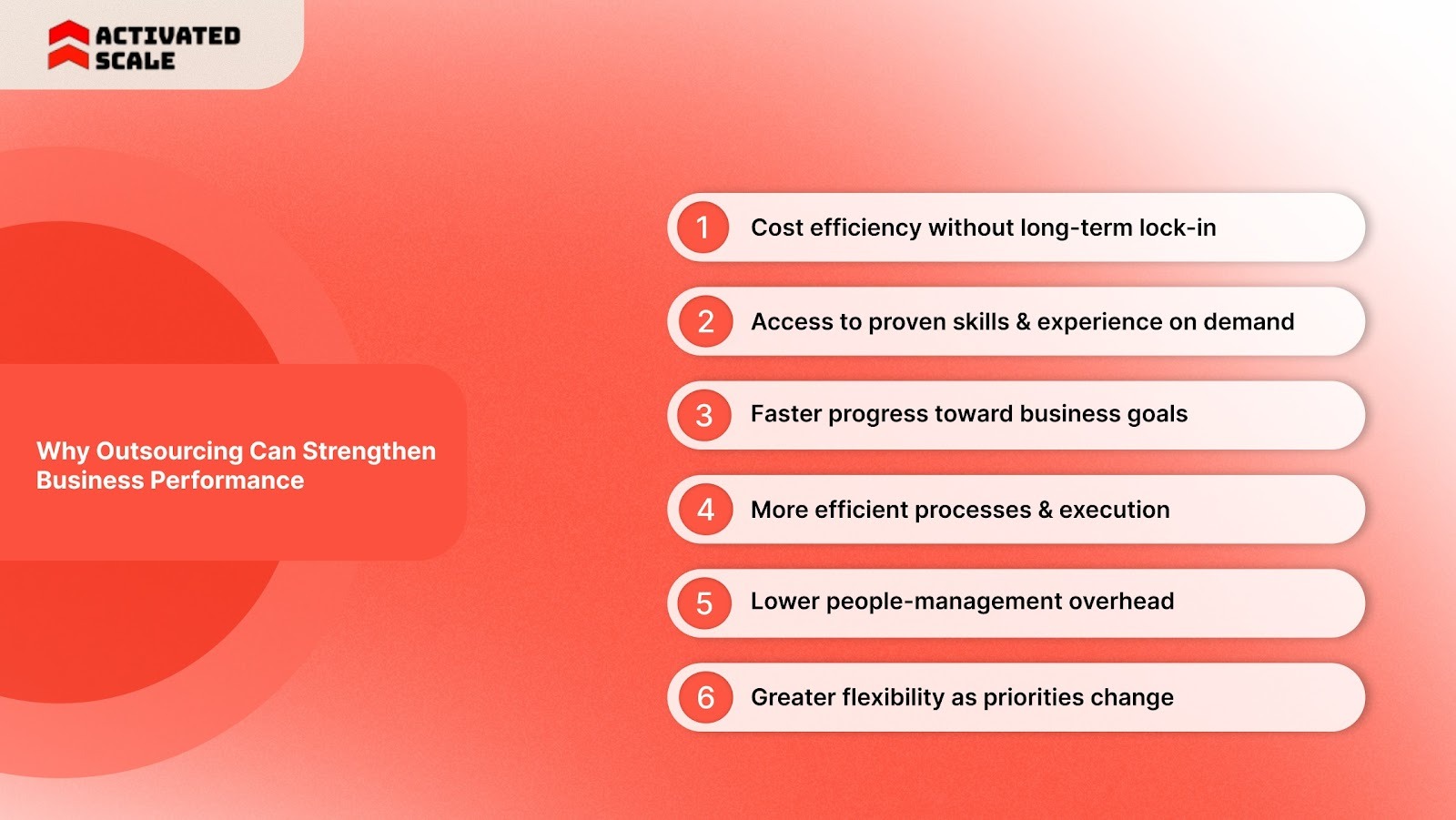
- Cost efficiency without long-term lock-in: Outsourcing reduces the need for permanent headcount when demand is uncertain or evolving. Instead of committing to fixed salaries, benefits, and ramp time, companies can align spending with specific outcomes and timelines, keeping budgets flexible.
- Access to proven skills and experience on demand: Some capabilities are needed immediately, but not forever. Outsourcing allows teams to bring in specialists who have already solved similar problems, avoiding the delay and risk of building that expertise internally.
- Faster progress toward business goals: Hiring and onboarding slow teams down. Outsourcing removes that friction. Work can begin quickly, helping companies move from planning to execution without waiting for internal capacity to free up.
- More efficient processes and execution: External partners often operate with defined scopes, deliverables, and timelines. This structure can introduce discipline into workflows, reduce rework, and improve consistency across functions.
- Lower people-management overhead: Managing employees takes time and attention. Outsourcing shifts some of that responsibility away from internal leaders, reducing distractions related to staffing gaps, performance issues, or short-term workload spikes.
- Greater flexibility as priorities change: Business needs don't stay static. Outsourcing makes it easier to scale support up or down as priorities shift, without reorganizing teams or making premature hiring decisions.
Once the value is clear, the next step is knowing how to outsource work in a way that actually delivers results.
Also read: 8 Successful Strategies for Building Your Outsourcing Plan
A Clear, Practical Approach to Outsourcing Work Effectively
Outsourcing succeeds when it's treated as an operating decision, not a shortcut. The most effective teams follow a deliberate process that keeps ownership clear, risk contained, and outcomes measurable. The steps below outline how to outsource work in a way that actually supports business growth.
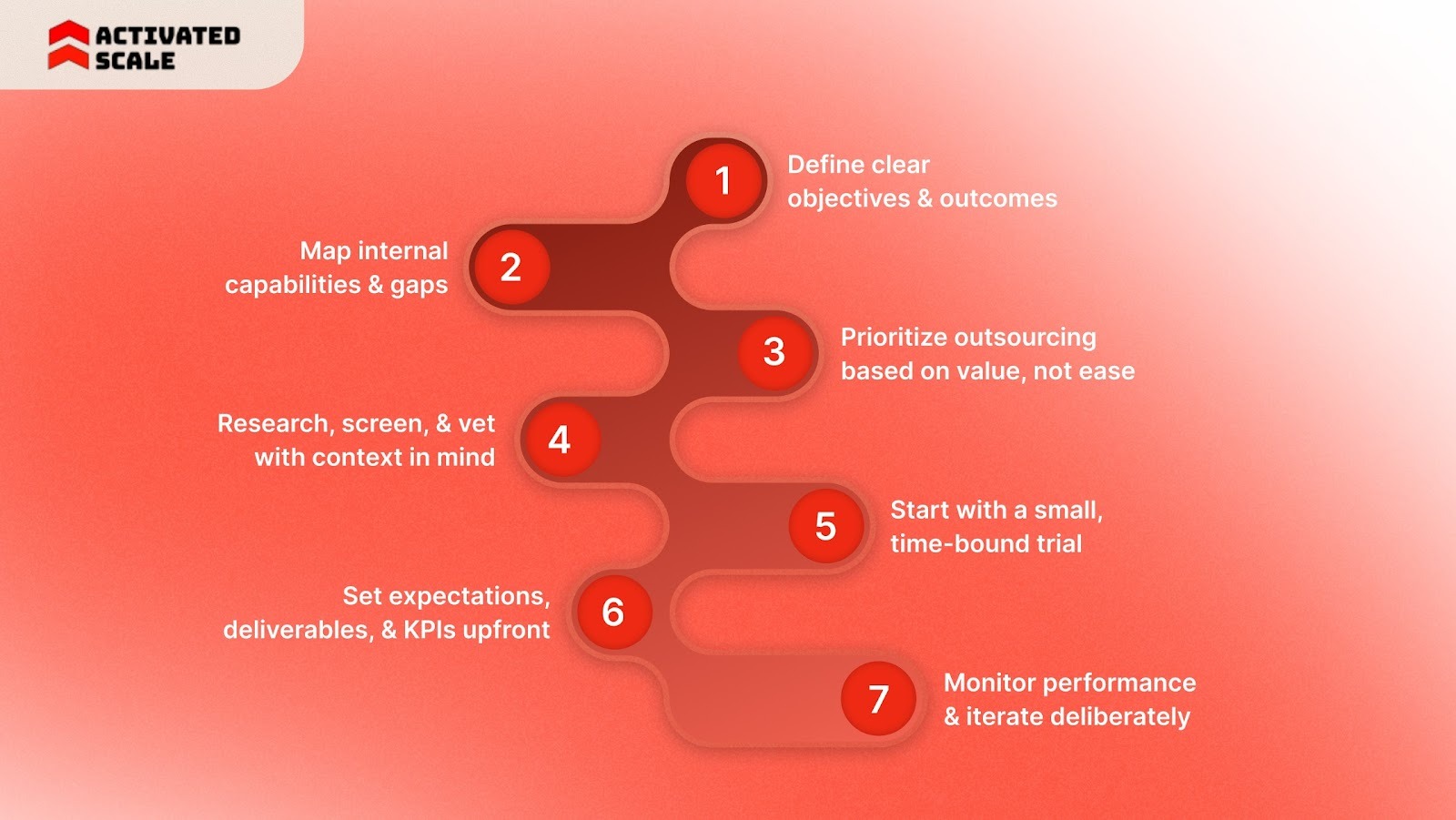
1. Define clear objectives and outcomes.
Start by answering one question: what problem are you trying to solve? This could accelerate execution, fill a skills gap, or free internal leaders to focus on strategy. Vague goals lead to vague results, so define outcomes in concrete terms, timelines, quality standards, or business impact, before involving external help.
2. Map internal capabilities and gaps.
Take stock of what your team does well today and where progress slows. Work that requires deep product context or decision-making should usually stay in-house. Outsourcing works best when it supports execution, not when it replaces ownership you still need internally.
3. Prioritize what to outsource based on value, not convenience.
Focus on tasks or roles that create leverage. This often includes specialized expertise, repeatable execution work, or functions that bottleneck growth. The goal is to remove friction from the system, not just reduce workload.
4. Research, screen, and vet with context in mind.
Look beyond resumes. Evaluate whether partners or individuals have experience in similar business stages, markets, or sales motions. Pay close attention to how they communicate and how clearly they understand your goals; misalignment here is costly in the long run.
5. Start with a small, time-bound trial.
A pilot engagement reduces risk and reveals how the relationship works in practice. Early performance, responsiveness, and problem-solving ability matter more than promises. This step protects you from overcommitting before fit is proven.
6. Set expectations, deliverables, and KPIs upfront.
Define scope, success metrics, and review cadence before work begins. This keeps accountability clear on both sides and prevents scope creep. If performance can't be measured, it can't be managed.
7. Monitor performance and iterate deliberately.
Outsourcing requires active management. Regular check-ins help refine scope, address issues early, and decide whether to scale, adjust, or stop. Treat outsourcing as an evolving partnership, not a fixed contract.
For teams that want to follow this structured approach while keeping commitments flexible, platforms like Activated Scale align well with this model. Their services are designed to support trial-based, low-risk outsourcing, allowing teams to validate execution before making long-term decisions.
When outsourcing is approached this way, it becomes a growth tool rather than a gamble.
How to Manage Outsourced Work With Clarity and Accountability
Outsourcing fails less often due to capability issues and more often due to a weak management structure. The goal isn't to supervise every task, but to make expectations, ownership, and outcomes unmistakable.
- Design communication around decisions, not updates: Set a clear rhythm for check-ins, but be specific about the purpose of those conversations. Daily or weekly syncs should focus on blockers, trade-offs, and next actions, not status reporting. This keeps momentum high without creating dependency.
- Create a shared operating context, not just shared tools: Aligning tools is necessary, but insufficient on its own. Document workflows, definitions, and handoff points so outsourced teams understand how decisions are made, not just where work lives. Context reduces back-and-forth and prevents rework.
- Define quality and compliance as measurable standards: Quality expectations should be explicit and observable. Define what "done" looks like, how work is reviewed, and which standards are non-negotiable. This avoids subjective feedback loops and protects consistency as volume increases.
- Anchor reviews to outcomes tied to business goals: Regular reviews should answer one question: Is this work moving the business forward? Track progress against agreed metrics and adjust scope or approach when results drift. Activity without impact is an early warning sign.
Effective management of outsourced work isn't about control. It's about designing a system that keeps execution aligned even when teams sit outside your organization.
Learn more about: What are the Three Types of Outsourcing: Pros and Cons Explained!
Where Flexible Outsourcing Models Make Sense
Outsourcing doesn't always mean handing work to an external vendor and stepping away. In many cases, businesses need experienced operators embedded into their workflow, without committing to full-time hires too early.
Instead of blindly outsourcing tasks, teams can engage proven professionals to test execution, refine scope, and build confidence before making long-term decisions. This approach works especially well for revenue-critical functions where ownership and accountability matter.
Activated Scale connects companies with vetted, U.S.-based sales professionals who operate as part of the internal team, not as detached vendors.
Their core models support this approach:
- Contract-to-Hire Sales Recruiting helps teams validate performance before committing to a full-time role.
- Fractional Selling allows companies to maintain sales momentum while internal capacity is still evolving.
- Fractional Sales Leadership provides experienced oversight when strategy, process, and execution need alignment.
For businesses outsourcing sales or revenue work, flexible models reduce risk, preserve control, and keep execution close to the core of the business.
Outsource With Intention, Not Assumptions
Outsourcing works when it's intentional. The goal isn't to hand work off and hope for the best, but to create space for your team to focus on what actually drives progress.
When the scope is clear, and ownership stays close to the business, outsourcing becomes a way to move faster without losing control. It helps teams fill gaps, test new motions, and scale execution without locking into decisions too early.
Many companies apply this same thinking to revenue roles, where flexibility matters as much as experience.
If outsourcing is something you're actively considering, click here to explore the available options at Activated Scale.
FAQs
1. What types of work should businesses outsource first?
Most companies start by outsourcing non-core or specialized work that consumes internal time but doesn't require deep strategic ownership. Common examples include administrative tasks, customer support, content production, IT support, or parts of sales execution.
2. How do I know if outsourcing is the right choice for my business?
Outsourcing makes sense when internal teams are stretched, expertise is missing, or execution is slowing growth. If important work keeps getting delayed or handled inconsistently, outsourcing can help restore focus and efficiency.
3. What are the biggest risks of outsourcing?
The main risks include unclear scope, poor communication, and loss of accountability. These issues usually stem from weak planning rather than the outsourcing model itself. Clear expectations and regular check-ins reduce most risks.
4. Should I outsource overseas or use U.S.-based talent?
This depends on the function. Cost-sensitive or highly standardized work may work offshore, while revenue-critical roles often benefit from U.S.-based professionals who understand the market, buyers, and communication norms.
5. How can businesses outsource without losing control?
Successful outsourcing keeps ownership internal. Define goals, set measurable outcomes, document processes, and review performance regularly. Flexible models, such as contract-to-hire or fractional roles, also help maintain control while assessing fit.
The Ultimate Guide to Hiring a Salesperson!
Get the step-by-step guide to hiring, onboarding, and ensuring success!