_edi.png)
Recruitment costs often spiral when hiring plans change faster than budgets can keep up. Many companies feel this pain after committing to long-term recruiting contracts that no longer match hiring demand. According to SHRM, the average cost per hire in the U.S. reached $5,475 in 2025, and that figure climbs sharply for specialized roles.
Recruitment process outsourcing pricing reflects these pressures. Understanding what actually drives RPO costs helps teams avoid overpaying for capacity they do not need and choose models that stay aligned as hiring conditions shift.
In a nutshell
- Common RPO models include Cost-Per-Hire, Monthly Retainers, Performance-Based, and Fixed Project Fees. Each has its own advantages depending on your hiring volume, urgency, and role complexity.
- The Cost-Per-Hire model is ideal for companies with fluctuating or seasonal hiring needs. Typically, U.S. pricing ranges from $3,000 to $10,000 per hire.
- If you have consistent hiring demands, the Monthly Retainer model offers a predictable budget with a fixed monthly fee.
- With Performance-Based pricing, your RPO provider is incentivized to deliver measurable results, such as hiring speed, retention rates, or quality of hire.
- Hiring for specialized, senior, or technical roles will generally increase RPO pricing due to the additional effort involved in sourcing, screening, and interviewing. Niche roles often require domain expertise, leading to a higher cost per hire.
- Some RPO models allow you to test the process before making a long-term commitment. Activated Scale’s approach, for example, evaluates the hiring process in real time to ensure that recruitment efforts align with actual business needs before scaling to full engagement. This reduces risk and ensures hiring effectiveness.
What is RPO? How Recruitment Process Outsourcing Pricing Works
Recruitment process outsourcing involves paying a specialized provider to manage part or all of your hiring workflow. This can include candidate sourcing, screening, interviewing, and coordination through the offer acceptance process.
RPO pricing varies based on the extent of the recruiting process outsourced and the structure of hiring demand. Costs are shaped by hiring volume, role complexity, and engagement duration.
Most RPO agreements use one of several pricing frameworks. These may include a fixed cost per hire, an ongoing management fee, or charges tied to candidate volume. Each model is designed to manage hiring spend differently based on predictability, speed, and internal recruiting capacity.
Understanding how these pricing structures work helps organizations compare providers and avoid contracts that misalign cost with hiring outcomes.
6 Common RPO Models and How They're Used

Recruitment Process Outsourcing (RPO) is not a one-size-fits-all solution. Different models exist to match hiring volume, urgency, and internal capability. Understanding these models helps explain why the pricing for recruitment process outsourcing varies so widely.
1. End-to-End RPO
In this model, the provider manages the full recruitment lifecycle. This includes workforce planning, sourcing, screening, interviews, offers, onboarding coordination, and reporting. It's often used by large or distributed organizations that want consistent hiring standards across teams or locations.
2. Project-Based RPO
Project-based RPO supports hiring tied to a defined initiative or timeframe. The engagement ends once the hiring goal is met. This model works well for short bursts of demand, such as expansion phases or product launches, without long-term contracts.
3. Hybrid RPO
Hybrid RPO splits responsibilities between internal teams and an external provider. Companies retain ownership of certain stages while outsourcing others. It’s commonly used when internal recruiters need targeted support rather than full process replacement.
4. Recruiter-On-Demand RPO
This model provides experienced recruiters for temporary gaps. The focus is speed and flexibility, not process ownership. It's useful when internal capacity drops or hiring spikes unexpectedly.
5. Functional RPO
Functional RPO outsources a specific recruiting function, such as sourcing, screening, or compliance checks. Organizations choose this when one part of their hiring process creates challenges or requires specialized expertise.
6. Contingent RPO
Contingent RPO supports hiring for temporary or contract roles. The provider manages volume hiring and onboarding for short-term labor needs. It's commonly used in industries with seasonal or project-driven workforce demand.
Each RPO model carries different cost structures, timelines, and levels of control. Pricing depends on the extent of the process outsourced and the frequency of support required.
Also read: Guide to Hiring the Right Salesperson for your Business
RPO Pricing Structures Explained: What You're Really Paying For
Recruitment process outsourcing pricing isn't just about cost; it reflects how risk, accountability, and effort are shared between you and the provider. Each model below shifts that balance differently, which is why understanding the mechanics matters before you sign a contract.

Industry-Benchmarked Flat Fee
This model uses industry salary data to set a standard fee, often as a percentage of the hire's first-year compensation. The rate remains consistent across similar roles, regardless of how difficult the search becomes.
This works best when roles are well-defined and hiring patterns are predictable. You're paying for access to process and capacity, not experimentation. The tradeoff is limited flexibility if a role becomes harder to fill than expected.
Why teams choose it
- Easier forecasting across similar positions
- Less negotiation on every role
- Stable costs when hiring profiles don't change
Performance-Based Pricing
Performance-based pricing ties fees to outcomes such as speed, retention, or quality benchmarks. Providers are rewarded only when agreed results are achieved.
This model shifts pressure onto the RPO partner to deliver measurable impact. It works well when the success criteria are clear, and the data is reliable. However, it requires strong alignment on metrics upfront to avoid disputes later.
Why teams choose it
- Accountability is built into the contract
- Costs increase only when results improve
- The focus stays on outcomes, not activity
Fixed Project Fee
A fixed fee covers a defined scope of work, often tied to a hiring project or short-term initiative. The cost does not change based on difficulty or speed.
This model favors clarity over flexibility. It suits time-bound needs such as launching a new team or clearing a hiring backlog. If the scope expands, renegotiation is usually required.
Why teams choose it
- Clear budget boundaries
- Simple contracts with fewer variables
- Useful for short, contained hiring efforts
Cost-Per-Hire
Here, spending increases only when hires are completed. All recruiting activities are bundled into a single per-hire cost.
This model works well when hiring volume is uncertain or seasonal. It provides transparency but can discourage providers from spending additional time on more complex roles unless incentives are well-designed.
Why teams choose it
- Direct link between spend and hires
- Easy cost tracking per role
- Flexible for variable hiring demand
Monthly Retainer
A retainer provides ongoing recruiting capacity for a fixed monthly cost. The provider functions as an embedded extension of your team.
This model suits companies with steady hiring needs or long-term growth plans. The value depends on utilization: unused capacity still incurs costs, while overuse can strain delivery.
Why teams choose it
- Continuous recruiting support
- Predictable monthly spend
- Better alignment for long-term hiring
Across these models, the real question is how much commitment you want upfront versus how much proof you need first. Many teams now favor structures that allow them to test execution before locking into long-term costs. That same thinking is reflected in how Activated Scale approaches hiring, prioritizing real-world performance and flexibility before full commitment.
How RPO Pricing Compares to In-House Recruitment Costs
Recruitment process outsourcing pricing differs from in-house hiring mainly in how costs behave over time.
In-house recruitment carries fixed overhead. Recruiter salaries, benefits, tools, and job-advertising costs remain constant even when hiring slows. Costs rise further during growth or turnover spikes.
RPO pricing converts recruiting into a variable expense. Companies pay based on hiring volume, using models such as cost-per-hire or monthly fees. Spending aligns more closely with demand, improving cost control.
RPO providers also include sourcing tools, market expertise, and recruiting infrastructure that would otherwise require separate internal investment.
The same cost logic applies to revenue roles. Activated Scale's Contract-to-Hire Sales Recruiting follows this model by letting teams evaluate real performance before committing to full-time headcount, reducing hiring risk while preserving flexibility.
What Drives Recruitment Process Outsourcing Pricing
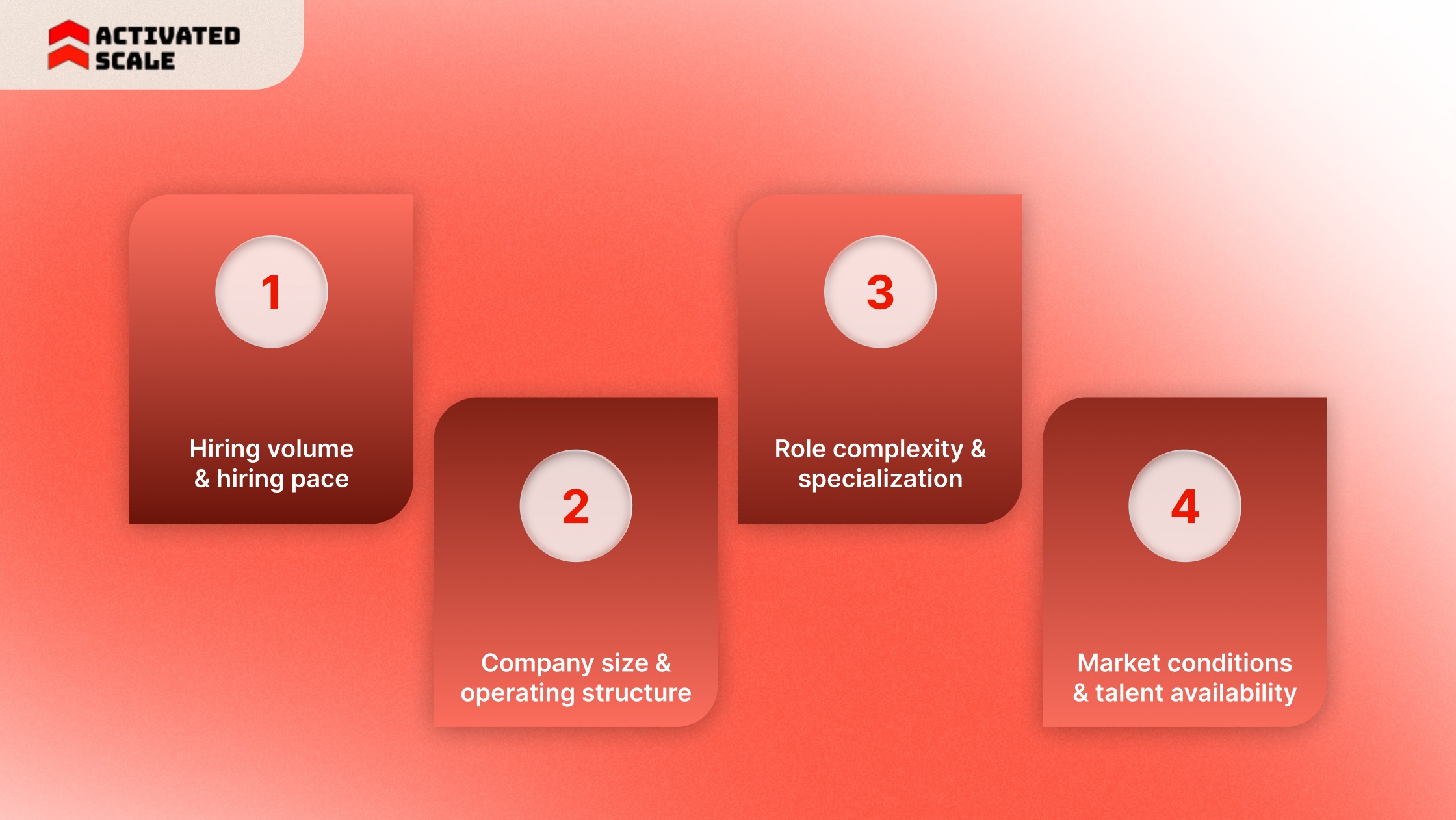
Recruitment process outsourcing pricing is not fixed. Costs vary based on hiring demand, role complexity, and the level of operational support your organization truly needs. Knowing these drivers helps prevent overspending on capacity you may not fully use.
Hiring volume and hiring pace
The number of roles and the urgency of hiring directly influence cost. High-volume hiring can reduce the cost per hire by leveraging shared resources. Inconsistent or low-volume hiring increases costs due to setup and ramp time.
Company size and operating structure
Larger organizations with layered approvals or multiple teams require broader coordination. That often includes reporting, process alignment, and stakeholder management, which raises overall RPO pricing.
Role complexity and specialization
Senior, technical, or niche roles cost more to fill. These searches demand deeper sourcing, longer screening cycles, and recruiters with specific domain expertise. Repeatable roles typically require less effort.
Market conditions and talent availability
Hiring becomes more expensive when the talent supply tightens. Recruiters must invest more time in sourcing, outreach, and candidate engagement, as these activities directly affect pricing.
Additional cost contributors
- Geography: Competitive or high-cost regions increase recruiting efforts.
- Technology: Advanced sourcing tools can raise fees but improve efficiency.
- Customization: Tailored recruiting programs cost more than standardized models.
Understanding these variables allows teams to select recruiting support that matches actual demand rather than paying for unused scale.
Some companies apply this same principle outside traditional RPO by testing leadership or execution capacity before expanding recruiting spend. Activated Scale's fractional sales leadership approach reflects this mindset, adding experienced operators only where complexity justifies the cost.
Learn more about: 8 Successful Strategies for Building Your Outsourcing Plan
Where Cost Control and Hiring Precision Actually Meet
One reason RPO pricing often escalates is early overcommitment. Companies lock into broad recruiting programs before fully understanding role requirements, ramp timelines, or what "success" should look like in practice. Costs rise not because recruiting is ineffective, but because scope expands faster than clarity.

Activated Scale approaches this problem differently. Our model is designed around measured exposure, not upfront scale. Instead of building large recruiting pipelines immediately, teams engage experienced, U.S.-based sales operators who work inside real revenue motions from day one. This creates early signals on role fit, hiring needs, and performance benchmarks before recruiting spend increases.
Activated Scale supports companies through three structured pathways:
Experienced VPs of Sales step in to define stage criteria, tighten forecast discipline, coach managers, and integrate sales methodology into daily execution. This creates operational clarity before expanding hiring budgets. Companies avoid paying RPO costs for roles that are not yet properly defined.
Rather than committing immediately to full-time hires, companies use structured contract-to-hire models to validate performance and process fit in real conditions.
Activated Scale also deploys SDRs and AEs who execute within defined methodology frameworks. These operators reinforce process standards through real deals, generating proof of role design and ramp expectations before scaling permanent hiring.
For companies evaluating recruitment process outsourcing pricing, this approach offers a practical contrast. Instead of locking into fixed recruiting capacity early, teams validate leadership structure, execution standards, and revenue impact first. Only then does it make sense to scale hiring investment.
Conclusion
Recruitment process outsourcing pricing is shaped by volume, role complexity, and the level of flexibility a company builds into its hiring strategy. Costs rise fastest when the scope expands before performance expectations are clear. The most effective hiring models start with precision, not scale.
If you are evaluating RPO or alternative hiring approaches, the next step is clarity on demand, timing, and outcomes. Get connected to explore hiring models that prioritize measured investment and real execution before long-term commitments.
FAQs
1. What does recruitment process outsourcing pricing usually include?
RPO pricing typically covers sourcing, screening, coordination, reporting, and recruiter support. The scope depends on whether the model is project-based, ongoing, or hybrid.
2. Why does RPO pricing vary so widely between companies?
Differences in hiring volume, role difficulty, speed requirements, and organizational complexity lead to significant variations in pricing.
3. Is RPO more cost-effective than internal recruiting?
It can be, especially for sustained or high-volume hiring. Costs increase when RPO is used for demand that is unclear or fluctuates.
4. How do market conditions affect RPO costs?
Tight labor markets require more outreach and longer hiring cycles, which increases recruiter effort and pricing.
5. How can companies avoid overpaying for RPO services?
By defining hiring demand clearly, limiting upfront scope, and choosing flexible models that scale only after results are proven.
The Ultimate Guide to Hiring a Salesperson!
Get the step-by-step guide to hiring, onboarding, and ensuring success!