_edi.png)

Outsourcing in 2026 looks very different from what it did a decade ago. It’s no longer treated as a back-office decision or a last-resort cost lever. Instead, companies use outsourcing deliberately to stay flexible, access specialized expertise, and move faster without locking themselves into long-term structures.
What’s changed is not just how much businesses outsource, but what they outsource and why. From IT and business processes to revenue-adjacent functions, outsourcing now plays a direct role in how organizations scale, compete, and adapt to uncertainty.
This article breaks down the key outsourcing statistics shaping 2026 and what they reveal about how modern teams are building for resilience and execution.
At a Glance:
- The global outsourcing market surpassed $854.6B in 2025 and is projected to reach $1.11T by 2030, driven more by flexibility, speed, and specialized talent than pure cost savings.
- Over 92% of organizations outsource IT services, with rising demand across AI, cloud, cybersecurity, and data making IT central to outsourcing strategies.
- More than half of outsourcing contracts now include front-office functions, such as customer support, sales operations, and marketing, signaling a move beyond back-office work.
- Asia-Pacific remains a key delivery hub, while 66% of U.S. companies outsource at least one function; vendor choice is increasingly shaped by data security, compliance, and collaboration quality.
- Flexible, execution-first models like fractional and contract-to-hire are preferred as businesses validate performance before committing to long-term headcount.
What Is Outsourcing?
Outsourcing is the practice of handing specific tasks or business functions to external specialists, either temporarily or on an ongoing basis. Companies typically turn to outsourcing when internal teams are stretched thin, operational work starts slowing growth, or critical processes consume more time than value.
Instead of forcing in-house teams to cover every need, outsourcing allows businesses to bring in focused expertise where it’s needed most, whether that’s finance, technology, customer support, or operations. The goal isn’t to replace internal talent but to remove bottlenecks, improve efficiency, and gain access to skills that would be difficult or costly to build internally.
When done right, outsourcing becomes a practical way to scale, adapt, and stay competitive without overloading core teams.
Why Businesses Are Increasingly Turning to Outsourcing
Outsourcing has shifted from a cost-saving tactic to a strategic advantage. Many businesses now outsource because it allows them to move faster, stay competitive, and focus on what they do best.
Specialized outsourcing partners often develop deep expertise in specific domains. Instead of spreading internal teams thin, companies can tap into proven capabilities that are already refined through repeated execution. This makes it easier to handle complex challenges without building everything in-house.
Technology is another major driver. With tools, platforms, and frameworks evolving constantly, keeping internal teams fully up to date can be expensive and time-consuming. Outsourcing gives businesses access to the latest skills and technologies without the burden of continuous retraining or infrastructure investment.
Shorter product life cycles and increasing pressure to launch faster also play a role. By outsourcing non-core or highly specialized work, companies can reduce time-to-market, adapt more quickly to change, and stay ahead in competitive environments.
Outsourcing Statistics for 2026: What the Data Shows
Outsourcing in 2026 reflects a clear shift in business priorities. Companies are no longer outsourcing only to reduce costs; they’re doing it to access specialized skills, move faster, and stay competitive in increasingly complex markets. The statistics below help explain how outsourcing is being used today and where it’s heading next.
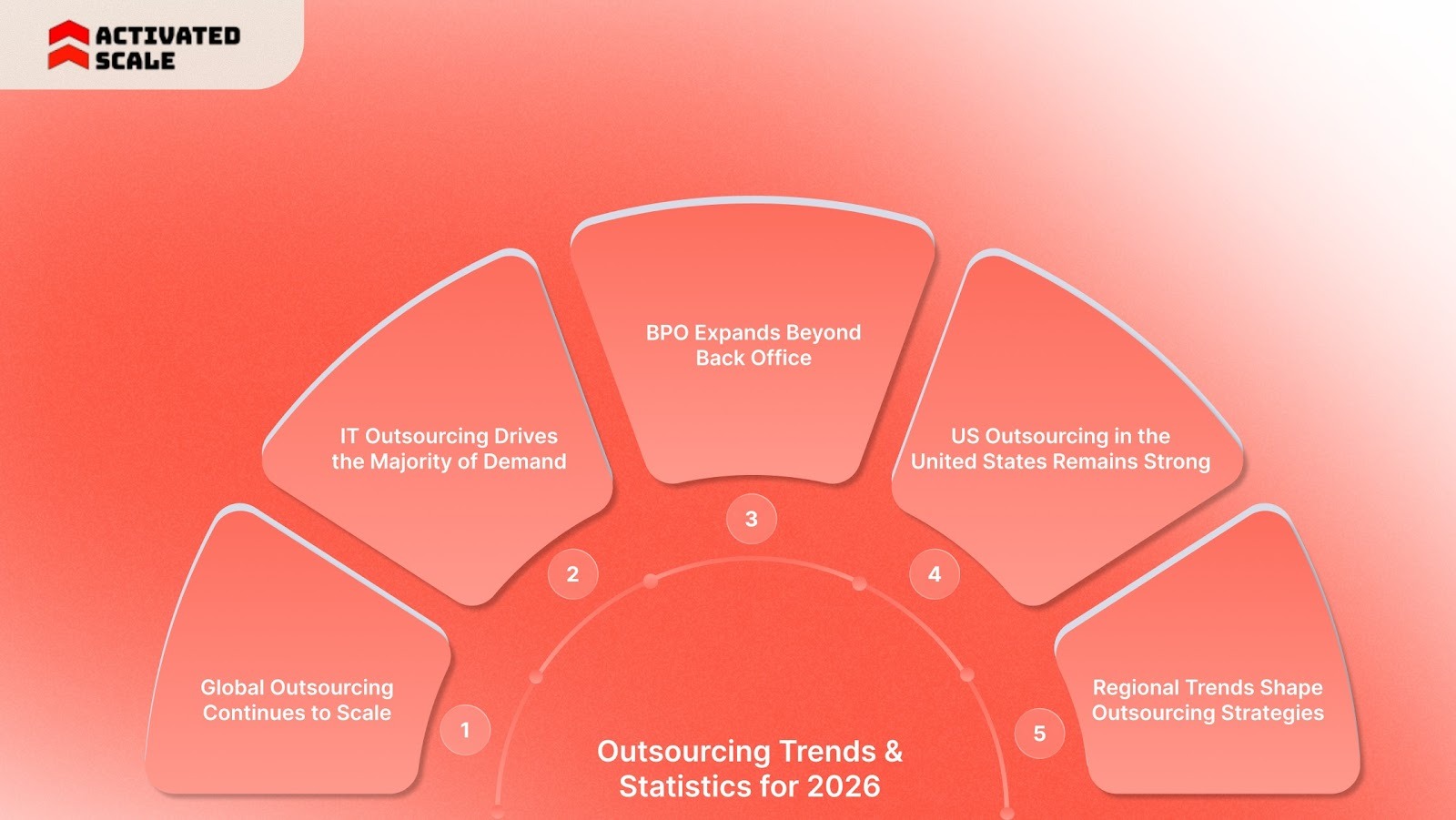
Global Outsourcing Continues to Scale
Outsourcing remains a core operating model for large and mid-sized organizations worldwide:
- The global outsourcing market gained $854.6 billion in 2025, with continued growth expected beyond that point. The outsourcing market will reach a total market size of $1.11 trillion in 2030.
- 57% of G2000 companies outsource work, showing how deeply embedded outsourcing is in enterprise operations.
- Notably, access to skilled talent (42%) now outweighs cost savings as the top reason companies outsource, signaling a strategic shift rather than a tactical one.
What this means: Outsourcing is increasingly about capability and speed, not just lowering expenses.
IT Outsourcing Drives the Majority of Demand
Digital transformation continues to fuel outsourcing growth:
- The global IT outsourcing market was valued at $588.38 billion in 2025 and is expected to exceed $800 billion by 2030.
- 92% of organizations that outsource include IT services, ranging from software development to cybersecurity and data analytics.
Why it matters: As internal tech teams struggle to scale quickly, outsourcing fills critical skill gaps without long-term hiring risk.
Business Process Outsourcing Expands Beyond Back Office
Outsourcing is no longer limited to support functions:
- The global BPO market reached $415.73 billion in 2025 and is growing at nearly 9.4% annually.
- Over half of outsourcing contracts now include front-office functions, such as customer support, sales operations, and marketing services.
What’s changing: Companies are outsourcing revenue-adjacent work, not just administrative tasks.
US Outsourcing in the United States Remains Strong
The U.S. continues to lead outsourcing adoption:
- IT outsourcing revenue in the U.S. is expected to reach $218 billion in 2025.
- About 66% of U.S. companies outsource at least one business process, reflecting widespread adoption across industries.
Key takeaway: Outsourcing is no longer reserved for large enterprises, it’s standard practice across company sizes.
Regional Trends Shape Outsourcing Strategies
Geography still plays a major role in outsourcing decisions:
- Asia-Pacific accounts for roughly 23% of global IT outsourcing revenue, driven by strong talent availability and mature delivery ecosystems.
- In legal process outsourcing alone, the region holds over 71% of global market share.
Why this matters: Regional specialization continues to influence where and how companies outsource.
Why These Statistics Matter Going Into 2026
Taken together, these numbers point to a clear conclusion: outsourcing has become a long-term operating strategy, not a short-term fix. Businesses are optimizing for flexibility, access to expertise, and faster execution, trends that will only accelerate as markets become more competitive and talent more distributed.
This shift mirrors how modern teams approach growth overall, prioritizing on-demand expertise, flexible engagement models, and outcome-driven execution. The same principles driving smarter outsourcing decisions are reshaping how companies build and scale functions like sales, operations, and go-to-market, where adaptability often matters more than fixed headcount.
This is the operating model behind Activated Scale, which connects companies with experienced sales aligned to real business outcomes.
Also read: 7 Essential Steps for Successful Outsourcing Strategies
Outsourcing Trends Shaping How Companies Operate in 2026
Outsourcing in 2026 is less about offloading work and more about operating smarter at scale. As companies face tighter timelines, global competition, and constant technology shifts, outsourcing strategies are evolving to prioritize speed, adaptability, and specialized expertise.
Here are the trends defining that shift.
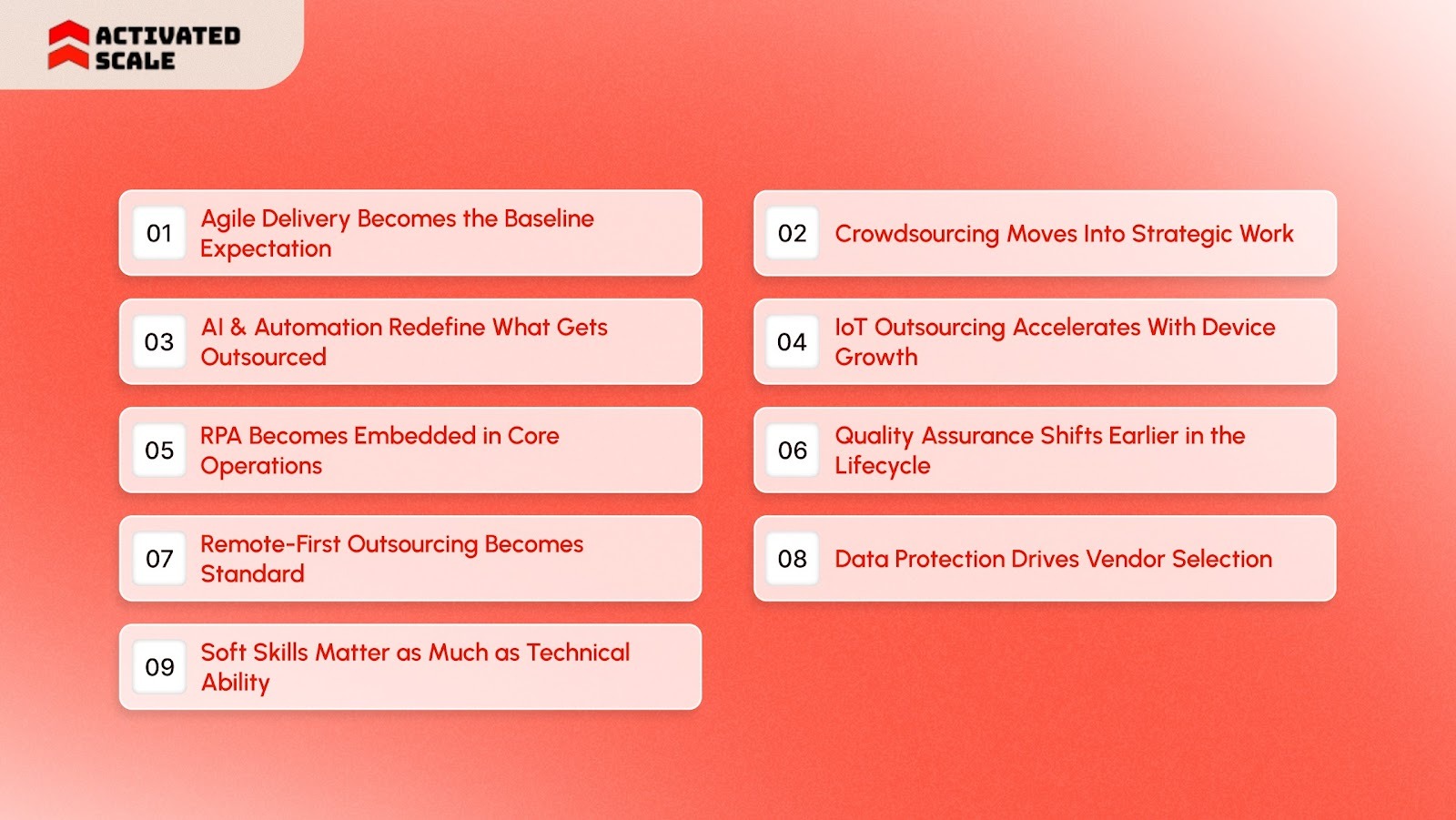
1. Agile Delivery Becomes the Baseline Expectation
Agile is now the default model for outsourced work, especially in software, product, and digital services. Companies expect partners to operate in short cycles, adapt quickly, and collaborate closely with internal teams.
Organizations using Agile practices are up to 3× more likely to successfully complete projects compared to traditional methods. This explains why Agile-led outsourcing continues to expand as speed-to-market becomes a competitive requirement.
2. Crowdsourcing Moves Into Strategic Work
Crowdsourcing is no longer limited to small tasks or idea collection. Companies increasingly use it for specialized problem-solving, early-stage innovation, and access to niche skills.
Market forecasts show the global crowdsourcing market growing at over 25% CAGR, driven by organizations looking for flexible, on-demand expertise without long-term commitments. This model works best when speed and diversity of input matter more than ownership.
3. AI and Automation Redefine What Gets Outsourced
AI and automation are reshaping outsourcing priorities. Instead of manual execution, companies now outsource AI-assisted workflows, from analytics and forecasting to customer support and operations.
Gartner reports that organizations using AI-enabled automation expect cost reductions of 20–30% across operational functions. As AI maturity increases, outsourcing partners are evaluated on their ability to deploy and manage these tools, not just staff capacity.
4. IoT Outsourcing Accelerates With Device Growth
As connected devices multiply, managing IoT infrastructure internally becomes complex and costly. Companies are outsourcing IoT development, monitoring, and data handling to specialized partners.
With global IoT connections expected to exceed 25 billion devices by the end of the decade, outsourcing helps businesses scale securely while maintaining performance across industries like manufacturing, healthcare, and logistics.
5. RPA Becomes Embedded in Core Operations
Robotic Process Automation has moved beyond experimentation. Organizations now rely on RPA outsourcing to automate high-volume workflows such as invoicing, onboarding, and reporting.
Enterprises using RPA consistently report 40–70% reductions in processing time for repetitive tasks, making it a core efficiency lever rather than a side initiative.
6. Quality Assurance Shifts Earlier in the Lifecycle
Outsourced QA is no longer a final checkpoint. Companies now integrate testing throughout development to reduce risk and protect customer experience.
The growing use of automated testing reflects this shift, with most QA teams now combining human expertise with automation to support faster release cycles and higher reliability.
7. Remote-First Outsourcing Becomes Standard
Remote delivery is now a permanent feature of outsourcing. By 2026, a significant portion of outsourced work, especially in IT, product, and support, will be handled by distributed teams.
LinkedIn workforce data shows companies using remote models experience lower attrition and wider access to specialized talent, reinforcing why remote outsourcing continues to scale.
8. Data Protection Drives Vendor Selection
Data privacy and compliance are now decisive factors in outsourcing decisions. As regulations expand globally, companies prioritize partners with strong governance, security, and transparency practices.
By 2025, analysts estimate over 65% of the global population will be covered by modern data protection laws, raising the bar for compliant outsourcing relationships.
9. Soft Skills Matter as Much as Technical Ability
As outsourced teams work more closely with internal stakeholders, communication, adaptability, and problem-solving have become critical.
A LinkedIn hiring survey found 92% of hiring leaders rate soft skills as equally or more important than technical skills, especially in collaborative, long-term outsourcing engagements.
Many of these trends point to the same shift: companies want flexibility without sacrificing execution quality. Activated Scale and contemporary outsourcing models naturally fit together in this situation.
Rather than outsourcing entire functions or committing to long-term hires upfront, teams use Activated Scale to access experienced, US-based sales talent on a fractional or contract-to-hire basis. This allows companies to move fast, validate performance in real conditions, and scale responsibly, mirroring the same principles driving smarter outsourcing decisions across industries.
Commonly Outsourced Business Functions
Most companies outsource to reduce operational load and focus internal teams on higher-impact work. These are the functions most often handled externally, where specialist support delivers clear efficiency gains.
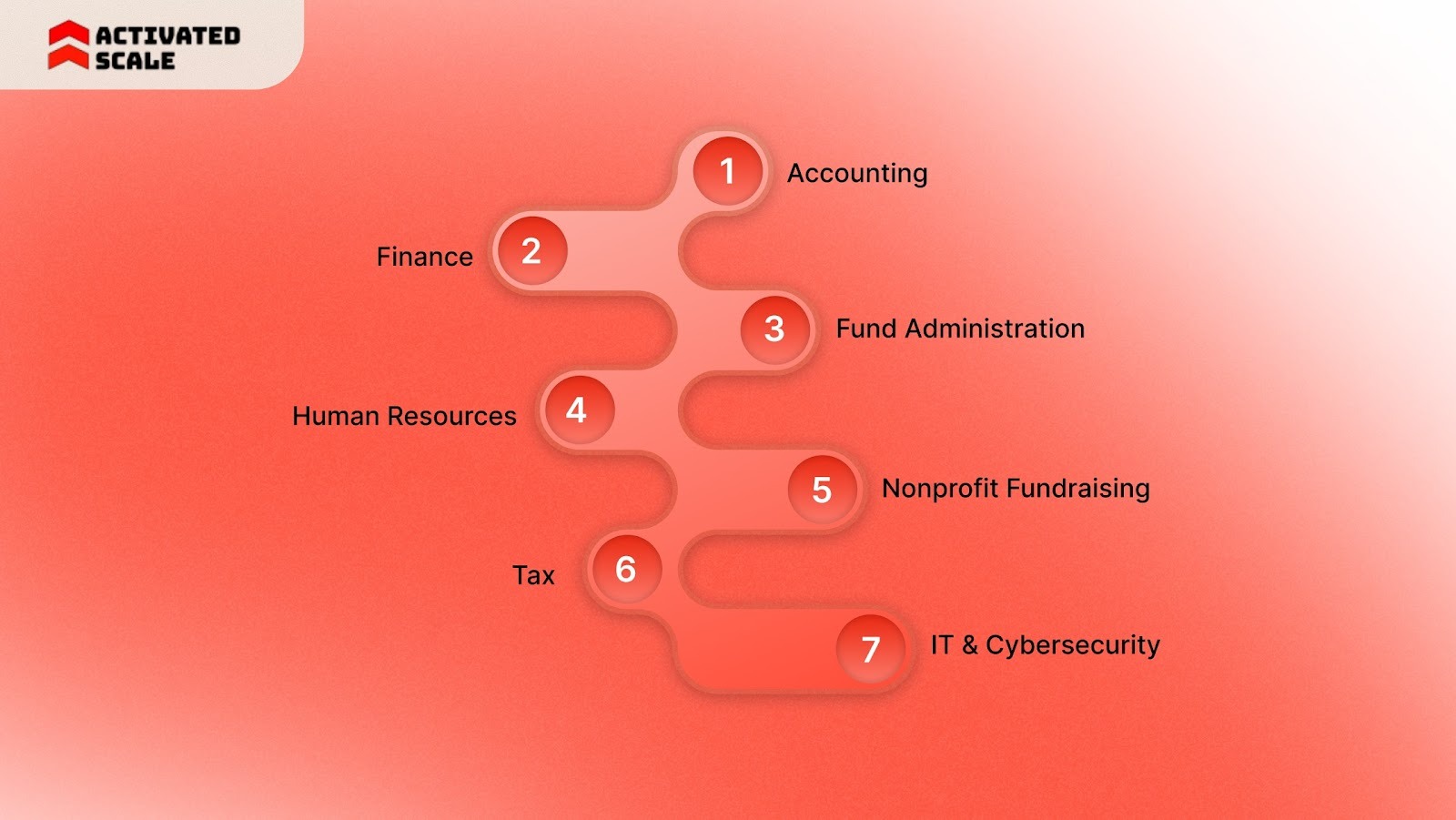
- Accounting: Bookkeeping, financial reporting, compliance filings, and KPI tracking are commonly outsourced to ensure accuracy without tying up internal teams in day-to-day finance tasks.
- Finance: Companies often outsource financial planning, forecasting, cash flow management, and transaction support. Fractional finance leaders are frequently used to guide fundraising or growth decisions without hiring full-time executives.
- Fund Administration: Investment firms outsource fund accounting, investor reporting, and regulatory compliance, especially when operating across multiple jurisdictions, to reduce administrative overhead.
- Human Resources: HR outsourcing typically covers payroll, benefits administration, recruitment support, compliance training, and onboarding or offboarding processes.
- Nonprofit Fundraising: Many nonprofits outsource fundraising strategy and execution to improve donor engagement, campaign planning, and long-term funding sustainability.
- Tax: Tax outsourcing helps manage filings, reporting, and regulatory changes while reducing errors and meeting strict deadlines.
- IT and Cybersecurity: IT infrastructure, security monitoring, cloud management, backups, and help desk support are often outsourced to improve reliability and reduce in-house IT costs.
Types of Outsourcing: What They Mean and When to Use Them
Outsourcing isn’t a one-size-fits-all decision. Different models offer different levels of control, cost flexibility, and integration with your internal team. The right choice depends on how much work you want to hand off, how involved you want to stay, and what stage your business is in.
Below are the most common outsourcing models, explained simply, without the fluff.
Core Outsourcing Models Explained
- Full Outsourcing
You hand over an entire function or department to an external provider. They manage people, processes, and delivery end-to-end. Best suited for non-core functions where efficiency and cost control matter more than day-to-day involvement.
- Bundled Services
Multiple related functions are handled by a single provider under one agreement. This reduces vendor sprawl but increases dependency on one partner.
- Co-Sourcing
External specialists work alongside your internal team, sharing responsibility. Useful when you want added expertise without losing operational control.
- Staff Augmentation (Interim or Fractional)
External professionals are brought in temporarily or part-time to fill skill gaps. Common for leadership roles, peak workloads, or specialized expertise, you don’t need full time.
- Managed Services
A provider owns the ongoing delivery and maintenance of a function under a defined SLA. Works well when predictability, scalability, and consistency matter more than customization.
Which Outsourcing Type Fits Your Business Size and Goals?
The table below shows how each outsourcing model typically aligns with business size and primary goals. This isn’t rigid, but it’s a practical starting point.
The right outsourcing model depends on intent, not trend-following:
- If speed and cost matter most → full outsourcing or managed services
- If control and knowledge retention matter → co-sourcing
- If flexibility is the priority → interim or fractional support
Clear scope, access controls, and expectations matter more than the model itself. Most outsourcing issues don’t come from what you outsource, but how clearly you define it.
Must read: What is the First Step in Managing Outsourcing?
How Outsourcing Differs by Location
Outsourcing isn’t limited to one geography. It can take different forms depending on where the work is performed:
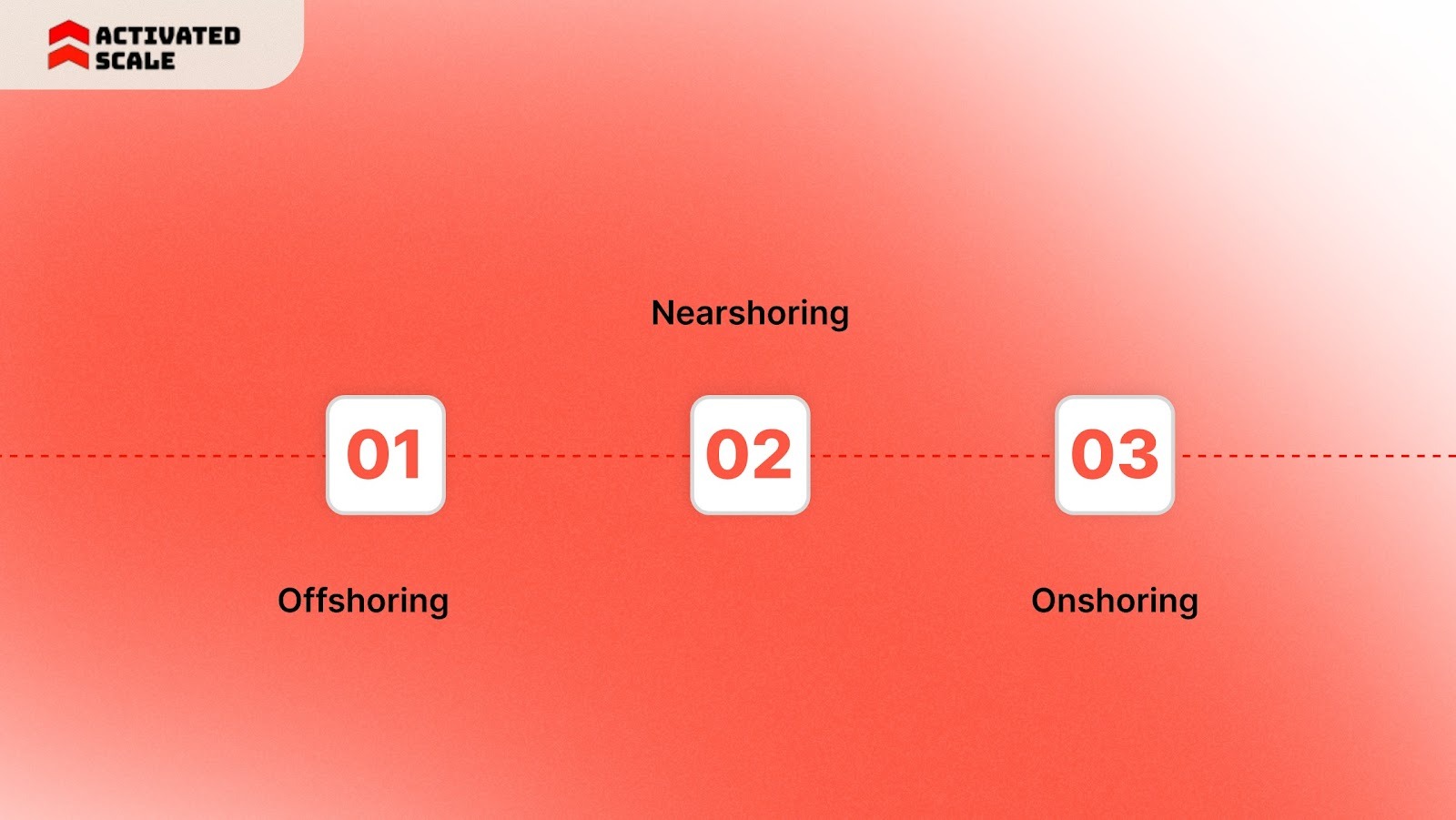
- Offshoring: Outsourcing work to countries farther away, often to reduce costs.
- Nearshoring: Working with teams in nearby countries to balance cost savings with closer time-zone alignment.
- Onshoring (Reshoring): Outsourcing work within the U.S. while keeping operations domestic.
These models fall under global resourcing, where companies choose locations based on cost, availability of skills, time-zone coverage, and operational control. Many organizations combine offshore or nearshore teams with U.S.-based oversight to keep quality high while improving efficiency and responsiveness.
This location-based approach is especially relevant for sales and revenue teams, where time zones, market familiarity, and execution speed directly affect outcomes. Activated Scale takes a U.S.-based resourcing approach, connecting companies with vetted sales professionals who understand the local market, buyer behavior, and GTM expectations, while still offering the flexibility businesses look for in modern outsourcing models.
Learn more about: Top 10 US Companies' Outsourcing Providers in 2026
Who’s Involved in Outsourcing Decisions and Transitions?
Outsourcing decisions are rarely made by one person. They usually involve a small group of stakeholders, each responsible for a different part of the risk, cost, and execution.
Key Decision Makers by Organization Type
- Small businesses: Owner or president, often supported by external legal counsel.
- Startups: Founders, COO or finance lead, advisors or board members, and legal counsel.
- Mid-sized companies: C-suite leaders, department heads (IT, HR, marketing), finance, procurement, and legal teams.
- Enterprises: Executive leadership, board members, functional leaders, procurement, finance, legal, IT, and HR.
- Nonprofits: CEO or executive director, board, program and fundraising leaders, finance, legal, and IT.
- Investment funds: Managing partner or CEO, investment team, COO or operations lead, and financial and legal advisors.
Roles That Drive a Smooth Outsourcing Transition
Once the decision is made, execution depends on clear ownership across teams.
- Process owners: Know how internal systems, data access, and workflows operate. They work directly with the outsourcing partner to transfer knowledge.
- Project manager: Coordinates the transition end to end, defining scope, managing vendors, aligning budgets, and keeping stakeholders informed.
- Executive leadership: Provides final approval, sets priorities, and ensures the transition aligns with business objectives.
Successful outsourcing depends on shared accountability. Clear roles, early alignment, and strong leadership involvement reduce delays, cost overruns, and operational risk.
How Activated Scale Reflects Modern Outsourcing in Practice
Modern outsourcing focuses on accessing specialized expertise without long-term commitment. Activated Scale applies this model to sales hiring by giving companies flexible access to experienced sales professionals without locking into permanent headcount too early.
How this shows up in practice:
- Access to US-based SDRs, AEs, and sales leaders with proven selling experience
- Flexible engagement models (fractional, contract-to-hire, or full-time) based on business needs
- Ability to validate execution in live sales environments before scaling roles
- Reduced hiring risk while maintaining control over strategy and outcomes
This structure mirrors the core purpose of modern outsourcing: staying agile, minimizing risk, and relying on proven expertise only when it adds real value.
Wrapping Up
The data makes one thing clear: outsourcing has become a strategic operating model, not a temporary solution. Companies are choosing flexibility over fixed structures, expertise over generalization, and outcomes over headcount. This shift is visible across IT, business processes, regional markets, and even revenue-critical functions.
As organizations rethink how work gets done, the most effective outsourcing strategies share a common theme: accessing the right capability at the right moment without overcommitting. That same principle applies when building go-to-market teams, where adaptability and execution often matter more than permanent scale.
Activated Scale enables companies to work with experienced sales professionals through flexible, execution-first engagements. Activated Scale reflects the same modern outsourcing mindset highlighted throughout this report.
Explore how Activated Scale helps teams access proven sales talent on terms that match today’s operating reality.
FAQs
1. Why is outsourcing still growing in 2026?
Because it allows companies to scale skills and execution quickly without committing to long-term internal structures.
2. Is outsourcing still mainly about cost reduction?
No. Access to specialized talent and faster execution now outweigh cost as the primary drivers.
3. Which functions are most commonly outsourced today?
IT services, business processes, customer support, and increasingly revenue-adjacent functions.
4. How does outsourcing affect internal teams?
When done well, it complements internal teams by filling capability gaps without replacing strategic control.
5. How does Activated Scale differ from traditional outsourcing models?
Activated Scale focuses on flexible, execution-first access to experienced sales talent, allowing companies to validate performance before scaling long-term headcount.
The Ultimate Guide to Hiring a Salesperson!
Get the step-by-step guide to hiring, onboarding, and ensuring success!