_edi.png)
Growth doesn’t usually stall because demand disappears. It stalls because revenue execution becomes fragmented as complexity increases.
According to Gartner, by 2026, nearly 75% of the highest-growth companies will adopt a Revenue Operations (RevOps) model, up sharply from less than 30% just a few years ago. The shift signals a clear pattern: companies that want predictable growth are standardizing how revenue teams operate.
RevOps optimization goes beyond creating a shared dashboard. It focuses on tightening execution across sales, marketing, and customer success so pipeline flow, forecasting, and retention improve together. Instead of layering more tools, optimization removes friction, clarifies ownership, and aligns decisions to revenue outcomes.
This guide breaks down what RevOps optimization really means, why it directly impacts revenue growth, and how scaleups can implement it without disrupting momentum.
Quick Snapshot
- RevOps optimization focuses on improving execution quality across sales, marketing, and customer success, not adding more tools or dashboards.
- Revenue growth stalls when teams operate with different definitions, unclear ownership, and unreliable data, even if demand is strong.
- Optimized RevOps improves pipeline flow, forecast accuracy, sales velocity, and revenue retention by removing friction from handoffs and decision-making.
- The highest-impact optimization levers include standardizing funnel stages, governing revenue data, tightening cross-team handoffs, and enforcing an operating cadence.
- Measuring RevOps optimization requires fewer, sharper metrics that link operational changes directly to revenue outcomes.
- Scaleups often accelerate optimization by bringing in experienced execution support before committing to permanent RevOps leadership.
What RevOps Optimization Actually Means
RevOps optimization isn't about introducing a new framework or reorganizing teams. It's about improving the existing revenue engine under real operating conditions.
At its core, RevOps optimization focuses on strengthening the connections among sales, marketing, and customer success so execution becomes predictable rather than reactive. The strategy may already be sound. Optimization is about how consistently that strategy shows up in daily decisions, handoffs, and reporting.
In practical terms, optimized RevOps means:
- Teams work from shared definitions, not parallel interpretations of the funnel.
- Revenue data is trusted and comparable; it is not reconciled each quarter.
- Ownership is clear at every stage, so issues surface early instead of compounding.
- Execution follows a repeatable cadence, not one-off fixes.
Many companies claim to "have RevOps" because they track metrics or use shared tools. Optimization is what separates that baseline from a system that actively drives revenue growth. It's the difference between observing performance and improving it.
Why Revenue Growth Stalls Without RevOps Optimization
Revenue growth usually stalls for operational reasons, not market ones. As scale increases, small execution gaps compound quickly.
Without RevOps optimization, scaleups commonly face:
- Misaligned team goals, where marketing, sales, and customer success optimize locally instead of for shared revenue outcomes.
- Broken handoffs, leading to lost context, slower follow-ups, and deals that stall late in the cycle.
- Decision delays are caused by inconsistent or untrusted data that requires manual reconciliation.
- Processes that don't scale, forcing teams to rely on workarounds and intuition as complexity grows.
These issues don't show up as single failures. They surface gradually: missed forecasts, longer sales cycles, and experience unpredictable growth. RevOps optimization removes these friction points by streamlining execution, clarifying ownership, and restoring confidence in revenue management.
Key Areas Where RevOps Optimization Drives Growth
RevOps optimization creates impact where execution and revenue intersect. These are the areas where scaleups typically see measurable improvement once alignment and structure are in place.
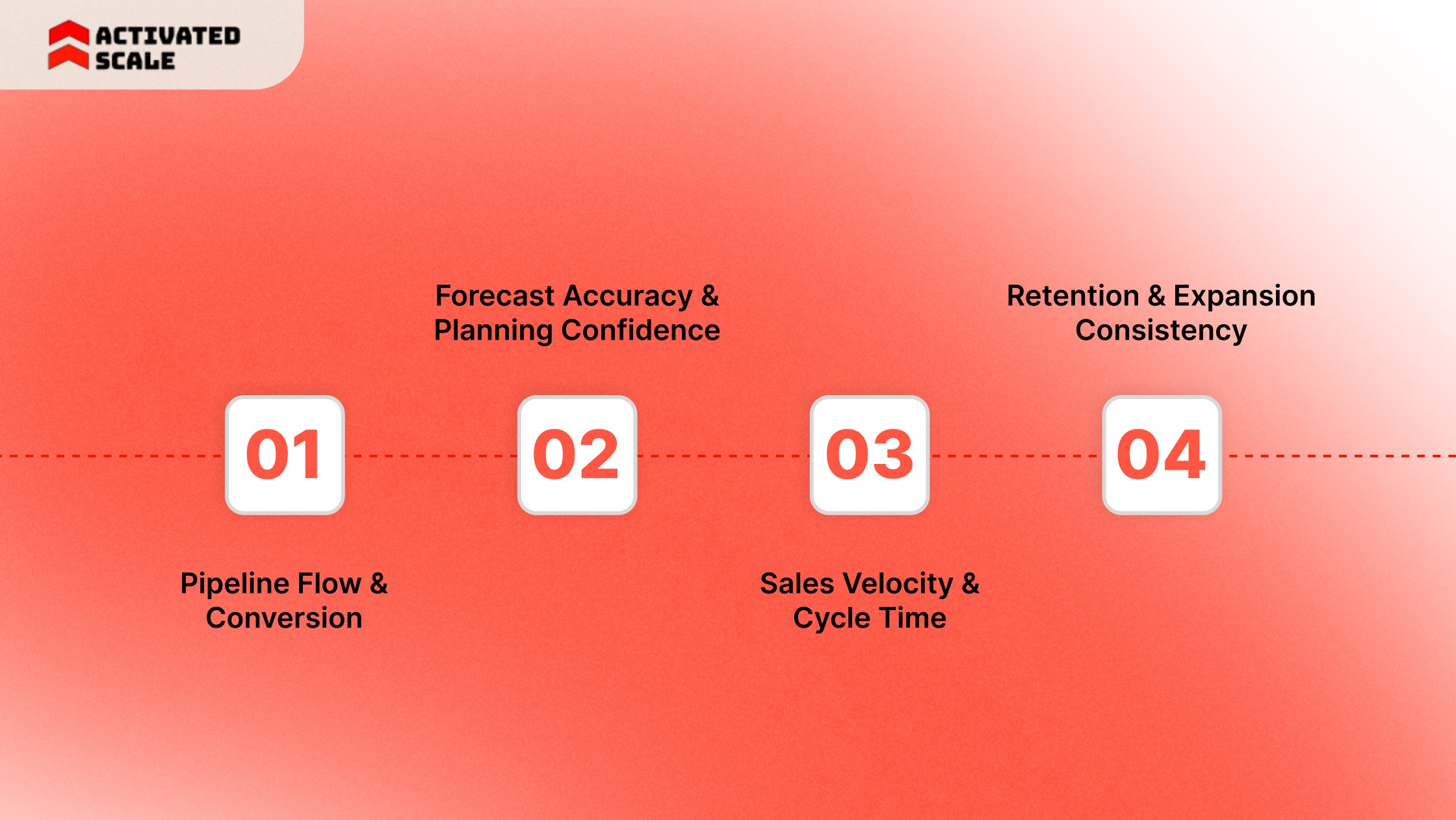
Pipeline Flow and Conversion
Optimized RevOps ensures leads move through the funnel with clear criteria and ownership. Stages are applied consistently, and handoffs include the context that sales teams need to act quickly. This reduces stalled deals and improves conversion without increasing lead volume.
Forecast Accuracy and Planning Confidence
When data definitions and processes are standardized, forecasts become more reliable. Leadership can plan hiring, spending, and targets with confidence because pipeline health reflects reality, not optimism.
Sales Velocity and Cycle Time
RevOps optimization exposes where deals slow down, whether it's qualification, approvals, or buyer indecision. By addressing these friction points, teams shorten sales cycles and drive faster revenue growth without requiring reps to work harder.
Retention and Expansion Consistency
Revenue growth doesn't end at close. Optimized RevOps connects post-sale data back to acquisition and qualification, helping teams identify which customers expand and which churn. This improves revenue quality, not just top-line numbers.
Together, these improvements compound. Growth becomes steadier, easier to predict, and less dependent on last-minute recovery efforts.
Must read: Sales compensation plans for startups
Practical RevOps Optimization Levers
RevOps optimization is effective when teams focus on a few high-impact levers rather than trying to fix everything at once. These levers directly influence execution quality and revenue outcomes.
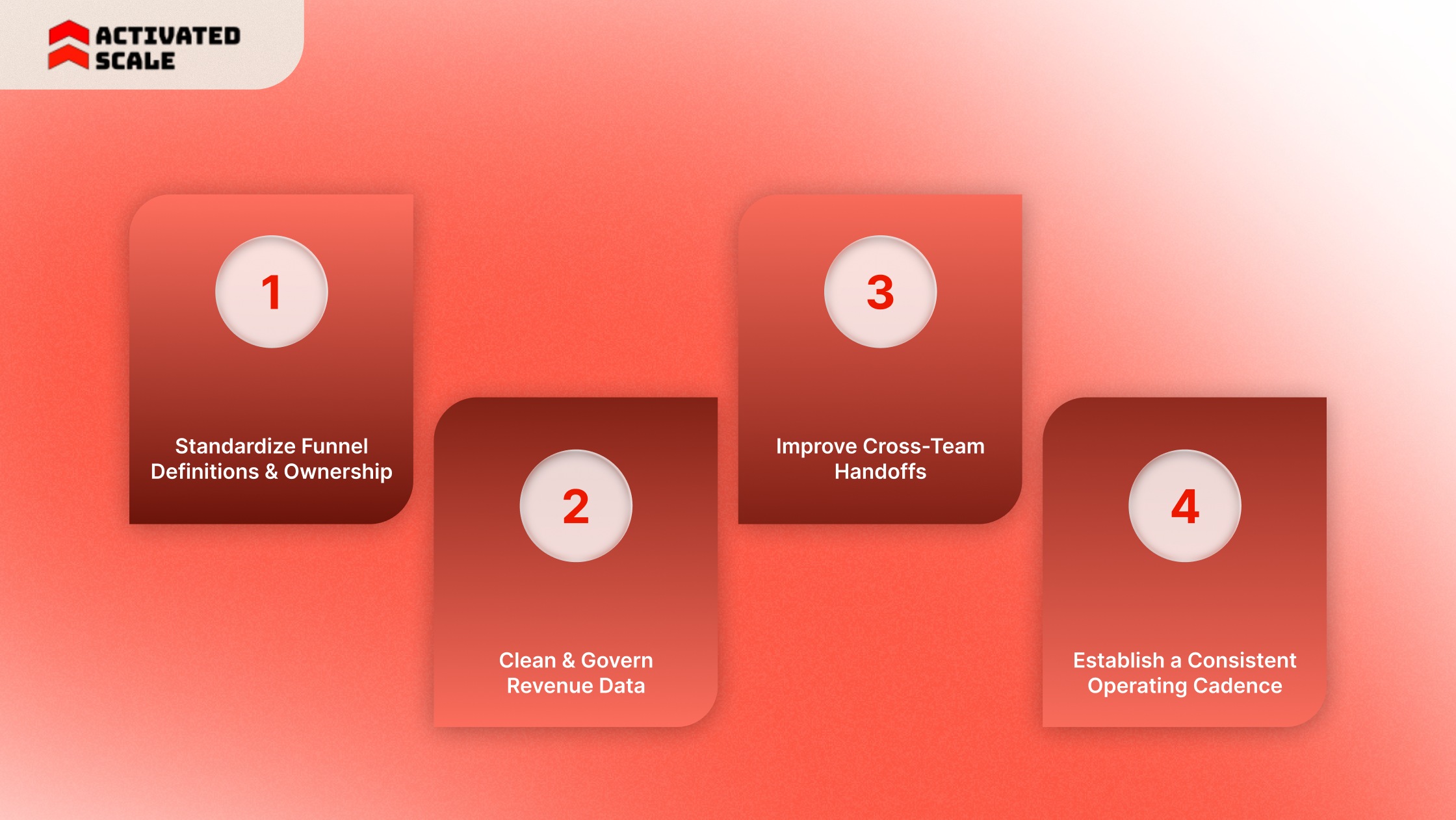
Standardize Funnel Definitions and Ownership
Optimization starts with clarity. Each funnel stage requires clear entry and exit criteria and a defined owner. When teams agree on what qualifies as a lead, opportunity, or active customer, pipeline data becomes actionable instead of debatable.
Clean and Govern Revenue Data
Reliable decisions depend on consistent data. RevOps optimization involves establishing rules for data entry, validation, and reporting to ensure revenue metrics are trusted across teams. This reduces manual cleanup and shortens decision cycles.
Improve Cross-Team Handoffs
Most revenue leakage happens between teams. Optimizing handoffs means defining what context must be transferred at each stage, such as lead source, buying signals, deal risks, or customer goals, so momentum isn't lost during transitions.
Establish a Consistent Operating Cadence
RevOps only works when reviewed regularly. Forecast reviews, pipeline checks, and cross-functional syncs create accountability and surface issues early. This cadence keeps optimization ongoing rather than reactive.
These levers don't require new tools or restructuring. They require discipline, clarity, and consistent execution, exactly where RevOps optimization delivers the most value.
Also read: How to Build a Strong Sales Pipeline: A Sales Leader's Guide in 2026
Measuring the Revenue Impact of RevOps Optimization
RevOps optimization only matters if it changes outcomes. Measuring impact means tying operational improvements directly to revenue behavior, not just reporting cleaner dashboards.
- The first signal is forecast stability. As RevOps processes mature, late-stage forecast swings shrink. Leadership spends less time debating numbers and more time acting on them. Consistency here reflects real execution alignment.
- Next is pipeline efficiency. Optimized RevOps improves how quickly opportunities move through stages and how reliably they convert. Instead of asking whether the pipeline is "big enough," teams can see where deals slow down and why.
- Sales cycle compression is another clear indicator. When handoffs, approvals, and qualification rules are clear, deals move with fewer pauses. Shorter cycles translate directly into faster revenue realization.
- Finally, revenue quality metrics tell the longer story. Improved retention and expansion rates, along with lower churn, signal that RevOps optimization is influencing not just close rates but also customer outcomes.
The goal isn't to track more KPIs. It's to track fewer metrics that clearly show how improved execution drives revenue growth.
When Scaleups Need External RevOps Execution Support
RevOps optimization often stalls not because teams lack direction, but because they lack execution ownership. Scaleups know what needs to change, but internal leaders are already stretched across hiring, planning, and delivery.
.jpg)
Activated Scale works with scaleups at this exact inflection point, when RevOps needs experienced ownership, but a full-time hire feels premature or risky.
Their services support RevOps optimization by:
- Fractional Sales Leadership, providing senior operators who can align sales, marketing, and customer success around shared revenue metrics and execution standards.
- Contract-to-Hire Sales Recruiting, allowing scaleups to validate RevOps or revenue leadership impact before committing long-term.
- Fractional selling helps maintain pipeline discipline and execution consistency while processes and systems are being optimized.
This model lets scaleups move forward with RevOps optimization without slowing momentum or locking into structure too early. Execution improves, ownership becomes clear, and revenue impact is visible sooner.
Conclusion
RevOps optimization is not a one-time initiative. It's an ongoing effort to make revenue execution clearer, faster, and more predictable as the business grows.
The scaleups that see real gains don't optimize everything at once. They focus on where friction costs the most, unclear ownership, broken handoffs, and unreliable data, and fix those first. Over time, these improvements compound into stronger forecasts, faster deal movement, and higher-quality revenue.
When internal teams lack the bandwidth or experience to consistently drive optimization, flexible execution models can bridge the gap without forcing early structural commitments.
If you want to explore how RevOps optimization can be applied to your growth stage, visit the Activated Scale website to see how experienced revenue operators support scaleups in turning execution improvements into measurable revenue impact.
FAQs
1. What is RevOps optimization?
RevOps optimization is the process of improving how revenue teams operate together by tightening ownership, standardizing processes, and aligning data to drive better revenue outcomes.
2. How is RevOps optimization different from setting up RevOps?
Setting up RevOps establishes the structure. Optimization focuses on refining execution, improving handoffs, decision speed, and revenue predictability as complexity increases.
3. What are the biggest signs that RevOps needs optimization?
Common signs include unreliable forecasts, manual reporting, stalled deals, inconsistent funnel definitions, and revenue surprises late in the quarter.
4. Which metrics best show RevOps optimization impact?
Forecast accuracy, pipeline conversion, sales cycle length, retention, expansion, and process adoption metrics are the clearest indicators of impact.
5. Can scaleups optimize RevOps without hiring full-time leaders?
Yes. Many scaleups use fractional or contract-to-hire revenue leadership to drive optimization before committing to permanent roles.
The Ultimate Guide to Hiring a Salesperson!
Get the step-by-step guide to hiring, onboarding, and ensuring success!