_edi.png)

Revenue attribution is no longer optional for growth-focused organizations. Yet many companies struggle to measure it accurately.
According to Gartner, B2B buyers spend only 17% of their purchase journey meeting with potential suppliers, while the rest is spent researching independently or internally.
That fragmentation makes revenue attribution increasingly complex. Buyers engage across channels, devices, and teams before a deal closes. Without a structured revenue attribution model, marketing and sales leaders operate on assumptions rather than data.
Revenue attribution provides clarity. It links revenue outcomes to the marketing and sales efforts that drove them, enabling organizations to allocate resources based on measurable impact rather than intuition.
In a nutshell:
- Revenue attribution connects closed revenue to the marketing and sales touchpoints that influenced the deal.
- Multi-touch models provide more accurate insight than last-touch reporting in complex B2B sales cycles.
- Data integrity, lifecycle clarity, and CRM discipline are critical for reliable attribution results.
- Attribution accuracy depends on consistent pipeline management and sales execution.
- Without structured leadership and accountability, attribution becomes reporting noise instead of strategic guidance.
Understanding Revenue Attribution and Why It Matters
Revenue attribution is the structured process of determining which marketing and sales touchpoints contribute to pipeline creation, deal progression, and closed revenue.
Instead of assigning credit to a single channel, revenue attribution evaluates how multiple interactions, paid campaigns, organic search, events, outbound efforts, and direct sales conversations collectively influence a deal.
This allows revenue teams to answer critical questions:
- Which channels generate a qualified pipeline?
- Which activities accelerate deal velocity?
- Where should the budget be increased or reduced?
The amount of credit each touchpoint receives depends on the attribution model applied. Some models prioritize first engagement, others emphasize closing interactions, while more advanced approaches distribute value across the entire buying journey.
Without revenue attribution, investment decisions rely on surface-level metrics. With it, leadership can directly link marketing activity and sales execution to revenue outcomes.
How Revenue Attribution Actually Operates in Practice
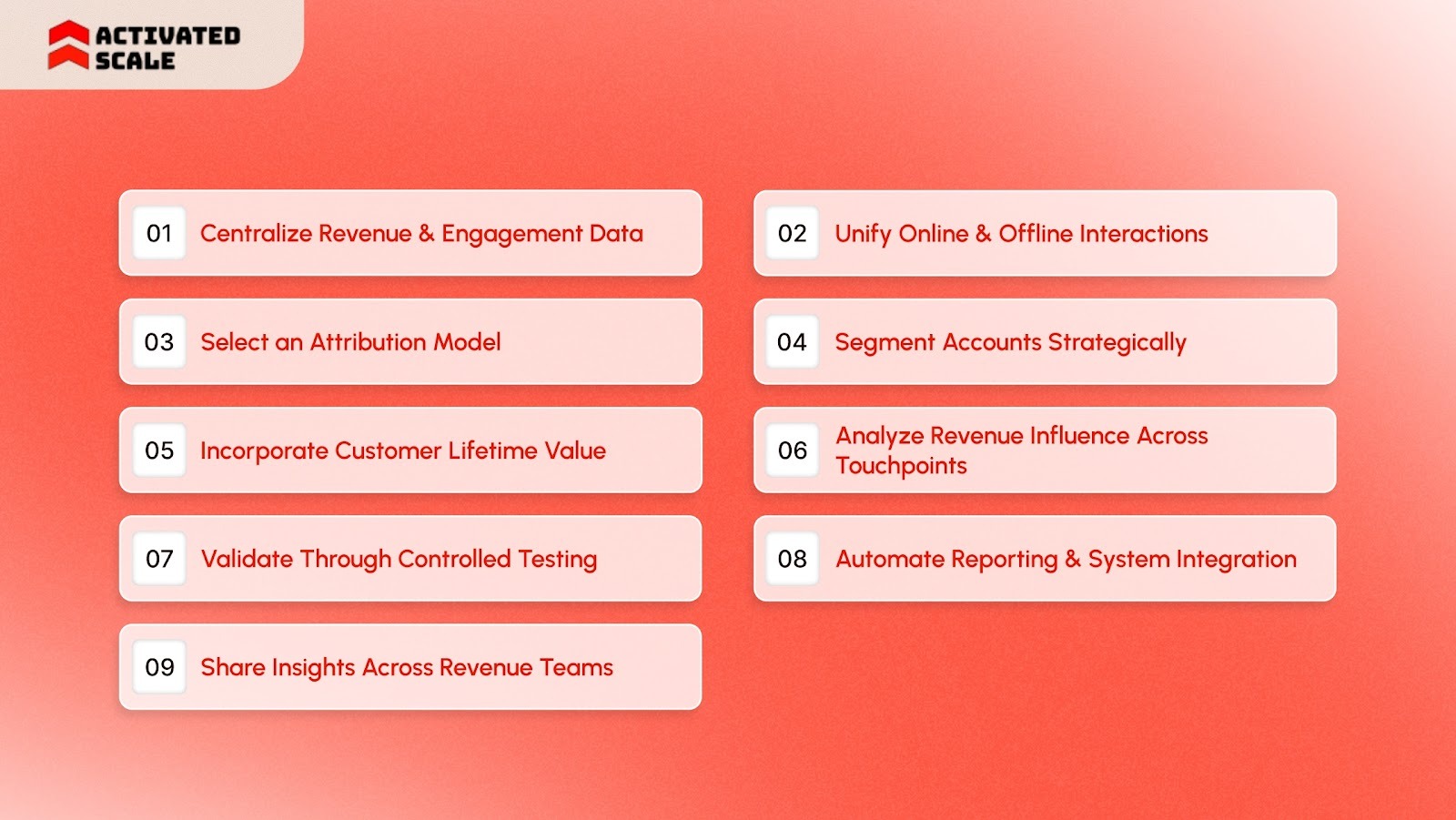
Revenue attribution links revenue outcomes to the specific marketing and sales activities that drove them. Instead of tracking isolated touchpoints, it connects engagement data, pipeline movement, and closed revenue to understand what truly drives growth.
Here is how the process typically works:
1. Centralize Revenue and Engagement Data
Collect data across marketing campaigns, website activity, CRM records, sales interactions, renewals, and expansion revenue. Attribution accuracy depends on complete, structured inputs.
2. Unify Online and Offline Interactions
Combine digital engagement with sales conversations, demos, events, and customer success touchpoints. Revenue is rarely generated from a single channel, so visibility must extend across the full buyer journey.
3. Select an Attribution Model
Choose a model that aligns with your sales cycle and deal complexity. First-touch, last-touch, multi-touch, and weighted models each assign revenue differently. The right model depends on how your buyers evaluate and purchase.
4. Segment Accounts Strategically
Group customers by lifecycle stage, deal size, industry, or engagement behavior. Segmentation improves clarity by identifying which channels influence high-value accounts versus lower-intent leads.
5. Incorporate Customer Lifetime Value (CLV)
Revenue attribution should extend beyond acquisition. Include renewals, upsells, and expansion revenue to understand long-term contribution rather than initial deal impact alone.
6. Analyze Revenue Influence Across Touchpoints
Apply your chosen model to determine how marketing campaigns, sales outreach, and customer engagement contribute to pipeline creation and closed-won revenue.
7. Validate Through Controlled Testing
Use structured experimentation to test channel performance and refine attribution assumptions. This prevents over-crediting a single source and strengthens budget allocation decisions.
8. Automate Reporting and System Integration
Integrate CRM, marketing automation, and analytics platforms so attribution data updates consistently. Manual reporting limits accuracy and delays decision-making.
9. Share Insights Across Revenue Teams
Attribution data should inform both marketing investment and sales strategy. When insights are distributed across teams, resource allocation becomes aligned with actual revenue impact.
Revenue attribution is not a reporting feature. It is a revenue intelligence discipline that clarifies which efforts generate measurable returns and which do not.
Revenue Attribution vs. Marketing Attribution: What's the Real Difference?
Marketing attribution and revenue attribution are related but not the same.
Marketing attribution measures how specific marketing channels and campaigns contribute to lead generation or conversions. It focuses on evaluating performance at the channel or campaign level, such as paid search, email, content, or events, and determining which efforts influence pipeline creation.
Revenue attribution, in contrast, takes a broader view. It evaluates how revenue is generated across the entire customer journey, not just marketing touchpoints. This includes the combined impact of marketing, sales engagement, deal progression, and customer expansion efforts.
Where marketing attribution answers, "Which campaigns generated this lead?" revenue attribution answers, "What combination of interactions across teams actually produced this revenue?"
Here's the distinction clearly:
Revenue attribution provides a cross-functional lens on revenue. Marketing attribution provides a lens on campaign performance.
Organizations that confuse the two often optimize channel performance without understanding what truly drives closed revenue. A clear revenue attribution framework ensures decisions are based on revenue impact, not just marketing activity.
Must Read: Remote Staff Augmentation for Future Work Strategies
Understanding Revenue Attribution Models
Revenue attribution models determine how revenue credit is distributed across marketing and sales touchpoints. A structured revenue attribution framework helps organizations evaluate which efforts generate pipeline, influence opportunity progression, and contribute to closed revenue.
Without clear attribution logic, budget allocation becomes reactive. With it, revenue investment decisions become measurable and defensible.
Below are the most widely used attribution models and how they function in practice.
First-Touch Attribution
This model assigns 100% of revenue credit to the first recorded interaction between a prospect and your brand.
It is commonly used to evaluate top-of-funnel performance across paid ads, organic search, referrals, and outbound campaigns. The primary benefit is clarity around what drives initial demand generation.
However, it does not account for nurturing efforts, sales engagement, or downstream interactions that move the deal forward. In longer B2B sales cycles, this model often oversimplifies the concept of influence.
Best suited for: Organizations focused on lead source efficiency and demand generation performance.
Last-Touch Attribution
Last-touch attribution credits the final interaction before conversion or deal close.
This model is frequently used to evaluate bottom-of-funnel performance, including retargeting campaigns, demo bookings, or direct sales outreach. It highlights what pushed the buyer to act.
The limitation is that it ignores the cumulative influence of earlier engagement, which can distort budget decisions in multi-channel strategies.
Best suited for: Short sales cycles or conversion-driven campaigns with minimal touchpoints.
Linear Attribution
Linear attribution distributes revenue evenly across every recorded touchpoint in the customer journey.
This approach recognizes that multiple interactions contribute to conversion. It provides a broader view than single-touch models and supports cross-channel analysis.
The trade-off is precision. Equal weighting assumes each interaction has an identical impact, which rarely reflects real buyer behavior.
Best suited for: Organizations that are beginning to move beyond single-touch models but are not yet ready for weighted complexity.
Time Decay Attribution
Time decay assigns increasing weight to interactions that occur closer to the point of conversion.
This model assumes that momentum builds over time and that later-stage engagement plays a stronger role in final decision-making. It is particularly useful in longer buying cycles where nurturing sequences influence deal progression.
Its limitation is an undervaluation of early-stage brand awareness efforts that may have created the opportunity.
Best suited for: Mid-to-long sales cycles where engagement intensity increases before conversion.
U-Shaped Attribution
Also known as position-based attribution, this model assigns significant credit to the first touch and the lead-conversion touchpoint, with the remainder distributed across subsequent interactions.
It emphasizes two critical moments: demand creation and qualification. This structure reflects many B2B environments in which lead capture is a measurable milestone.
While more balanced than single-touch models, it may still underweight later-stage sales activities that directly influence deal closure.
Best suited for: B2B organizations that prioritize both lead acquisition and formal qualification stages.
W-Shaped Attribution
The W-shaped model expands on the U-shaped approach by assigning weighted credit to three milestones: first touch, lead conversion, and opportunity creation.
This framework acknowledges the impact of marketing in generating interest, sales development in qualifying prospects, and revenue teams in advancing opportunities.
It offers greater alignment between marketing and sales by recognizing shared influence across the funnel.
Best suited for: Complex B2B sales processes with clear handoff stages between marketing and sales.
Subscriber Lifetime Value (SLV) Attribution
SLV attribution extends beyond acquisition to include total customer lifetime revenue, including renewals, upgrades, and expansions.
This model is critical in subscription-based businesses where retention and expansion revenue often exceed initial acquisition value.
Its effectiveness depends on accurate life cycle tracking and disciplined renewal forecasting.
Best suited for: SaaS and recurring revenue models where long-term customer value drives profitability.
Multi-Touch Attribution (MTA)
Multi-touch attribution distributes revenue credit across multiple touchpoints using predefined weighting rules or algorithmic modeling.
Unlike static models, MTA can incorporate channel performance, engagement depth, deal size, and historical conversion data to produce a more nuanced revenue distribution.
It provides the most comprehensive view of complex buying journeys but requires strong data governance and cross-system integration to maintain accuracy.
Best suited for: Organizations with multi-channel go-to-market strategies and structured CRM data.
Building a Practical Revenue Attribution Framework
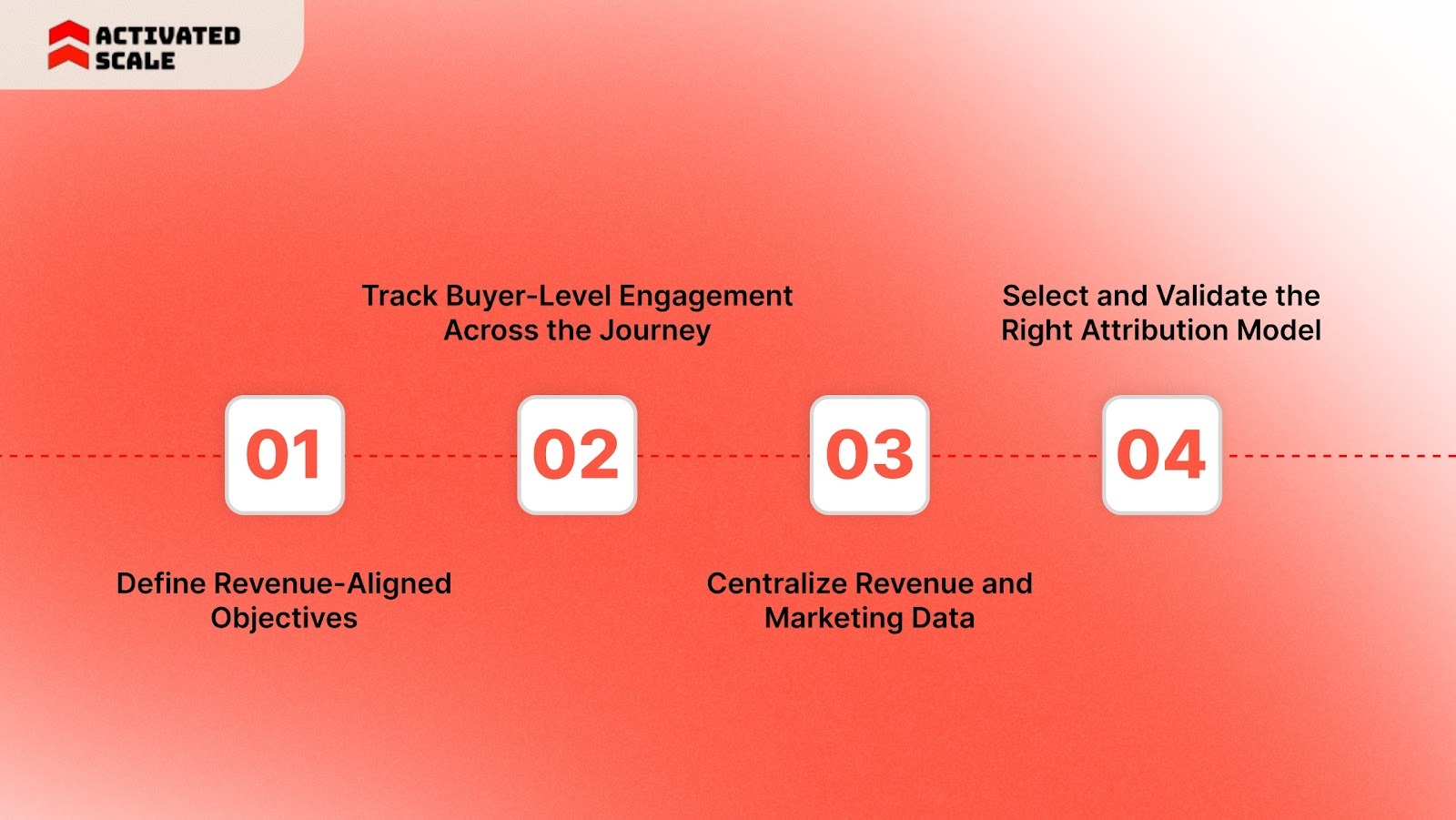
Revenue attribution only works when it is tied to measurable outcomes and enforced with disciplined execution. The goal is not reporting activity. The goal is to understand what drives revenue and to reallocate resources accordingly.
1. Define Revenue-Aligned Objectives
Start with outcomes that directly impact growth.
Revenue attribution must answer a simple question: Which activities generate profitable revenue?
Set measurable targets such as increasing recurring revenue, improving pipeline conversion rates, reducing customer acquisition cost, or accelerating deal velocity. Each objective should be tied to financial performance, not to marketing activity.
Track metrics that influence revenue predictability:
- Revenue contribution by channel
- Customer acquisition cost
- Customer lifetime value
- Return on ad spend
- Pipeline conversion efficiency
If your objectives focus on expansion, your attribution model must reflect retention and upsell influence. If growth depends on new acquisition, early-stage touchpoints may carry more weight. The structure must match your revenue model.
2. Track Buyer-Level Engagement Across the Journey
Revenue attribution requires visibility at the individual account or contact level.
Understand how prospects move from first interaction to closed revenue. Track which campaigns, channels, and content assets influence progression through lifecycle stages.
Anonymous traffic data provides directional insight, but it does not connect marketing activity to revenue outcomes. Attribution must connect identifiable engagement to opportunity creation, pipeline progression, and closed-won revenue.
Without this linkage, reporting remains disconnected from financial impact.
3. Centralize Revenue and Marketing Data
Attribution breaks down when data is fragmented.
CRM data, marketing automation activity, paid media performance, and sales engagement metrics must connect within a unified reporting structure. If systems operate independently, influence cannot be measured accurately.
The objective is not more dashboards. It is consolidated visibility into how marketing and sales interactions influence pipeline creation, deal velocity, and expansion revenue.
Centralization eliminates duplicate reporting, reduces manual reconciliation, and improves confidence in performance data.
4. Select and Validate the Right Attribution Model
The attribution model must reflect the complexity of your sales cycle.
For short, transactional journeys, single-touch models may provide sufficient clarity. For longer B2B sales cycles involving multiple stakeholders, multi-touch attribution typically offers more accurate insight.
However, the model alone does not solve the problem. Revenue attribution must be tested against actual outcomes. Compare model outputs against closed-won deals and retention performance to ensure the model reflects revenue reality rather than theoretical influence.
The goal is not to credit every touchpoint equally. It is to understand which interactions consistently drive profitable growth.
Revenue attribution is not a reporting exercise. It is a revenue allocation framework. When implemented with clear objectives, buyer-level visibility, integrated systems, and a validated model, it allows leadership to invest confidently in the channels and activities that drive measurable return.
Learn more about: How to Build a Strong Sales Pipeline: A Sales Leader's Guide in 2026
Why Revenue Attribution Directly Impacts Growth Decisions
A structured revenue attribution model does more than report marketing performance. It clarifies where revenue originates, which activities drive pipeline movement, and where investment should increase or be stopped.
Here's what it enables:
- Smarter budget deployment: Attribution identifies the campaigns, channels, and touchpoints that generate qualified pipeline and closed revenue. Budget shifts toward proven drivers instead of being distributed evenly without evidence.
- Clear revenue-level ROI: By connecting revenue back to specific initiatives, leadership gains visibility into which efforts produce measurable returns. This strengthens financial planning and eliminates guesswork in future campaign investments.
- Stronger strategy refinement: When you know which touchpoints influence deal progression, you can adjust targeting, messaging, and channel mix with precision. Revenue attribution replaces assumption-based optimization with performance-backed decisions.
- More effective personalization: Understanding how prospects engage before converting allows teams to tailor outreach based on behavior and buying stage. Messaging becomes aligned with actual engagement patterns rather than broad audience segments.
- Improved cross-functional accountability: Attribution aligns marketing and sales around shared revenue outcomes. Instead of debating lead volume or channel performance, teams evaluate contribution to closed revenue.
- More confident executive decisions: Revenue attribution transforms reporting from activity tracking into revenue intelligence. Leaders can decide where to scale, refine, or reduce spending based on verified impact.
When implemented correctly, revenue attribution creates financial clarity. It ensures that growth decisions are driven by revenue contribution, not by channel preference or internal bias.
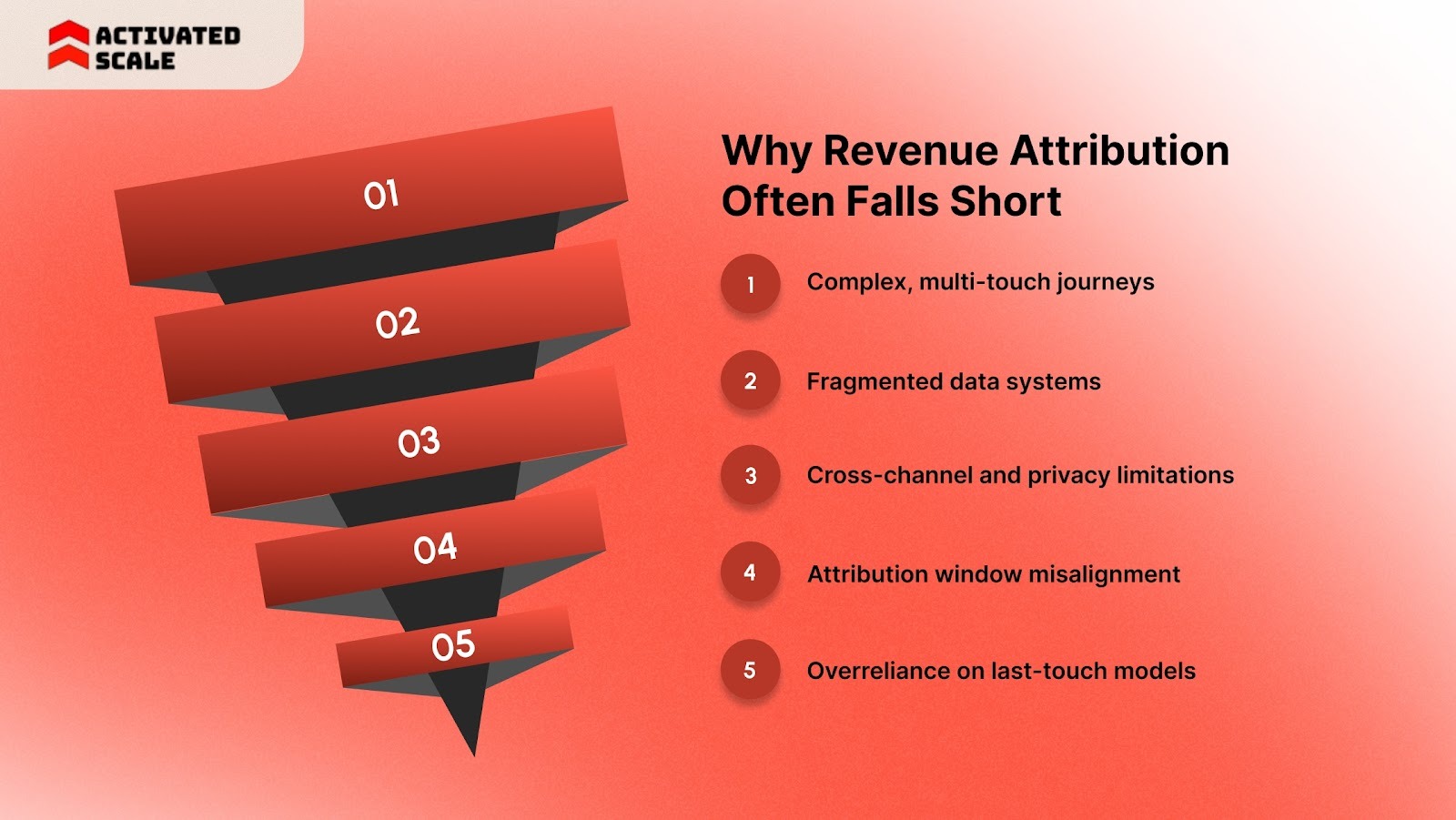
Why Revenue Attribution Often Falls Short
Revenue attribution becomes difficult when operational discipline does not match analytical ambition.
- Complex, multi-touch journeys: Buyers engage across ads, outbound sales, referrals, webinars, and direct conversations before converting. Accurately distributing revenue credit across nonlinear touchpoints is inherently challenging.
- Fragmented data systems: Disconnected CRM, marketing automation, and sales tools create incomplete visibility into the customer journey. Attribution models built on partial data produce distorted conclusions.
- Cross-channel and privacy limitations: Device switching, offline interactions, and evolving privacy regulations reduce tracking precision and weaken attribution accuracy.
- Attribution window misalignment: Long B2B sales cycles complicate revenue timing. Short windows undervalue early influence; long windows over-credit distant touchpoints.
- Overreliance on last-touch models: Last-touch attribution simplifies reporting but ignores the cumulative impact of earlier marketing and sales engagement.
Beyond modeling limitations, revenue attribution often fails due to inconsistent sales execution. When pipeline stages are not maintained, deal activity is not logged, or forecasting discipline is weak, attribution reports cannot reflect reality.
Organizations that reinforce structured sales leadership, often through fractional sales leaders or vetted sales talent, are better positioned to maintain clean pipeline data and reliable revenue tracking.
Attribution accuracy depends as much on execution discipline as it does on analytics.
Revenue Attribution Is Only as Strong as Sales Execution
Revenue attribution is only as accurate as the pipeline data behind it. If deal stages are inconsistent, activities go unlogged, or forecasting lacks ownership, attribution models will produce distorted conclusions.
Strong sales execution is a prerequisite for reliable revenue attribution.

Activated Scale supports this through fractional sales leadership, fractional selling, and contract-to-hire sales recruiting. Companies can connect with vetted sales professionals in under seven days, save 20+ hours of interview time per hire, and reinforce structured pipeline management.
With 200+ customers served and 80% of talent retained beyond eight months, their model strengthens the execution layer on which attribution depends.
Attribution assigns credit. Disciplined sales leadership ensures that credit reflects reality.
Conclusion
Revenue attribution brings clarity to how revenue is generated across marketing and sales efforts. It helps leaders allocate budgets with confidence, identify high-impact channels, and refine go-to-market strategies based on measurable contributions.
But attribution models are only as reliable as the data and execution behind them. Inconsistent pipeline management, weak stage discipline, and incomplete activity tracking undermine even the most advanced attribution frameworks.
If your revenue attribution strategy depends on stronger execution, explore how Activated Scale supports scalable sales performance.
FAQs
1. What is revenue attribution?
Revenue attribution is the process of assigning credit for closed revenue to the marketing and sales touchpoints that influenced a deal.
2. Why is revenue attribution important?
It helps organizations allocate budget effectively, optimize campaigns, improve sales alignment, and make data-backed decisions that drive growth.
3. What are the main revenue attribution models?
Common models include first-touch, last-touch, linear, time-decay, and multi-touch attribution. Multi-touch models typically provide more balanced insights in B2B environments.
4. How does CRM data impact revenue attribution?
CRM data determines pipeline accuracy, stage progression tracking, and the integrity of revenue reporting. Poor data quality weakens attribution reliability.
5. What challenges affect revenue attribution accuracy?
Fragmented systems, privacy limitations, long sales cycles, inconsistent deal logging, and overreliance on last-touch models reduce accuracy.
6. Can revenue attribution work without strong sales leadership?
It is difficult. Attribution depends on disciplined pipeline management, accurate data entry, and accountability for forecasting. Without structured sales leadership, attribution outputs are often unreliable.
The Ultimate Guide to Hiring a Salesperson!
Get the step-by-step guide to hiring, onboarding, and ensuring success!